

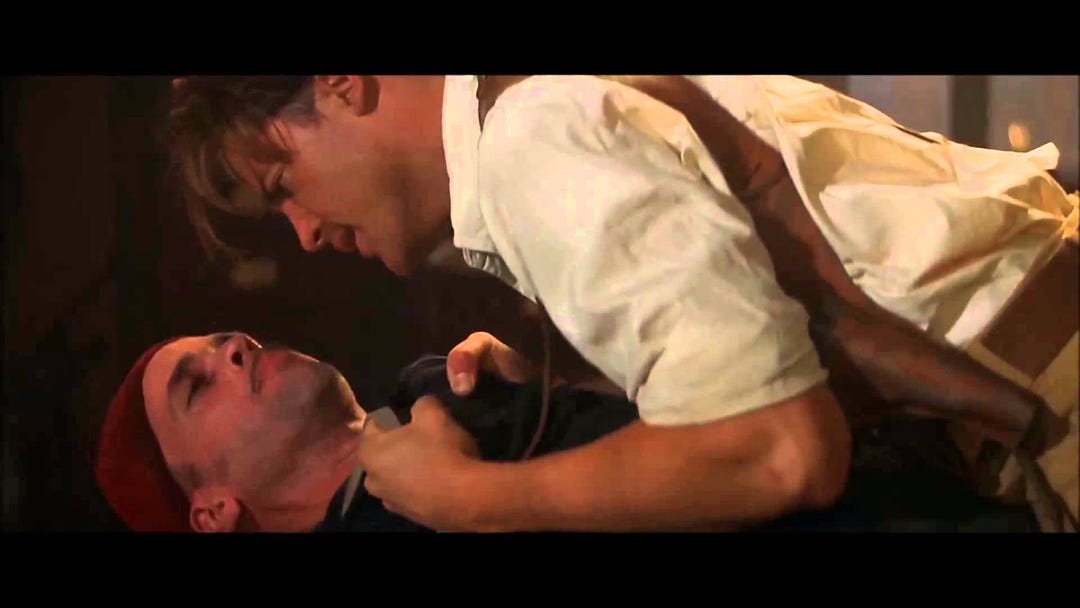
The best part of the 1999 film The Mummy is one of its minor villains—Beni Gabor, played by Kevin J. O’Connor. We first see Beni standing side-by-side with our hero, Rick (Brendan Fraser); they are involved in a brutal battle between the French Foreign Legion and hordes of Arabs at the lost city of Hamunaptra. Rick asks Beni seriously, “You’re with me on this?” to which Beni, with a noble tremor, replies, “Oh, your strength gives me strength.” Then he bolts. Later, after Rick is forced to run too, he sees Beni duck into a tomb…and shut the door before Rick can get inside.
That’s Beni throughout. On principle, and with determination, he refuses to stand with Rick. And the glorious thing about Beni is that he’s right; standing with Rick is stupid and immoral. Beni runs away and doesn’t kill anyone; Rick, with his pistols and his swagger and his noble jaw, has invaded someone else’s land and then slaughters the folks who try to resist him. Why are we rooting for Rick, again?
The answer to that question in The Mummy is straightforward; we root for Rick because he’s white. The Mummy is set in the 1920s, and it exudes an imperial nostalgia for a racist past. Rick, amateur Egyptologist Evie (Rachel Weisz) and her brother Jonathan (John Hannah) are bumbling jerks whose hubris and entitlement almost bring about the end of the world. They casually travel to Hamunaptra and unleash an ancient evil because they’re greedy and unwilling to credit the warning of the native peoples who tell them to stop. They’re also racist; they say over and over that their Arab traveling companion smells, and they (and the film) treat him with studied contempt until he dies.
Yet, despite their idiocy and their casual bigotry, the film, and the characters in the film, all treat Rick, Evie, and even Jonathan as the most important people in the universe. Multiple Arab characters sacrifice themselves to save the English, letting themselves be torn apart by their fellow nationals (living and dead) so the white people can kill more Egyptians and have a happy ending. Even the risen mummy Imhotep (Arnold Vosloo) is enchanted by whiteness; he falls in love instantly with Evie, and decides she is the perfect vessel to reincarnate his dead love. White men and white women are, everyone agrees, at the center of the story about Egypt.
Everyone agrees, that is, except Beni. O’Connor, who plays Beni, is white himself. But in the film, Beni is supposed to be Hungarian, and he dresses in North African garb for most of the run time. His character is presented, in short, as not quite white, and Beni, of all those in the film, is uniquely unwilling to show solidarity with whiteness. Beni is out for himself. He is hired by Americans to lead them to Hamunaptra, but admits he would abandon them in the desert in a minute if they hadn’t told him he’d only get paid on arrival. In fact, he’s led numerous adventurers astray in the past; his lack of fellow-feeling with white people has made him into a kind of one man defender of Eastern treasures from the depredations of asshole moron Westerners.
When Beni is trapped in a tomb with Imhotep, he prays to Christ, to Mohammad, and to the Jewish God. The quick switch from Christ to other, less white-approved religions is supposed to be indicative of Beni’s lack of character—as is his quick alliance with Imhotep when the fleshless mummy recognizes Hebrew as the language of Egyptian slaves, and inducts Beni into his service.
Again, though, Beni’s willingness to betray white people is only a failing if you buy the film’s assertion that the white people are the good guys. Imhotep is planning to destroy the world, but that destruction looks, at times, suspiciously like anti-imperial revolution. Imhotep takes over the minds of Arabs, who attack our heroes zombie-like. Are those zombies weak-willed, or are they just sick of having their resources ransacked by white interlopers?
Rick and Evie constantly upbraid Beni as if he’s betrayed them. But he resolutely refuses to acknowledge that he owes them camel spit. “You came back from the desert with a new friend. Didn’t you Beni?” Rick accuses, to which Beni responds, with the easy flattery of the colonial subject, “What friend? You are my only friend.” Evie for her part sneers at him, “You know, nasty little fellows such as yourself always get their comeuppance.” Beni answers, with understandable nervousness, “They do?”
Alas, they do. Evie’s brother Jonathan is every bit as venal as Beni, and a good bit less charming. But he’s resolutely on the side of whiteness and insults Arabs on cue, so he’s saved. Beni is a “nasty little fellow” because he doesn’t see that European thieves deserve to be treated with more respect than native resistors. He is therefore doomed through sheer bad luck—or through the machination of the plot—to be locked in the tomb and eaten alive by scarab beetles. That was, not coincidentally, the punishment ordained for Imhotep when he violated the laws of ancient Egypt. Beni chooses the side of the colonized, and so must share their fate.
Beni is supposed to be transparently venal, dishonest and cowardly; O’Connor plays him as a bundle of nervous tics, glancing around like a trapped bird, his voice shuddering nervously towards falsetto. But his commitment to his own survival, and his rejection of heroic ideals (”It is better to be the right hand of the devil than in his path”) makes him, in many ways, the film’s one honest man. He sees, as nobody else seems to, that Rick and Evie are hypocritical exploiters who deserve neither affection nor support. He doesn’t confuse whiteness with virtue or beauty or power, as everyone else, even Imhotep, does. He’s the real hero of the story—and his gratuitous death means that The Mummy, like most colonization narratives, is not a comedy or a heroic triumph, but a tragedy.
—
This ran at my Patreon years back; I read it and realized I still really like it, so figured I’d share it here.
This subgenre has always had the superiority of white folks at its core. The rage for Egyptian artifacts begun with the discovery of the tomb of Tutankhamen in the 1920s was motivated as much by white greed as it was by the desire for historical discovery. Orientalism, as Edward Said has termed it, involved both the exotification of the land and the dehumanization of the people of Asia, something which Hollywood easily picked up on. One might say that setting this film in the 1920s is a sort of means of chasing orientalism back to its original source.
Welp. There goes my feels for Indiana Jones, international thief.