

Kane Parsons’ hit debut feature Backrooms exists somewhere between David Lynch and the Blair Witch Project, with vivisected bits of creature features, slashers, and maybe Hitchcock scattered around the flickering interior landscape. The bricolage effect can feel a little unfocused and unfinished—but that also seems very much the point. The movie’s eerie thesis is that our world, our dreams, our fears and ourselves are composed of half-remembered flashes of somewhere and something else. To go into the backrooms is to find your life just where you left it, lying around with its strings cut and its heart replaced with a desk lamp.
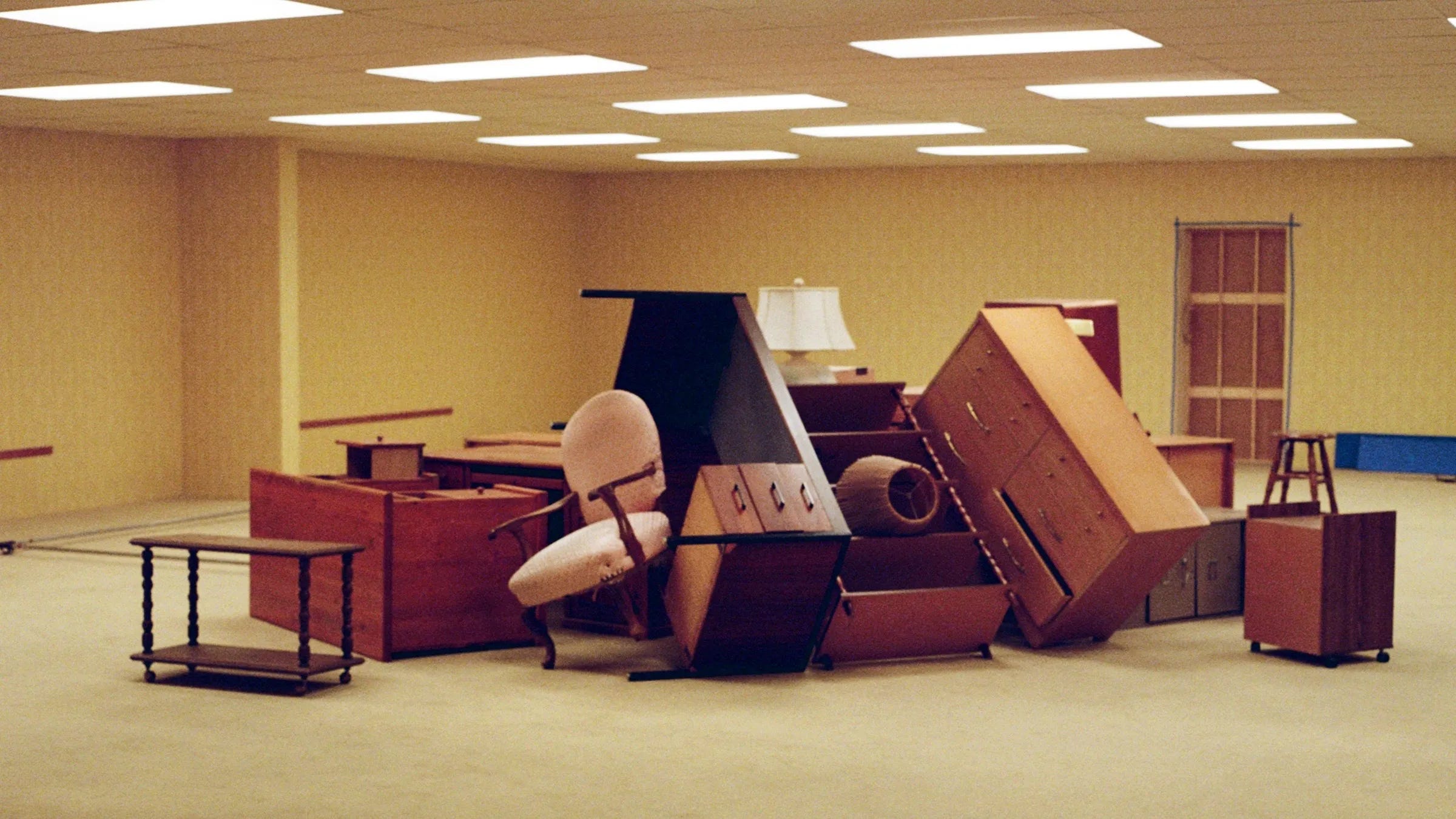
Inspired by internet creepypasta memes and Parsons’ web series, the film makes a (deliberately) half-hearted attempt to provide a more coherent narrative than the source material. Clark (the always compelling Chiwetel Ejiofor) is a failed architect and furniture store owner whose marriage has collapsed. Wandering around the store’s sub-basement after a power outage, he stumbles through a wall into another dimension consisting of endless oddly off spaces—furniture is stacked in the middle of a room; a stop sign with mirror lettering stands in a door; lamps are attached to ceilings; shoes and desks are half-submerged in the flooras if mired in concrete; stairs lead up to nowhere.
Clark tells his therapist, Mary (Renate Reinsve), about his find, and she doesn’t believe him. But inevitably she finds herself following him through into the backrooms as well, and in the space where nothing is put together right, everything falls apart.
The backrooms are stalked by entities you don’t see, and there are some hand-held camera horrors as Clark tries to record his discovery with his employees Kat (Lukita Maxwell) and Bobby (Finn Bennett). The space also though seems like a metaphor for Clark’s dead-end life—and perhaps for Mary’s as well. Mary tells Clark that his choices, his alcoholism, and his bitterness have left him alone and isolated, but she herself seems equally disconnected. The only relationship we ever see of hers is through flashbacks to her childhood in which she remembers traumatic experiences with her mentally-ill mother.
Part of the power of the movie is in fact the way in which both Clark and Mary lead lives that seem to exist in backroom spaces even when they are not in the backroom. We see Mary in her empty house, and then we see her watching workmen knock down her childhood home, turning a place she loves into a broken nonplace. The only thing left of her past is her handprints in the driveway from when she was a child and the concrete was new; an incongruous blot that the workman will eventually blot out.
For his partClark’s wife kicked him out of his house, so he lives in his store. He sleeps surrounded by furniture trying to look like it’s in a home, watching a television set propped at the foot of his bed which keeps going on the fritz. Clark also films ads for his store—Ottoman Empire—in which he dresses like a pirate with a wooden leg attached to his left knee. His clearly functional left leg is bent up behind him; when he sits down on a chair, it snaps.
Even on the supposed right side of reality, nothing works. Clark describes the backroom as a place that seems to have been constructed by someone who never saw a dog and tried to draw one from a verbal description. But that applies to his imitation of a pirate too (on television and in its monstrous backrooms incarnation), and to his life. And it also applies to Backrooms the movie, with its ill-fitting parts. No wonder Clark says he feels like he belongs in the backroom—with the human head in the fridge and his therapist tied up in a chair—as he belonged nowhere else.
Mary, and to some extent the film, claim that Clark is trapped because he keeps following the same mental patterns or enacting the same behaviors. It’s unclear how seriously we’re supposed to take that, or what exactly it’s supposed to be telling us about Clark’s alcoholism, or his misogyny, or the racism that it seems plausible may have helped derail his architecture career. The thematic material, like the detached pipes in the backroom bathrooms, never seems to quite connect; meanings are left partially constructed and buzzing like the lights. Genre markers provide some structure, but they too tend to erode or meld into each other like the chairs and desks and walls. The indie story about broken lonely people gets kidnapped by the psychological horror gets eaten by the slasher which gets gassed by the government conspiracy which gets abruptly cut off.
That cut-off ending too is unsatisfyingly detached. Parsons gives you a series of imagistic and imperfect memories of what we’ve just seen rather than a concluded plot or character arc. That feels like a cop out in some ways, as literary fiction “let’s just stop here” endings often feel like a cop out. But when credits start to roll it also leaves you thinking about how movie themselves are imperfect, weirdly-joined memories of memories, and how maybe you, sitting there watching in a weird space dedicated to flickering lights, have also stumbled into the wrong end of the wrong office building. In Backrooms, we’re all imperfect copies.