

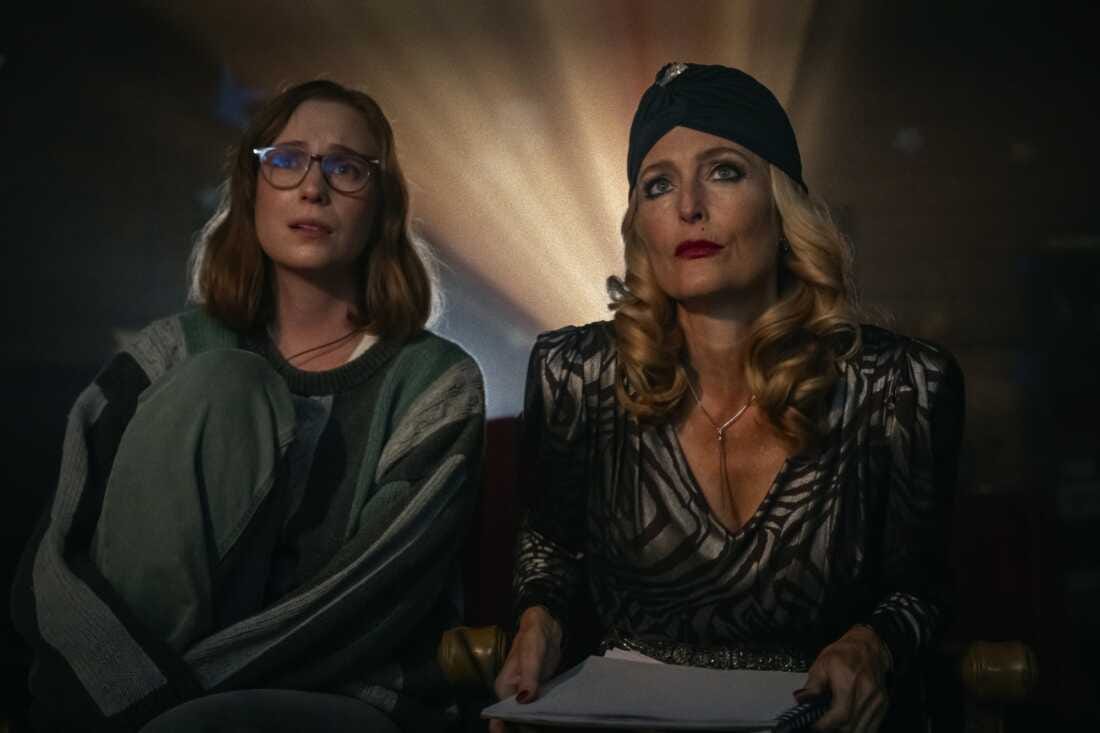
Teenage Sex and Death at Camp Miasma is a film about, and also about a film that is, a “meta commentary on the gender trouble inherent in the slasher genre.” Jane Schoenbrun has clearly read her Laura Mulvey and her Carol Clover, and she shuffles gaze and gender identity to turn her slasher into a bindungsroman/romcom/art film, each looking at and inhabiting the other in gouts of flesh, fluids, winking queer nerd knowledge, and a certain amount of revenge fantasy against the film industry.
The woman who needs revenge on the film industry is young director Kris (Hannah Einbinder)—who has an androgynous name in the best slasher tradition. Kris has been given the opportunity, as a queer woman, to resuscitate the transphobic Camp Miasma slasher franchise. As a passionate fan of the series, Kris travels to find the original film’s final girl, Billy Presley (Gillian Anderson) who has retired from acting. The two form a passionate attachment, and as part of their role-playing fantasy, and/or because their sex has summoned retribution, the slasher Little Death (Jack Haven) rises from the lake and starts murdering people with his phallic spear and his ceiling vent mask.
The plot is not especially coherent because the film is not really about its plot. Rather, it’s about the way slashers allow for the slippage of identity, gender, and self. Many interpretations of slashers focus on the way they punish sex in general and sexual deviance in particular.
That grim logic of retribution is certainly largely true of Psycho, a film Schoenbrun references relentlessly. It’s also true in the film within the film; Little Death is originally, in the Camp Miasma lore, a camper who sometimes presented as a boy and sometimes as a girl; his parents were hermaphrodites. Other campers teased him and then drowned him; the camp covered it up. But Little Death came back, because queer people are terrifying supernatural killers motivated by carnal blood lust, and by the desire to see great, preposterous gouts of bodily fluids spurting every which way.
Violent destruction of deviance isn’t the only thing slashers can be about, though. Carol Clover in her seminal study Men, Women, and Chainsaws argues that the slasher does not (just) punish perversion, but that it actually embodies and relies on perversion. In slashers, Clover argues, the (presumed to be male) viewer is encouraged to take the position of the Final Girl—terrorized, feminized, victimized. Then that Final Girl, in the closing moments of the film, seizes the phallic weaponry to become the masculine avenger. Men gaze at the women onscreen and also become those women, alternating between violated and violator, penetrated and penetrating.
Slashers obsessively thematize this gendered bifurcation and reversal. to mention just the films that Miasma is most clearly indebted to, in Psycho, Norman is also his mother, in the first Friday the 13th movie, everyone thinks the killer is Jason, but it is his mother. To go a bit further afield, in Candy Man, the final girl becomes the seductive male slasher, magically regendered for purposes of revenge. Schoenbrun isn’t so much queering the slasher as she is acknowledging, or highlighting, the queerness that has always been at the genre’s core.
There’s queerness and there’s queerness though. Usually in the slasher the pleasure is in the rush of empowerment—the shuffling off of masculine position and the dramatic, ecstatic retaking of same. The women’s position is adopted to heighten tension and make the male apotheosis more intense. The route is from feminine to masculine—again, not least because the viewer in these interpretations is presumed to be male.
Schoenbrun flips every part of that around—just as, in one mass murder scene, she flips the slasher-cam viewpoint around so you are watching the carnage from the victim’s perspective and you have to strain around Little Death’s steadily advancing mask to see what he’s doing and to whom.
In the first place, for Schoenbrun, the viewer of the slasher is not male; it’s Kris, after all, who is the movie’s most obsessive and knowledgeable slash fan. And it’s Kris who explains that she had a sexual “queer awakening” while watching the first Camp Miasma—and in particular while watching the scene in which Billy loses her virginity. That’s also the scene in which Little Death murders the man who is having sex with Billy. It is this scene of violent murder and sex which Kris fantasizes about when she has sex. “Once Little Death comes for me,” Kris whispers as Billy plays with her, “I’m just a victim, a slut, tits bouncing as I run for my life…waiting for him to penetrate me. It’s stupid and so misogynistic.”
Kris is afraid Billy will judge her for the stupidity and misogyny. But Billy has a similar fantasy. She says that the scene with which Kris is obsessed was the moment she lost her virginity in real life; the scene supposedly shows her actually having sex. The experience was miserable, and Billy says she began to disassociate— staring upwards where she might have seen a ceiling vent that looks like Little Death’s mask. Then she began to see herself from outside herself, looking through the vent head at her own experience. “I was the killer and the victim too.” And that’s when she orgasmed.
The disassociation here is in part sexual trauma. But it’s also gender dysphoria. Kris, who is a woman who uses she/they pronouns, has trouble having or experiencing sex unless she imagines herself as a more stereotypically feminized woman. She says specifically that the sexual excitement of slashers is in “transformation”—turning from nerd or pipsqueak into the sexy object of the male gaze (and spear.) Billy similarly feels sexual pleasure when she is slipping between gendered positions of male attacker and victim.
The climax (in various senses) of the film is when the two imagine themselves in a slasher film (and or summon the orgasm that is Little Death.) Lying on the bed, Billy, deliberately, takes the top, assuming the role and position of the borderline abusive male jerk with whom she lost her virginity. Little Death then runs them through with his spear and they reach sexual apotheosis together, spitting up blood to celebrate the moment and mimic male ejaculation, albeit with redder bodily fluid.
Slashers, Schoenbrun shows, are pleasurable not just because they allow men (and everyone else) to inhabit women’s perspective as a prelude to male empowerment, but also because they allow women (and everyone else) to inhabit multiple perspectives of embodied, feminized disempowerment. Everyone gets to be sexy powerful man; everyone gets to be sexy victimized women. And everyone occupies those positions not as absolute truths, but as fantasies, which are hot in part because of the opportunity to be a range of gendered people in a range of gendered positions.
Trans women are heavily stigmatized, sexualized, and demonized for identifying with what are supposedly the wrong bodies. But Camp Miasma uses the gender slippage in the slasher to point out that gendered projection is a common pleasurable fantasy for pretty much everyone. The movie’s gorgeous, carefully choreographed visuals—in which bodies fall apart like ballet, in which the characters stand against beautiful obvious stage sets, in which Kris asks Billy to direct her final ecstatic flight—emphasize that the gendered play is play, and that the fantasy is fantasy.
The fantasy is also real though, inasmuch as daring to identify with one’s own body, as Billy does, can be a death sentence if others decide they want to pick up an axe. Kris breathlessly explains to the studio that Little Death is real and that he lives in a hole in the bottom of the lake from which the movies come. He is directing us, which is perhaps another way of saying that our fantasies make us as much as the other way around.
Sometimes those fantasies make us into pleasure. Sometimes they make us into killers. Or, as the title Teenage Sex and Death at Camp Miasma suggests, sometimes they can make us into both, if the art is queer enough.