

—
Everything Is Horrible has a sale today; it’s 40% off, $30/year. If you value my writing, please consider coming on board so I can keep scribbling.
—
Back on June 5 2025, Donald Trump had what is for him a typically grotesque exchange with German Chancellor Friedrich Merz. Merz was trying to encourage Trump to aid Ukraine. To make his case he pointed out that June 6, the next day, was the anniversary of D-Day. That was a moment when America fought against fascism. Trump, Merz suggested, should follow Roosevelt and Eisenhower, who took a stand against fascist Nazi invaders, and take a stand against fascist Russian invaders.
Trump, unsurprisingly, didn’t get the point. Instead—because he loves humiliating his interlocutors—he fixated on what he saw as his interlocutor’s humiliation. “That [D-Day] was not a pleasant day for you?” he said with a wink-wink, nudge-nudge. Then he turned to the cameras and said, “This was not a great day.”
“Well,” Merz responded, “in the long run, Mr. President, this was the liberation of my country from Nazi dictatorship.”
Merz’s point is very clear. Hitler was not the representative of the German people; Hitler was the oppressor of the German people. Like Pol Pot, or Stalin, or even King George III, Hitler seized power and used that power to torment and terrorize his own people—not least those of his own people who were Jewish, disabled, Roma, or leftists.
Germans today do not, and should not, see World War II as a loss for Germany and Germans. This is the case even though German influence and power was reduced after the war—even though Germany was divided and many of its people faced ongoing oppression under Communist rule. The war was horrible for people in Germany (and especially for Jewish Germans) in many ways. But Hitler’s defeat was not horrible. It was, as Merz says, liberation.
I’ve thought about Merz’s comments a lot in the last year. The application to the US is obvious, and yet in the public sphere it remains difficult to articulate, especially perhaps in foreign policy. Media, analysts, and the public in general are used to thinking of presidential victories—military and diplomatic—as the country’s. To the extent we are in conflict with other nations, we want to win, which means wanting the president to win. You don’t root for the president to fail because that is rooting for the country to fail.
That calculus was always dicey in cases where the US pursued unjust wars, from Vietnam to Iraq. But it is completely broken now that Trump is sending gestapo into the streets to murder his own people, denying disaster relief to blue states, and attempting to destroy our democracy. His administration is a war on Americans. And that means—as Merz understands—that when he is defeated abroad, or when he is resisted abroad, we benefit. We’ve seen that clearly in both Iran and Canada.
Iran
Trump’s war with Iran has been a devastating failure. He launched a reckless and illegal attack without considering Iran’s most likely response (seizing the Strait of Hormuz) and without any effort to bring foreign allies, partisan opponents, or the US public on board.
Most discussions of Trump’s loss have, understandably, focused on the ugly long-term consequences for the US and the world. Around 20% of the world’s oil flows through the Strait of Hormuz. Now that Iran controls the waterway, it can push up prices at will, creating global oil shocks around the world. The US has been affected as gas prices soar, but nations like China, South Sudan, and Mauritania have been even more painfully hit and have had to institute rationing.
Iran’s control of the Strait, if it persists longterm, also allows the regime to charge tolls. An enriched and empowered Iran could threaten its neighbors and certainly would tighten its grip on its own people, who live under a brutal and misogynist theocracy.
These are all terrible outcomes. But I think there is a strong case that a Trump win would have been even worse. Successful military action, we know, leads Trump to want more and bigger military action. He loved the rush of victory he got when special forces kidnapped Venezuela’s authoritarian dictator Nicolas Maduro. That “win” led him to turn his eyes to Iran.
And if Trump had in fact forced Iran to buckle quickly, what then? We know Secretary of State Rubio wants to overthrow the government in Cuba. We know that Israel’s genocidal Prime Minister Netanyahu has been trying to seize portions of Lebanon, and would probably take the whole country, and more, if he could. Trump has also threatened to invade Greenland and Canada. Every military victory creates the conditions for more ambitious and more reckless military adventures—military adventures which put innocent people at risk, definitely abroad, but also at home.
Germans did not benefit when Hitler conquered other territories; his victories just meant their own oppression was screwed tighter and was destined to last longer. His military defeats, on the other hand—even at the hands of the despicable Stalinist Soviet Union—meant that the day of liberation was brought closer. We are in a similar situation. Ideally, Trump would stop his senseless and grotesque wars. But if he pursues them, we all benefit when he is resisted—even when the resistance comes from other grotesque regimes like Iran.
Canada
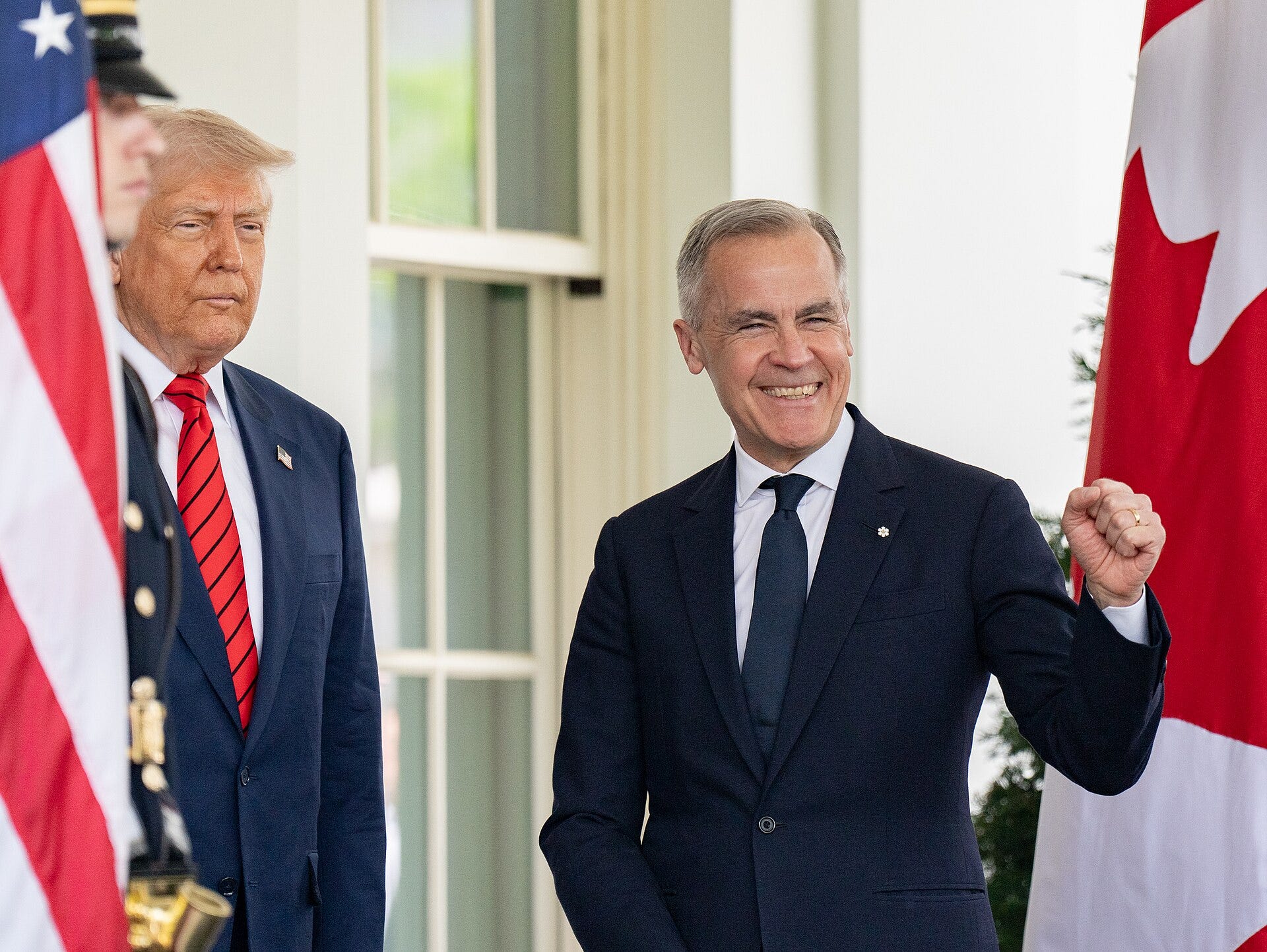
Trump has not attacked Canada militarily. But he has started a trade war which is likely to cause extreme pain for both the US and our northern neighbor. The US has put 50% tariffs on $20 billion of Canadian imports; Canada’s Prime Minister, Marc Carney retaliated with 50% tariffs on $20 billion in US goods.
A proposed deal to avoid the trade war disintegrated this week for a number of reasons. But a major one is that Trump demanded a sweeping veto power over Canada’s trade deals with other countries. Carney correctly identified this as an attack on his nation’s sovereignty. Trump has been saying for over a year that he wants to annex Canada and turn it into the 51st state. He appears to have seen the trade deal as a step towards forcing Canada to submit to his authority, rather than as a mutually beneficial agreement between neighbors. “They asked too much and they offered too little,” Carney said of the US negotiators. “You’re at war when you get attacked. We got attacked.”
Again, the trade war will be painful. No one wants to pay more for goods; no one wants people on both sides of the border to lose their jobs. But Carney believes that knuckling under to Trump would put Canada at the mercy of an erratic dictatorial regime with no accountability to Canadians.
And Americans should support his decision, because the more people fold to Trump, the more Trump demands that others fold. If he can steamroll Canada and force them to bend the knee, that will encourage him to redouble his efforts to force blue states to bend the knee. The attack on Canada’s sovereignty is, after all, an extension of his efforts to erode US state sovereignty by, for example, withholding public safety grants to force blue states to allow federal election interference.
Trump believes that he is and should be the sole authority on earth for everything. Each victory encourages him to seize more, demand more, expand the limits of his power. In contrast, each defeat makes him look weaker and easier to defy. In this case, Canadian resistance will directly stiffen resistance in states with longtime ties to Canada, like Maine and Michigan—both of which, as it happens, are the site of major Senate elections.
Resistance to Trump benefits America
Canada is a democracy which, whatever its flaws, is much less fascist than our regime. Iran is a vicious theocracy, and its empowerment is bad for its people and the world. In resisting Trump’s grotesque power grabs, though, they both reduce his power and make it harder for him to oppress his own people—just as Trump’s plummeting polls and weakening influence at home restricts his ability to bomb and bully people abroad.
Trump successes are not America’s successes. On the contrary, every Trump success allows him to tighten his grip on Americans—to steal from us, to terrorize us, to deny us rights to vote and to bodily autonomy, to imprison us and murder us. He is our enemy, and it is right and good to want him to lose. When he is defeated, it is not our defeat. It is, as Merz understood, a step towards liberation.
Nicely explained.
This brings to mind JD Vance‘s bizarre statement after Renee Good was shot in the head in Minneapolis.
He said that the man who shot her performed a very very important service to the United States of America.
How does this kind of statement slide by so easily?
Answers welcome.
And keep up the good work, Noah.
Thank you for your clarity. The emperor has no clothes: he is not serving the people, but himself. You clearly expand on this truth and it makes sense. Sense that is uncomfortable, and rarely found in my limited view.