

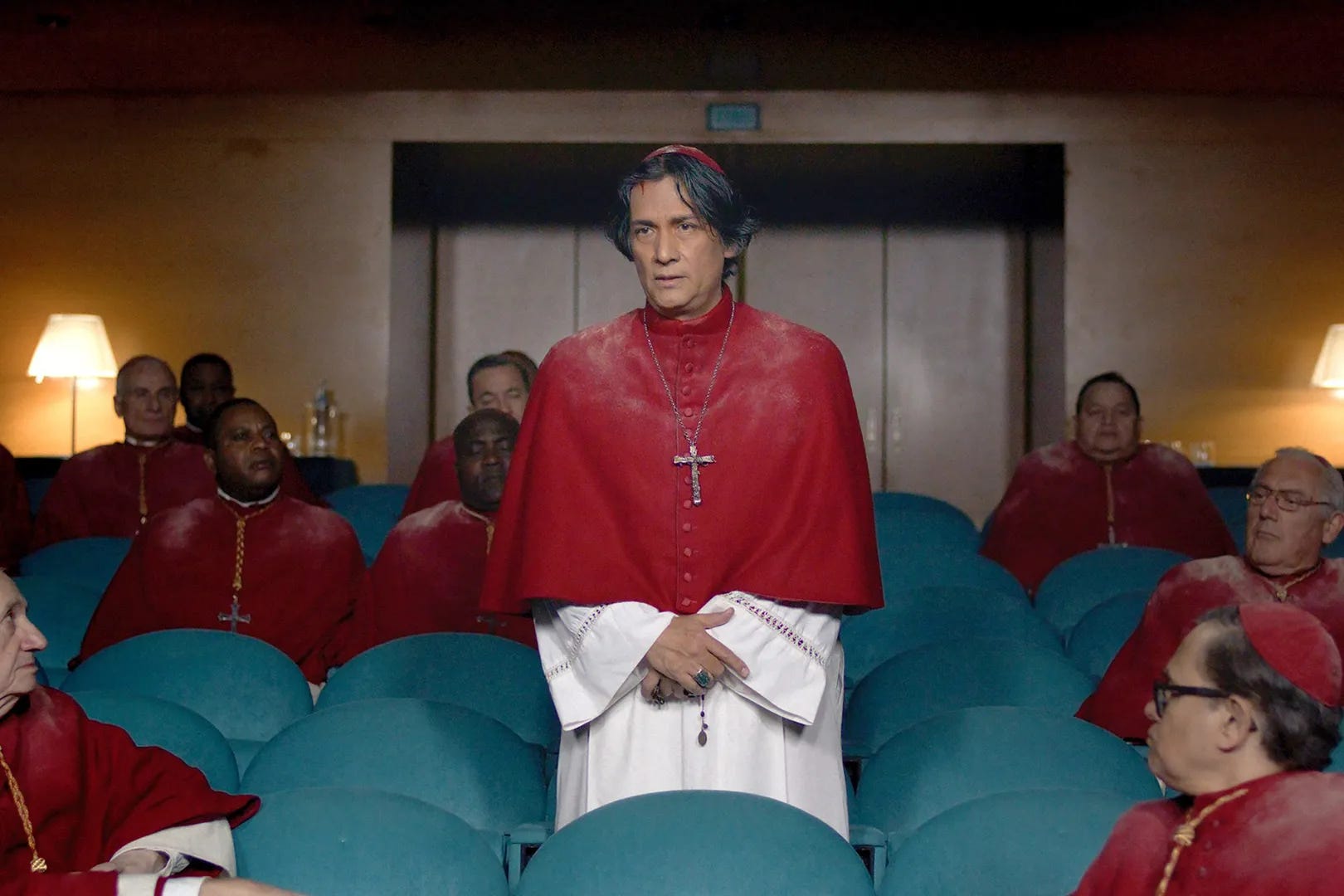
Edward Berger’s Conclave is famous for its final gendered twist, calling into question the determined masculinity of the preceding two hours. But the plot kink serves as its own kind of camouflage, highlighting maleness to erase it. Or, in other words, the fact that the film belatedly acknowledges that it’s all about men doesn’t change the fact that it’s all about men—and that the all-about-men-ness is central to its appeal and its prestige aspirations.
—
Everything Is Horrible is entirely reader supported. Please consider becoming a paid subscriber so I can keep writing! It’s $50/yr, $5/month.
—
The film’s high concept is practically designed to push women to the margins; Conclave is about the process of choosing a new Pope. The title refers to a gathering of all cardinals who are all male since the Catholic church is a hidebound patriarchal institutions. Following the previous Pope’s death by heart failure, the men are sequestered as they vote for a new pontiff under the direction of Cardinal Lawrence (Ralph Fiennes). T
The locked-room trope inevitably becomes the setting for mystery, as Lawrence turns himself into a Christie-like detective. He methodically, with a certain tortured sincerity, exposes secrets and lies as liberal Cardinal Bellini (Stanley Tucci), conservatives Cardinal Tedesco (Sergio Catellitto) and Cardinal Adeyemi (Lucian Msamati), power hungry Cardinal Tremblay (John Lithgow), and more all vie for the high seat.
The rich trappings of prestige drama hang over the proceedings like a surplice, reflected feelingly in Fiennes’ wounded eyes. Yet the actual plot machinations trip lightly through one pulpy, gossipy improbability after another—from the old Pope dying at the exact wrong moment, to the last-minute revealing of a secret cardinal, to a terrorist attack on the Vatican, to sexual improprieties. The film teeters precariously on the edge of campy soap opera; whenever the cardinals close their eyes in prayer, you get the sense that they’re asking God to let them get through the run time without dissolving into snorts and giggles.
God answers their prayers in large part by filling the film with men. Under patriarchy, the concerns of men and stories about men are seen as serious and important. 12 Angry Men—a film like Conclave about a good liberal man investigating wrongdoing in the teeth of a reactionary male antagonist—frames itself as serious and powerful not least because it exists in room sealed off from women. War movies, from Guns of Navarone to Full Metal Jacket, are an elevated genre not least because women barely exist in them except as foils to be sexualized and/or brutally murdered. The (more or less violent) exclusion of women is a guarantor of value, worthiness, and patriarchal matteringness. Manly men doing manly things elevates a film.
Conclave is unusually aware of this dynamic, which it highlights and covers up with the same swoosh of its mitre. When Bellini mentions in a strategy meeting that he wants to move towards allowing women priests, a colleague pipes up to say that talking about women could derail the whole enterprise. The fact that he’s referring to the diegetic progressive campaign cleverly overwrites the extent to which he’s talking about the movie itself.
In a similar vein, when Lawrence tries to interview a nun who he suspects had a sexual relationship with one of the candidates for Pope, chief housekeeper Sister Agnes (Isabella Rossellini) tries to block his access, insisting that she can deal with the matter herself. Lawrence pulls rank—and the viewer is rooting for him to pull rank, because that’s the way the plot will advance and patriarchal excesses and exploitation will be revealed. Women are in the way; it’s up to men to deal with men, and up to men to keep the story on track. (Agnes does get to take a more active role later—after she agrees to take a subordinate role and back Lawrence’s maneuvers.)
The most dramatic example of simultaneous subversion and reinforcement of patriarchy in the film, of course, is the revelation that the newly elected Pope, Cardinal Benitez (Carlos Diehz) is intersex, and has a uterus.
Benitez himself argues that his ascension is an illustration of, and a fulfillment, of Lawrence’s call for diversity and tolerance in the Church. Yet Benitez is a man (intersex people who identify as men are men) and the actor who plays him is a man. Is the reveal here really that the Pope is a woman? Or is the reveal the extent to which the film excludes women, locating virtually its only (fictional) uterus in the body of a male character played by a man? Femininity is carefully contained in the Pope’s body and in the narrative. Actual women—straight, queer, cis, trans, and/or intersex—have little say or role.
The last scene of the film shows Lawrence looking out of a window into a courtyard below where three nuns are chattering to each other. Lawrence has just come from his meeting with the new Pope, and he may be thinking about women’s place in the Church, and whether that place should be greater and less subordinate. But it also seems significant that Lawrence is looking down at the nuns; he remains elevated above them, and we see them through his eyes. Their voices are inaudible; they do not get to speak for themselves, just as Agnes’ only effective utterances are those at the behest of, or in support of, Lawrence. Certainly, Agnes never gets to express her views on women in the Church, much less on the new Pope.
Conclave isn’t necessarily more sexist than most Hollywood films. Women held only 35% of speaking roles in films in 2023; only 8.1% of the top grossing films of 2025 were helmed by women directors.
What’s different about Conclave, though, is that it specifically positions Hollywood as critiquing Vatican sexism—even while it uses its Vatican setting as an excuse and a justification for the very typical movie sexism of marginalizing women and paying virtually none of them to perform. The new Pope looks an awful lot like the old Pope, just as the new (male) prestige drama looks a lot like the old one. The frantic, opulent activity—the robes, the secrets, the sincere confessions of doubt—are pleasing, engrossing distractions from the main point, which is that only men get to vote.
I have to laugh whenever people claim that a pope is liberal or more openminded. The Catholic church is a white male patriarchy and will stay that way. I have never understood the appeal, and I have always been offended that women are relegated to secondary status as nuns. Granted, I was raised as a white Protestant, so it was a different patriarchal religion, but we didn’t have an infallible pope as our leader, and women are now ordained and in leadership positions. (Southern Baptists and fundamentalists excluded.)
A book set in the Catholic Church and a film based on that movie: we know going in that women aren't likely to figure big. Besides maybe Mary, and for all the hype that's definitely a supporting role.
Cardinal Lawrence's speech in the movie about the danger of certainty is the heart of Conclave. Uncertainty defines true faith. The plot twist isn't about men or women, it's about an individual outside how the church defines and categorizes people, and by extension dogma. Bad things happen when what one believes slips into being what one knows.
Cardinal Benitez literally embodies a mystery that sets him apart from the vast majority of humanity, at least in biological terms. And he works in dangerous parts of the world, in secret, living every day not knowing whether he might be tortured or killed, but carrying on nevertheless.
Uncertainty, doubt, fear, all these spring from how we individually encounter the only absolute truth: at the end of the day, our existence is an absolute mystery from minute to minute until we die and face the biggest mystery of them all. In Conclave, the church can wield faith as a cudgel destroying uncertainty by imposing control and meaning. Or it can embrace the mystery via a Pope who himself physically and in his life's work shows that faith only exists when we acknowledge that pretty much everything is ultimately unknowable.
For me and my kids, the book and movie gave hope that at least in Conclave's universe, the Church embraces the mystery, making space for love and acceptance of all beings.
But yeah, not probably going so far as women priests.