

Throughout the Trump era, Democrats have debated whether to focus on Trump’s assault on democracy or on his wretched economic policies.
Senior Illinois Senator Tammy Duckworth, for example, has argued that Democrats should not impeach Trump or anybody else after the midterms, if they control the House. Instead, she says, they should “get back to work” and find compromises on issues like funding USAID and repealing tariffs. If they have to, in order to get policy wins, they should allow Trump, she says, to “save face.”
In contrast, (almost certainly) incoming junior Illinois Senator Juliana Stratton has called Trump a “fascist” and said, “I will tell you is that I am not going to the United States Senate to find something to agree with Donald Trump on.” For Duckworth, the goal is to make progress on policy and on issues that will maybe put some money in the pockets of people from Illinois. For Stratton, Trump’s authoritarian racism is such a threat that the normal processes of legislation are, and must be, irrelevant. The goal is to stop Trump, not compromise with him.
Regular readers will not be surprised that I agree with Stratton here. What’s interesting, though, is that the current midterms, as they have played out so far, suggest that both kitchen table issues and democracy are very important to voters—as they should be, since you can’t, after all, vote on economic conditions if you can’t vote.
—
If you value my writing, please consider becoming a paid subscriber. It’s $50/yr, $5/month.
—
It’s the economy, stupid. And also democracy.
Surveys of voters before the midterms suggest that the economy is far and away the most important issue for voters. A Pew survey from the beginning of October found that 84% of registered voters beleived that the economy was very important; this included 88% of democrats and 82% of Republicans. Gallup similarly found that the economy and healthcare were the issues that most (50%) of voters saw as extremely important.
Trump’s economic approval is dismal; just 28% in one brutal survey. If the economy is very important to voters, and voters hate how Trump has handled the economy, it makes sense to conclude that GOP midterm woes are being driven in no small part by anger at high prices, sluggish job growth, and general economic disruption.
A year ago, most analysts thought the House would be a close fought battle. Then Trump launched an illegal war of aggression on Iran spiking gas prices, attacked immigrants kneecapping many industries, put in place tariffs, did everything he could to damage agriculture, and here we are with Democrats at 99% to take the House in the fiftyplusone model and leading polls for Senator in Kansas. QED.
When you look a little closer, though, it’s clear that economics is not the only story. That Pew Poll found that 85% of Democrats rated “the future of Democracy” as very important to the election. Moreover, early voting has had massive Hispanic turnout, especially from young Hispanic women. In Texas the turnout of Hispanic people under the age of 30 has doubled from the same point in 2024, which was a presidential year.
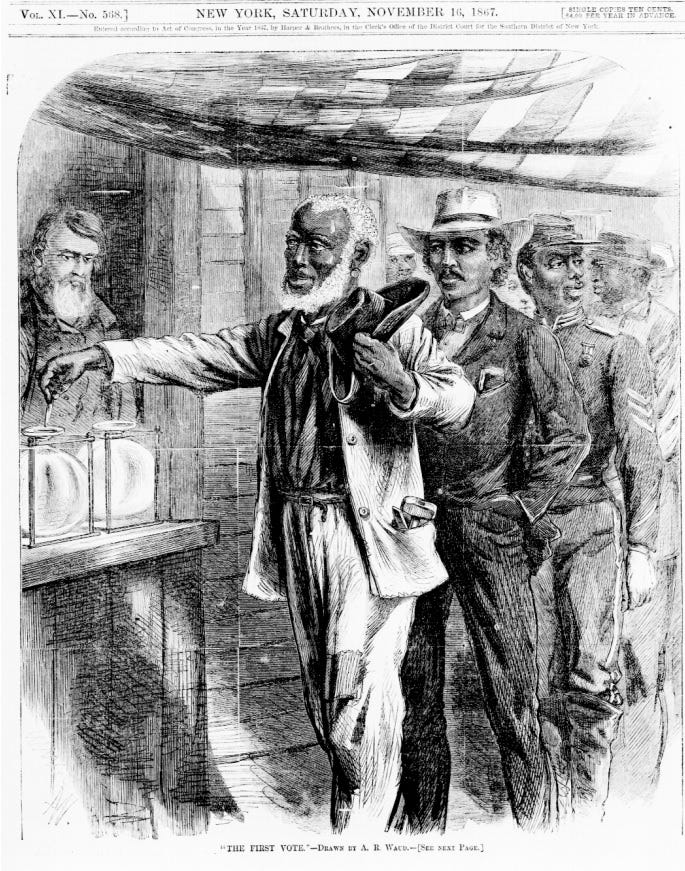
Similarly, there’s been a surge in Black voting, especially in the South. “Black voters accounted for nearly 32% of ballots recorded on the first day of early voting, a larger share than on almost any other opening day in the past 18 years,” according to MS Now. One analyst found Black share of early voting up 14%—and Hispanic early voting share up by a stunning 44%. White vote share was down 8%.
It’s possible white voters will surge on election day. But even if they do, it is clear that Black and Hispanic voters are very engaged and passionate about this election. And it’s not hard to figure out why: the Trump administration has obsessively attempted to exclude Black and Hispanic people from American citizenship and from Democracy.
With the collaboration of the Christofascist Supreme Court, which gutted the Voting Rights Act, Trump’s minions pushed through mid-decade racist gerrymanders which disenfranchised Black voters more thoroughly than at any time since Jim Crow. At the same time, Trump has obsessively targeted Hispanic people and their communities for kidnapping, incarceration and deportation. The pretext is that Hispanic people are in the US illegally and more that they are voting, illegally, against Donald Trump. Many observers fear Trump will send federal observers to the poll to intimidate Hispanic and Black voters (left and liberal groups have organized poll watchers themselves to prevent this.)
As Bill Kristol, points out
I hear Dem operatives going on about how kitchen table issues matter. They do. But why the huge and disproportionate surge in black and Latino turnout? Surely it has to do with assaults on civil rights and immigrants. Democracy may not matter much to Dem operatives; it matters to lots of Dem voters.
Voting for the right to vote them out
I think what these voters understand, and what politicians like Tammy Duckworth sometimes miss, is that if you are disenfranchised, you cannot vote on kitchen table issues.
Focusing on delivering policy wins is well and good. But if Black and Hispanic voters are gerrymandered out of choosing their representatives, and/or prevented from voting through state shenanigans up to and including terror, then it doesn’t matter if those voters are angry about the economy, and it doesn’t matter if you deliver them policy wins. Without robust democracy, they can’t vote, and that means they can’t make their views on the economy, or on anything, known. It is not an accident that enslaved people were stripped of all citizenship and legal rights the better to facilitate their economic exploitation.
Black and Hispanic voters are turning out because they are angry about high prices and a sputtering economy. But they are also turning out because they know that if they do not, they may well lose the chance to ever express their anger at the voting booth again.
It’s important for Democrats to try to pass good policies that help people. The destruction of USAID is expected to kill 14 million people if funds are not restored; Duckworth’s urgent call to address that is laudable and important. Repealing the tariffs would be a huge boon to people both at home and abroad—and it is a policy that might, plausibly, win over a certain number of Republican votes in Congress. It’s worth a shot anyway.
But these important initiatives can’t be a substitute for fighting for democracy—through hearings, investigations, aggressive blue state gerrymanders, and, yes, through impeachments. Joe Biden passed a lot of solid policies that helped people. But most of those gains crumpled into irrelevance before Trump’s authoritarian onslaught, as he ignored precedent and even Congress’ power of the purse. If you can’t protect democracy, you cannot protect or build on any democratic policy gains. Nor can you reap any electoral benefits from good policy.
What is on the kitchen table doesn’t matter much if agents of the state can kidnap your spouse or poison your drinking water with little or no accountability. The economy is inextricable from democracy because without democracy, you have no way to register your approbation or disapprobation of the economy. Democratic voters, and many Democratic officials, do seem to understand this. I hope they are able to convince people like Tammy Duckworth that getting back to work on the business of democracy is meaningless if there is no democracy to protect the business you’re doing.
If I could, I would make these essays required reading. For everyone. The clarity is stunning.