

Everything Is Horrible is entirely funded by readers. If you value my writing, please consider becoming a paid subscriber. It’s $50/yr, $5/month. Or you can tip me at Paypal or Venmo.
—For decades now, Republicans have regularly attacked Democrats with inflammatory and contemptuous language, mocking their identities and even celebrating when they are literally assassinated. Democrats have rarely responded in kind; they tend to issue more-in-sorrow-than-in-anger statements at best or simply duck and cover at worst.
Last week, though, that changed. In his debate with his disgusting bigot of a Republican opponent Mike Collins, Georgia Senator Jon Ossoff called Collins literally a “bigot”. He highlighted Collins’ habit of hobnobbing with open white supremacists by telling him bluntly, “You hired half the Third Reich to staff your office.” He added (accurately) that “If John Lewis were marching today, Mike Collins would be grabbing a billy club.”
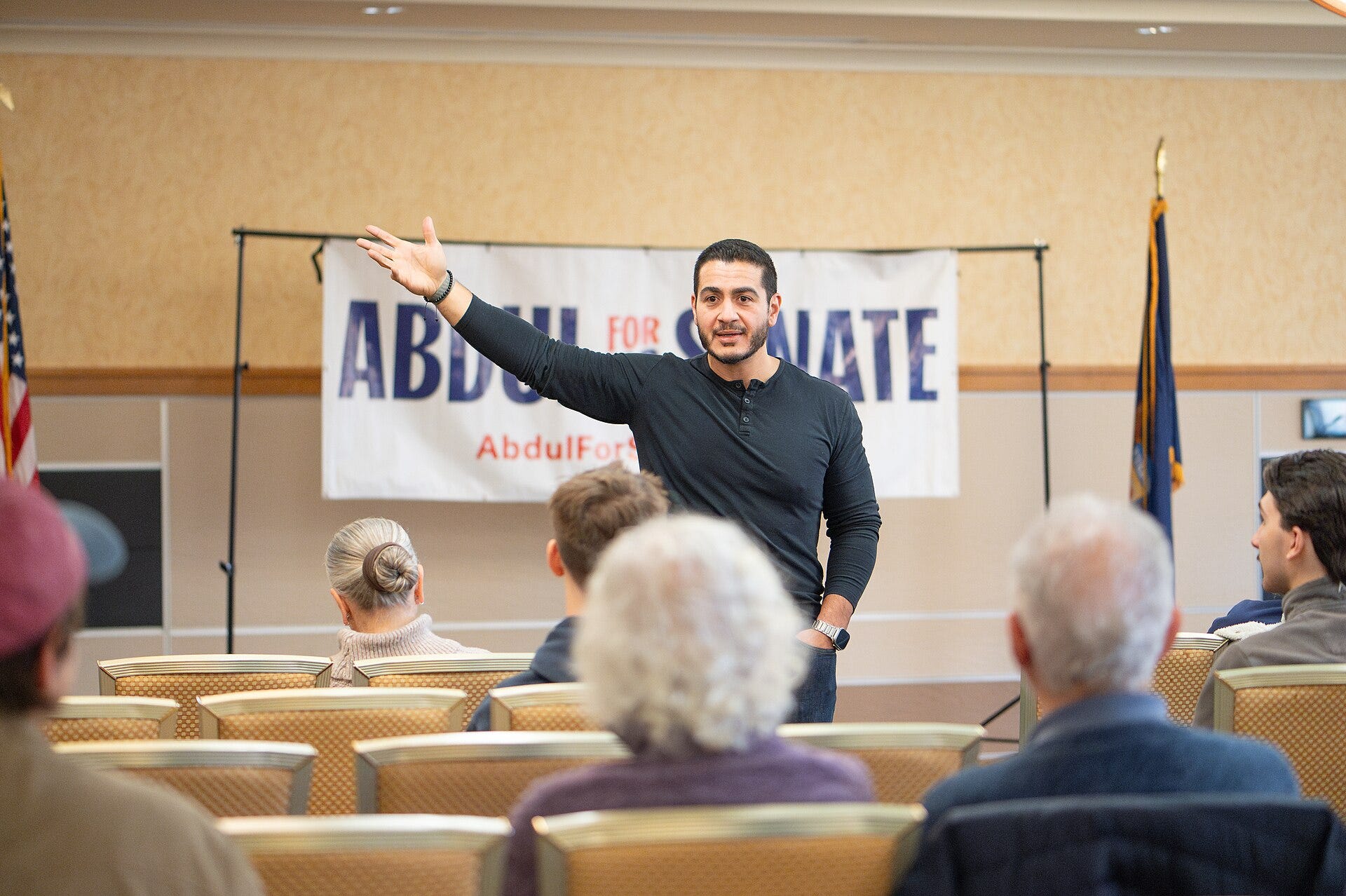
The next day, Louisiana Senator and disgusting bigot John Kennedy claimed that Democratic Michigan Senate candidate Abdul El-Sayed “sleeps in a Bin Laden jersey”—an unabashedly racist and Islamophobic insult. El-Sayed did not deplore the lack of civility. Instead, he said that Kennedy “wears his bed sheets out at night.” Which is entirely fair. If you say racist shit, you get called a Klansman.
Democratic partisans on social media—used to the wearisome substitution of thin gruel for red meat—were giddy and almost disbelieving. Finally, Democrats were hitting back; finally they were laying out the stakes of the election clearly; finally they weren’t cowering in a corner while Republicans pissed on them. It felt like a turning point.
And I think it is a turning point—or at least a potential turning point. It’s unlikely that El-Sayed and Ossoff will drastically change the trajectory or the margins of the midterms by calling a bigot a bigot or a Klansman a Klansman. But political rhetoric isn’t only about winning elections. It’s also about promises, and even more, perhaps, about identity.
Democrats have refused to call out white supremacy in the past because they have not wanted to be identified with overturning or resisting white supremacy. To have party leaders—potential incoming Senators—bluntly and forcefully call Republicans what they are is a statement that at least some people in the party do, in fact, want the party to be identified with crushing racists.
That doesn’t mean that white supremacy in the US is going to be overthrown in the immediate future, unfortunately. But it does mean it may be facing the kind of resistance from electoral leaders that has been very, very rare in American history.
Democrats are ambivalent about white supremacy
To some, it may seem strange to argue that Democrats have not wanted to be identified with overturning white supremacy. Democrats are, after all, the party of landmark civil rights legislation; they are the party that elected a Black president. The House Democratic leader is Black; many of the party’s leaders are Black. Most importantly, its base is Black; Southern Black voters were the deciding constituency which chose Obama in 2008, Clinton in 2016, and Biden in 2020. The party in a real sense, is its Black supporters.
The painful truth, though, is that party leaders have often been very leery of those Black supporters. Bill Clinton in 1992 expressed this ambivalence by attending a Black event hosted by Jesse Jackson and deliberately insulting a Black invitee, the rapper and activist Sister Souljah, by comparing her to literal Louisiana Klansman David Duke. Clinton virtually never used such harsh language against his rabid Republican opponents.
Clinton’s ugly Sister Souljah moment has become iconic. But it’s hardly unique. Barack Obama denounced his pastor, Jeremiah Wright, in more nuanced, but comparable ways during his first election effort. And, in contrast to these efforts by party elites to distance themselves from Blackness, Democratic leaders often go out of their ways to align themselves with whiteness. Thus Vermont Senator and leftist Bernie Sanders asserted after Trump’s victory in 2016, “I come from the white working class, and I am deeply humiliated that the Democratic Party cannot talk to the people where I came from.”
Democrats oppose the Republican white identity party of raging fascism. But they have shilly-shallied about being the party of Black identity or multi-racial identity. Instead, both left and centrist Democratic leaders have often been more comfortable being the party of consensus white supremacy.
There’s white supremacy and there’s white supremacy
As I’ve discussed before, following Julia Azari’s Backlash Presidents, the alternative to fascism in the US context is not generally anti-fascism. Instead, the alternative to fascist backlash is often a nostalgia for, and an attempt to restore, a bipartisan and less contentious white supremasist consensus.
Azari points out that before the Civil War, presidents mostly tried to defuse the issue of slavery and find a way to make it permanent and non-controversial. That compromise was ruptured by the Civil War and Reconstruction—but soon both parties were looking again for a way to find a bipartisan path which would subjugate Black people. They found it in Jim Crow in the South and grinding but less formal inequality in the North. Then that was upended by the Civil Rights movement—after which both parties again sought a compromise in color-blind racism. Everyone (ie, both party’s leaders) agreed to pretend that racism had been defeated and opposed real efforts (like busing) to alter de facto school segregation.
Or as I put it in another post:
What this means is that white supremacy is and has always been the elite consensus. That is in no small part because white people are the nation’s most stable and most powerful elite.
Sometimes, the elite white supremacist consensus is jarred or ruptured by a determined push for racial progress, like the Civil War or the Civil Rights Movement—or, in a different vein, by the election of a Black president. This is followed by a fascist white supremacist backlash, unleashing chaos, violent white supremacist terror, and massive presidential illegality—in the form of an Andrew Johnson, a Nixon, a Trump. Elites then scramble to palliate and neutralize fascists by finding a new white supremacist consensus that every (white) one can live with.
Centrist chud and NYT columnist David Brooks channeled this kind of politics when he scolded Jon Ossoff for his too great enthusiasm in denouncing bigots. “Jon Ossoff, my advice to him is, if you start calling your political opponents Nazis, maybe it’s time to shut up,” Brooks burbled. “That’s just not what we do here in this country.”
NYT columnist and guy who actually despises bigots Jamelle Bouie responded, “what if they are literally Nazis?”
But I think, from Brooks’ perspective, if they are literally Nazis, it is even more important not to say so. When confronted with fascism, the urgent bipartisan nice guy white supremacist response has always been to retreat. The problem, from Brooks’ perspective, is too much division, too much partisanship, too much resistance to fascism. Overweening equality upsets the hierarchy which has rewarded David Brooks and his ilk extravagantly. The goal is to kill (or, rather, not kill) the fascists with kindness.
Fascist brutality, from Brooks’ perspective, is unfortunate because it’s a sign that Black people and women and others have made too many gains and need to be smothered again in the bipartisan defense of hierarchy. That’s why Brooks objects to blunt repudiation of fascists (who he sees, ultimately, as his allies) rather than to the fascist program itself (which he believes is regrettable but ultimately on the right track if it represses Black Lives Matter, MeToo, and other left movements for equality.)
Brooks’ repudiation of Ossoff is, in other words, a Sister Souljah moment. As such, it is intended to do what all Sister Souljah moments are intended to do—rhetorically reassert bipartisan white supremacist consensus in the face of (supposedly) too strident calls for equality.
Why can we call them Nazis now?
The difference between Clinton attacking Sister Souljah and Brooks attacking Ossoff is, of course, that Clinton, as a potential president and Arkansas government, had a lot more power than the rapper and activist he was kciking. Brooks is an influential pundit, but he is not a sitting Senator. He’s attempting to enforce a top down consensus from a position that is not exactly on top.
Which brings us to the question, what has changed? Why are leading Democrats like Ossoff and El-Sayed willing to denounce white supremacy without the usual equivocation? What is it about this moment that has made white supremacist consensus seem undesirable to at least some Democratic party leaders?
One factor, undoubtedly, is that Republican fascists have delegitimized themselves over the last two years in ways that American fascists have not delegitimized themselves since the Civil War—and arguably in some ways even more fully than then.
Trump is a uniquely chaotic, ignorant, and corrupt human being with few parallels in human history, and everything he touches turns to shit. That includes the white supremacist coalition he now heads. Jon Ossoff was supposed to be in a fight for his political life in generally purple Georgia; instead, he’s leading polls by nine points. He can use Mike Collins as a punching bag because he knows Mike Collins, Nazi shithead, is not a threat.
That doesn’t fully explain, though, why Ossoff, who has obvious presidential ambitions, thinks that his best path forward to a 2028 nomination is calling bigots “bigots” with his whole chest. Other Democratic figures interested in being president—like California Governor Gavin Newsom for example—have taken a more typical path of palliating existing hierarchies, vetoing protections for trans people, and fighting tooth and nail to prevent his state from taxing billionaires.
I think it’s important here that, while Ossoff is white, his political base is not. Black people are more than half of all Democrats in Georgia. In 2021, in the Georgia runoff election that gained him his Senate seat, Ossoff won 92% of the Black vote. That’s an impressive percentage even given the fact that Black voters tend to overwhelmingly cast ballots for Democrats.
Julia Azari points out that impeachment efforts against fascist backlash figures like Johnson, Nixon, and Trump have generally been led by Black legislators representing Black constituencies. In that context, it’s also important that Black voters have become increasingly energized in the second Trump term. There is a massive surge in Black voters rightfully and righteously enraged by the brutal attack on Black voting rights through gerrymandering and disenfranchisement. Black centrist political leaders like House Minority Leader Hakeem Jeffries and South Carolina Representative Jim Clyburn have responded by endorsing radical procedural moves like aggressive blue state gerrymandering and expanding the Supreme Court.
National Black leaders—like Obama or Kamala Harris—are often more cautious because they feel like they need to prove they can appeal to white voters. Ossoff, however, is white himself, and may therefore feel less constrained. Indeed, he may feel that he has to prove himself to Black voters, since his primary strategy is surely based on convincing Black Southerners to cast their ballots for him rather than for Black candidates like Kamala Harris and Corey Booker. As a white leader uniquely dependent on Black voters, Ossoff has powerful incentives to denounce white supremacy more vociferously than his peers.
Abdul El-Sayed is not running for president in the 2028 cycle. He has, however, been having trouble, at least by some metrics, with Black voters. Denouncing white supremacy in explicit terms is one strong way to underline the ways that racism—from Republicans, especially, but also from Democrats—harms both Black people and Muslim Arabs like El-Sayed himself.
As with Ossoff, the electoral benefits of consensus white supremacy and catering to white voters—so obvious to Clinton and even to Obama—no longer apply, at least for some Democrats. In an environment where Trump and Republicans are loathed and in which Black voters—and not just Black voters—are enraged, Democrats have unusual and powerful incentives to treat white supremacists as despicable blights to crush, rather than as potential allies to cultivate.
The white supremacist consensus is still lurking
None of this means that Democrats have abandoned the dream of white consensus, nor the tactic of throwing marginalized people under the bus. Various cowardly, bigoted Democratic candidates—most recently South Carolina Senate contender Annie Andrews—have been trying to transphobia their way into office. Anti-Arab and anti-Palestinian racism remains an issue in the party in general and in the Michigan Senate race in particular. Democratic leadership still resists abolishing ICE even as the agency demonstrates over and over that is an unaccountable fascist gestapo dedicated to terrorizing the public. Democratic leadership waffles on impeachment as too divisive because it might annoy David Brooks and others nostalgic for white supremacist consensus. Ossoff himself voted for the ugly anti-immigrant Lakan Riley Act. Etc.
The appeal of white supremacist consensus to elites in a white supremacist country is powerful and lasting. But El-Sayed and Ossoff show that there is also, right now, a backlash to the backlash. Twelve years after Trump rode into office on a wave of white supremacist rage against the first Black president, the resistance to him is not waning into exhaustion and acceptance—as the resistance had 12 years after the end of the Civil War and 12 years after Johnson’s Voting Rights Act.
Instead, Democratic politicians are feeling impelled by their constituents to take a harder line not just against fascism, but against the broad politics of white reconciliation. When David Brooks whines that he doesn’t recognize America anymore, we should all take that as a sign that better things are, maybe, possible.
If only they were willing to do this ten fucking years ago.😑