

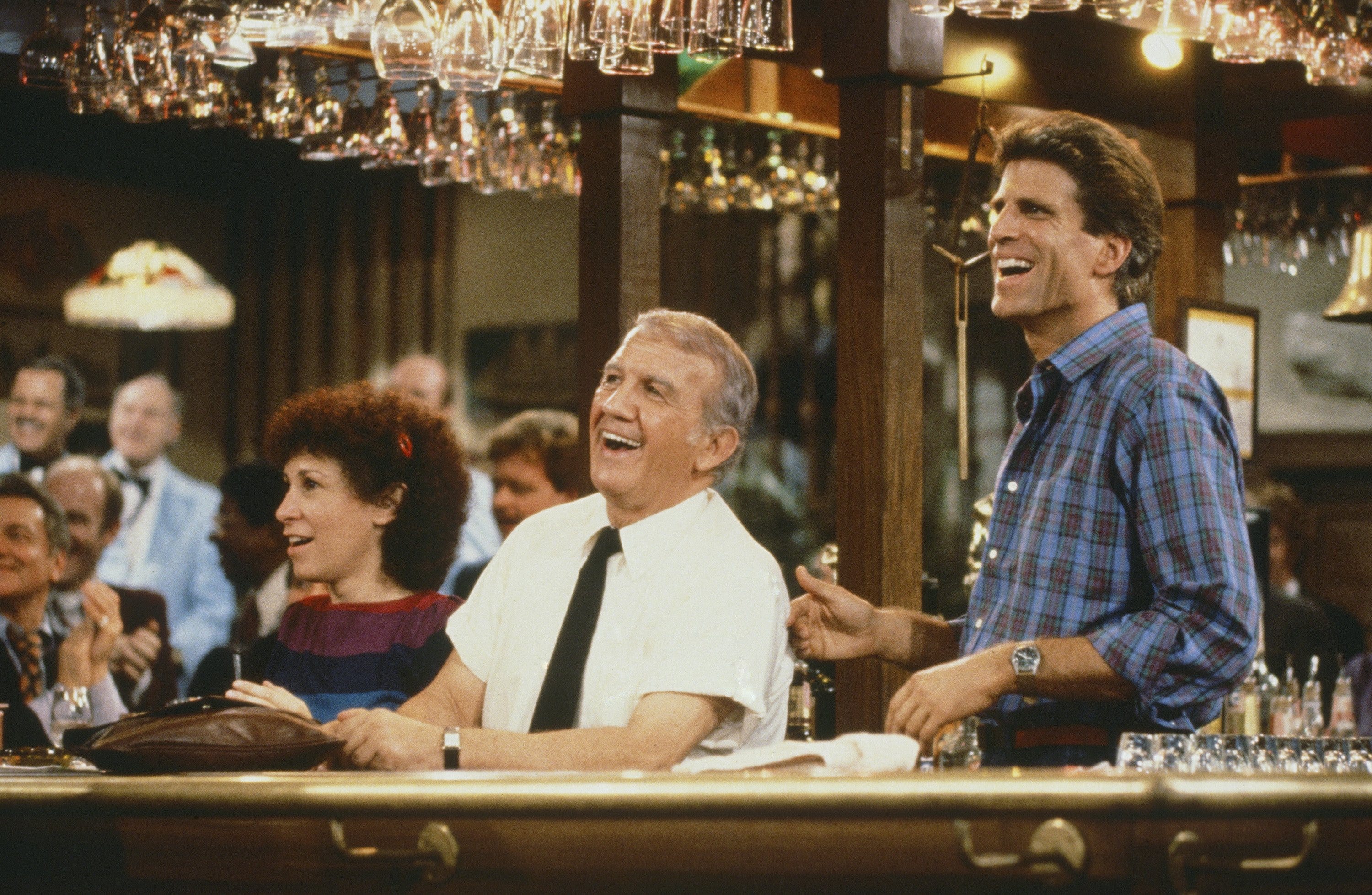
Cheers was a remarkably gentle show.
Rewatching the first few episodes of the venerable sitcom from 1982, the writers’ aggressive refusal to be aggressive is positively startling. Today, the aesthetics and approach of television and film have largely fused; sitcoms like Santa Clarita Diet and The Good Place (also starring Ted Danson) are high concept, sexually frank, foul-mouthed, and not infrequently gory. The giant giraffes on the loose in The Good Place, or the projectile vomit erupting from Drew Barrymore in Santa Clarita Diet seem to have escaped from Monty Python’s The Meaning of Life, rather than from sitcom history past. Even the studiously unadventurous network comedy The Big Bang Theory exists in a post-Seinfeld, post-Simpsons world, where comedy is expected to make some pretense at hipness, no matter how feeble.
Cheers, though, leaned into its stodginess. The Big Bang Theory‘s theme music is a goofy, witty, fast paced song by alternative rock icons the Barenaked Ladies. In contrast, the famous opening jingle for Cheers by unapologetic hack Gary Portnoy is saccharine easy-listening, and it played over an opening montage of retro-images from the 1920s. “You want a place to go where everybody knows your name,” the inoffensive vocal warbles. That place you want to go isn’t just a location but a time. When you go down those stairs into Cheers, you’re stepping into your grandpappy’s shoes.
The plots and gags of Cheers are resolutely low key and heartwarming. The first skit in the series shows an obviously underage kid trying to buy a drink from Sam Malone (Danson.) Sam rebuffs him, establishing his bona fides as a responsible quasi-patriarch. In the fourth episode, actor Harry Anderson shows up as “Harry,” a friendly con man who pleasantly fleeces bar patrons out of ten or twenty dollars at a pop. No one tries to call the police on him or punch him in the face. Instead, his shenanigans are treated as a friendly eccentricity. He’s a lovable rogue—and you can tell he’s a lovable rogue and not a scary gangbanger or a superpredator because he’s white and dresses like he’s strolled out of a Frank Capra film.
It’s not just Harry who’s white. There are no black people in the main cast, though the bar is located in Boston, and though Sam is supposed to have been a pitcher in the major leagues, where he presumably would have had many black colleagues. One of the gags in the early episodes involves a father upset because his son is marrying a Black gay man. Coach (Nicholas Colasanto) encourages him to be tolerant and accepting, but that advice apparently doesn’t extend to the show’s own hiring practices.
The one source of tension in this idyllic retro rest spot is gender politics. New waitress Diane (Shelley Long), is a well-read intellectual and an (aspirational) member of the upper crust. Sam, as the bar owner, is wealthier than her, but anxious that her accomplishments mean that she’ll look down on him and on the less accomplished women he tends to date.
Enlightened women are out of place in Cheers‘ nostalgic milieu, and that disconnect provides much of the show’s ongoing tension. In the show’s fourth episode, Sam kisses Diane for the first time. She immediately tosses him onto the billiard table in a karate move. She explains, sheepishly, that the reaction was automatic; she learned it in a course on “Practical Feminism.” Feminism stands in the way of the show’s romantic plot arc—which is unfortunate insofar as Diane seems to wish she hadn’t acted so hastily, but fortunate, since otherwise the series would have ended almost before it began.
The series did not end; it went on and on and on—with eleven seasons and 275 episodes, it remains one of the longest running sitcoms in history. It’s easy to see the show’s appeal. Watching it is restful and undemanding; all the characters are likable and nothing too bad ever happens. “You want to go where people know, people are all the same,” the jingle says. We all empathize with each other; we all share a common humanity. It’s nice.
The niceness, unfortunately, is predicated on the sameness, which in turn requires that people who aren’t the same are ignored or forgotten. Way back in the early 1980s, when Boston was roiled by racist riots and protests against school desegregation, Cheers was nostalgic for that time when America was great, friendly, and untroubled. There was never such a time, of course. But the dream that there was sells “Make America Great Again” baseball caps, and everything that goes along with them.
—
This piece first ran on Splice Today.
Insightful naming of the clear success and unspoken failures of that show of conformity.
Reminds me of golf, or going fishing -- men being 'busy' while doing nothing.
Sure, it was inoffensive, but you couldn't get a sitcom on network television in the 1980s by being controversial or "real". And it should be said that dramas were allowed to be "real" in a different way- for the first part of its run "Cheers" aired on the same NBC Thursday schedule as "Hill Street Blues", which rewrote all of the rules for TV cop shows by being extremely "real". You might say "Cheers" was originally intended as an appetizer for that main event....
Sitcoms of the 20th century were expected to be predictable, because their three-act narrative structures and live-in-the-studio taping processes did not allow for a great amount of experimentation. While Norman Lear ("All In The Family", etc.) managed to produce "realistic" sitcoms in the '70s, that production approach wore out its welcome by the end of that decade, and "Cheers" was a product of that backlash era.
The more experimental sitcoms of the 21st century are entirely products of a system where cable and streaming usurped a great deal of the audience of network television, chiefly by exploiting the fact that they were not bound by the same legal restrictions that the network were. But in the 1980s producers were forced to do as they were told to do by the networks because they had no other options, and what resulted is a reflection of that deal-with-the-devil compromise.