

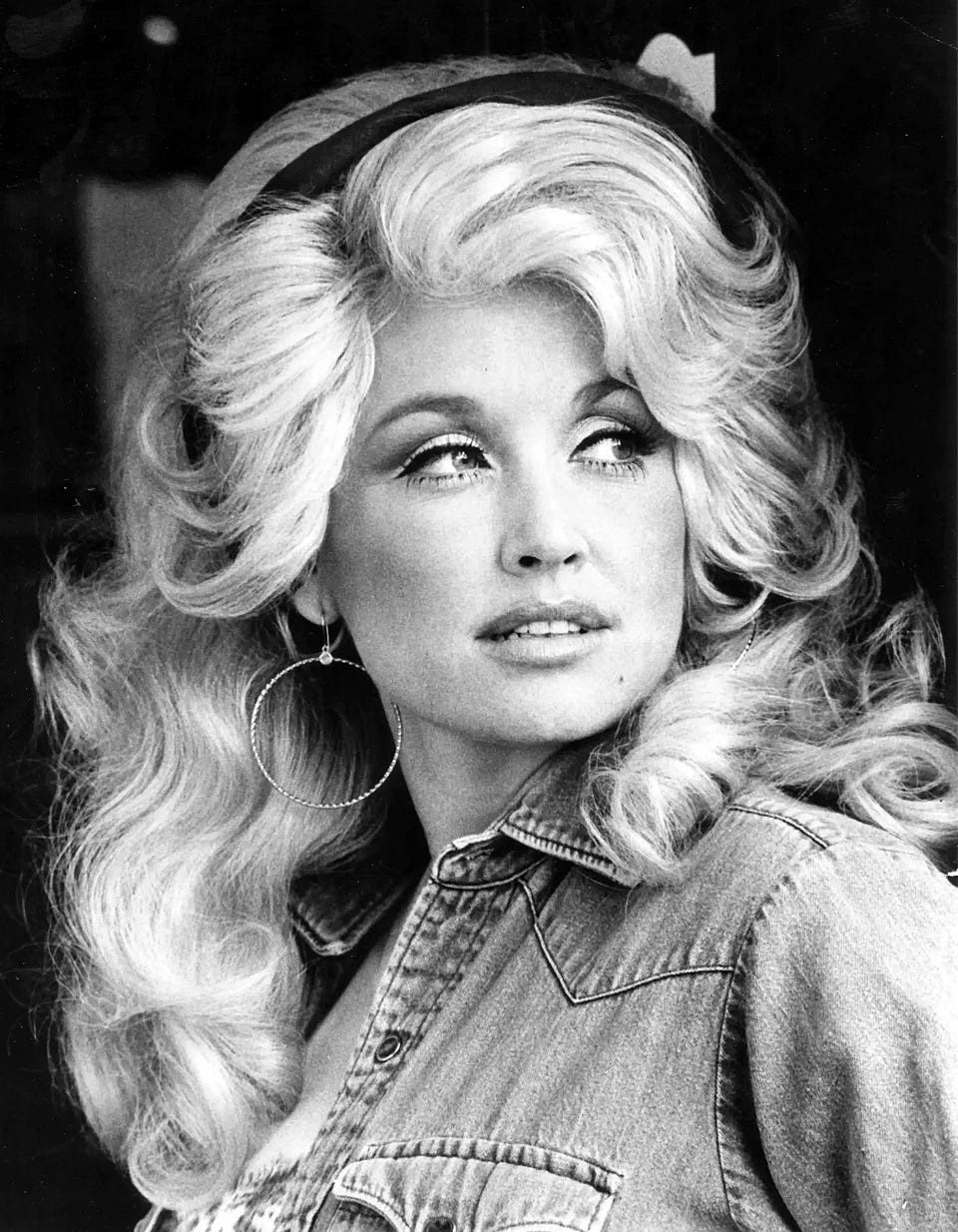
Dolly Parton, universally beloved singer, songwriter, and philanthropist, died earlier this month at the age of 80. Virtually everyone with a platform lined up to (rightfully) mourn her passing. Rap star Eminem shared a heartfelt message from Parton congratulating him on his induction into the Rock and Roll Hall of Fame; Democratic Senate minority leader Chuck Schumer praised her, as did Republican House Speaker Mike Johnson.
And in his usual fashion, Donald Trump made Parton’s death all about him, musing that Parton, “really liked me.” But, he insisted, she “wasn’t a very political person.”
—
The Everything Is Horrible sale ends today! It’s 40% off, $30/year. If you value my writing, please support me so I can keep scribbling.
—
Many people have weighed in to point out that Trump’s comments are nonsense. Parton was not apolitical. Nor could she be said to have “transcended politics” as the Washington Post claimed. On the contrary, and just for starters, she was a tireless and passionate advocate for LGBT people and a major donor behind development of the Moderna Covid vaccine. As writer Charlotte Clymer said on social media, “Parton’s art and life’s work were about interrogating power + amplifying the powerless.”
Clymer added, “You only think she wasn’t political because she did this by example, not bullshit slogans.” And while I think this is true in some sense, I don’t think it’s the whole story. Rather, what I would say is that Parton’s politics don’t register as politics because she was not partisan. She did not endorse candidates; she did not criticize presidents or political figures. Her political statements were couched in terms of universal acceptance and uplift for everyone. As a result, she called everyone—Democrats and Republicans and people who don’t care about Democrats or Republicans—to their better selves.
Parton is an important demonstration of why nonpartisan political engagement is valuable and powerful. But she also shows why it is very difficult to negotiate politics in a nonpartisan way—and why it is impossible for many people.
Dolly was amazing, and to understand why she was amazing we need to understand how she leveraged her identity and her commitment to politics in very specific ways. Those ways are unique and valuable. But I think we should also be careful not to toss partisanship aside altogether for everyone, as practice or as idea. Especially, and perhaps unfortunately, not right now.
What’s the difference between politics and partisanship?
In common usage politics and partisanship are often treated as indistinguishable from each other. Politics is partisanship is elections and advocating for electoral victories. Politics is partisanship is the people who run for office and the people who support them. People who care about politics are partisan and vote, donate to candidates, run for office, and/or advocate for issues in a partisan electoral context by pushing Democrats and Republicans to pass or block legislation.
But, as Parton shows, partisanship is not in fact the entirety of political life. Politics can also involve advocating for issues and pushing for change in ways that don’t intersect directly with political parties or elections.
For example, in 2011, a lesbian visitor at Parton’s Dollywood theme park said an employee made her turn a marriage equality t-shirt she was wearing inside out. Parton quickly apologized and sent the woman a refund, stating that “Everyone knows of my personal support of the gay and lesbian community.” She reiterated that everyone was welcome at Dollywood.
This is obviously political; LGBT rights have been a major partisan issue in US politics for decades. But Parton’s stance wasn’t really partisan. She didn’t condemn Republicans (or Democrats, for that matter). She didn’t call for legislation. She made a statement about her own views and about the policy of her park and business. She was leading by example, not by electoral advocacy, and certainly not by anti-Republican talking points.
Parton’s philanthropy was also determinedly political but non-partisan. One of her biggest initiatives was the Imagination Library—an initiative founded in 1988 which provided free books to children. She also offered $500 to every 12-14 year old student in Sevier County, where she grew up, if they graduated high school. Drop-out rates dropped from 35% to 6%.
Parton’s most recent commitment was to fighting Covid. She rewrote the lyrics of her iconic song “Jolene” and sang, “vaccine, vaccine, vaccine, vaccine, I’m begging of you, please don’t hesitate.” She did television spots filming herself getting the shot. “I’m old enough to get it and I’m smart enough to get it,” she said.
Vaccines are (not coincidentally!) an almost classic example of the crucial important of non-partisan politics. Public health requires mobilizing people in large numbers. It requires cultivating a commitment to the public good. It requires government action and it requires government propaganda—people need to understand that vaccines are trustworthy and they need to be disabused of disinformation and conspiratorial nonsense. All of that is highly political.
In this case, though, political ideally would not be partisan because vaccination requires the participation of everyone. You do not want a pro-vaccine party and an anti-vaccine party, because that means that suddenly you have millions of people whose partisan identity requires them not to get vaccines, which endangers their lives, the lives of their children, and everyone else’s lives as well. The fact that the right has turned public health from a political issue into a partisan issue is a public health disaster, which is killing children and will likely do untold harm for decades, or longer.
Parton is nonpartisan in ways few could be
Parton’s non-partisan politics were aimed, specifically, at trying to encourage everyone, regardless of party, to protect themselves and their neighbors from a horrific pandemic. And she was uniquely positioned to make that argument for a range of reasons. First, she was a remarkable person, who did really seem to want to help and protect everyone. Second, though, her partisan identity markers allowed her to speak for virtue to communities whose partisan affiliations have unfortunately become increasingly fascist.
Parton grew up extremely poor in a rural white community. She became a star at a young age—she was performing on radio at age 10 and recorded her first single at 13—and remained a visible and beloved country music icon for the next 70 years. She kept connected to her Tennessee roots through philanthropy and through her songwriting even as she became a Hollywood star and recorded crossover material. Like few other figures in US culture, she belonged to the whole country even though (or because) she continued to belong specifically to the Smoky Mountains and to white (though never for her just white) rural America.
As a result of her background, her history, and her careful and passionate commitments to particular communities (very much including LGBT people), Parton was in a unique position to endorse political issues like LGBT acceptance, education for the poor, and vaccines in a non-partisan way which could reach people who, as partisans, opposed all those things.
We need partisanship too
Parton’s non-partisan politics are vital and incredibly important; there is no doubt (as just one example) that her vaccination advocacy saved the lives of many people from families who might have otherwise listened to asshole elected Republicans and refused vaccination.
However, understanding how Parton managed her non-partisan politics also, I think, makes it clear that not everyone is in a position to do what she did. That’s partly temperament. But it’s also about identity.
Beyoncé, for example, is a very different person than Dolly Parton in a whole range of ways. She does, however, contribute a good deal to philanthropic causes; she’s donated school supplies to low income districts and provided millions in mental health relief during the pandemic.
She’s also tried to reach out to country music audiences—not least by covering Dolly Parton’s “Jolene” with an assist from Dolly herself.
But the country music industry not very subtly snubbed her, and she is very much not seen as a bipartisan figure. That’s in part because she has not tried to be; she is friends with the Obamas and endorsed Kamala Harris. But it’s also because she’s a Black woman, who no doubt realizes that non partisanship is not really an approach that Republicans will let her choose.
Another example is Lady Gaga. Like Parton, Lady Gaga has made LGBT acceptance a core part of her public advocacy. Her Born This Way Foundation is committed to advancing the mental health of young people (a non partisan political goal!) and provides grants to LGBT orgs as well as other causes.
Like Beyoncé, though, Lady Gaga is a partisan figure who has endorsed Democratic politicians and has denounced Trump repeatedly. To some degree that is her own choice. But it’s also true that as an out queer woman, Gaga’s advocacy for LGBT people was always going to be perceived in a much more partisan context than Parton’s statements—even when that advocacy is framed around something as nonconfrontational as mental health help for young people.
This is not to take away from Parton’s accomplishments, which are, again, numerous and inspiring. But I think it’s important to realize that stepping outside partisanship is not possible for many people because many people’s identities are seen as partisan statements in and of themselves.
More, recognizing that for many people partisanship is inescapable helps to show why non-partisan political action—as powerful and admirable as it can be—cannot unfortunately be the only approach to politics in our present moment. As I’ve discussed before, non-partisan politics, or bipartisan politics in the US has often in the past meant a broad bipartisan agreement on white supremacy, in which (at least for white people) Black subjugation was viewed as a common sense measure, not to be seriously debated in elections or between the parties. In a country where the nonpartisan default has been white supremacy, creating an antifascist partisanship is an absolute necessary (though not sufficient) step towards equality and freedom for everyone. When Bad Bunny or Bruce Springsteen denounce Trump and Trump policies, they’re using their celebrity for partisan purposes, and that’s admirable and good.
Parton’s achievement, then, wasn’t in pursuing nonpartisan politics over partisan politics; simply refusing to be partisan is not a virtue in itself. Rather, the reason she did so much good is that she identified areas where her resources and her carefully cultivated position as a nonpartisan figure would allow her to advance particular causes—LGBT acceptance, children’s literacy, vaccine development, vaccine uptake—in a way few others could. That took decades of unwavering commitment, careful strategy, and moral commitment. Everyone can’t be Dolly, and I don’t think everyone should be Dolly. But everyone can be inspired by a public figure who figured out her path and used it to do so much good.
One reason I think she was able to leverage her position as much as she did was, as someone on bluesky pointed out, she very visibly represented the "good" parts of stereotypical southern culture. She was witty, down to earth, kind, and generous. Most importantly though, it came across as *genuine*.
Olivia Rodrigo is another example in that she just did a concert event to benefit women's organizations. I haven't followed it or Rodrigo closely but I haven't seen her take on an overtly partisan tone or stance on anything, even though it's very much about supporting abortion. I guess you can argue abortion is about the most partisan issue possible. But I haven't seen much that explicitly talks about abortion in public statements. So it seems like she's following Dolly's path and isn't afraid that it could become partisan.
I just googled it to see if I'd missed her being partisan in any way and I thought I'd check the FoxNews link since they'd be likely to jump on any partisan statement and critique her. But their story about it is entirely uncritical: https://www.foxnews.com/entertainment/melinda-french-gates-stuns-festival-crowd-pledges-match-olivia-rodrigo-fundraising-20m-haul. Granted, none of the publicity I can find explicitly talks about abortion. So she might have made it easy on partisan media to avoid it. But several on the list of organizations being donated to are pretty clearly related to abortion and she still managed to get partisan media to cover it in a non-partisan way, even with organizations like Planned Parenthood being mentioned in their piece.