

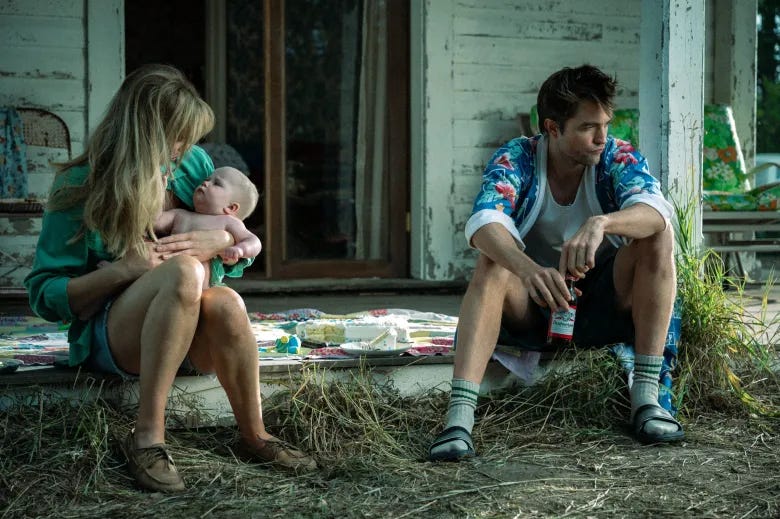
Lynne Ramsey’s Die, My Love is one of those Oscar bait films that is so focused on giving the stars a chance to display raw trauma that it forgets to bother with having a point, much less a plot. The movie is sort of about post-partum depression, sort of about marital infidelity, sort of about mental illness—but it is too busy having Jennifer Lawrence behave badly and take off her clothes to settle on any one option.
The clothes-shedding is supposed to indicate emotional nakedness, but the refusal to commit to theme inevitably is also a refusal to commit to character. The biggest failure of the film is that, for all her impassioned scene-chewing, Jennifer Lawrence never stops being Jennifer Lawrence, super star, emoting for the awards committee.
The film starts with Jackson (Robert Pattinson) and writer Grace (Lawrence) moving to Montana from New York. Soon afterwards they have a baby, and their happy-go-lucky relationship turns into a metastasizing nightmare. They cheat on each other; they scream at each other, Grace shoots Jackson’s dog (which was probably dying?) and walks through a plate glass window. Jackson eventually has her committed, which looks like it may improve things, and then doesn’t. The end involves Jennier Lawrence naked (again) and a lot of flames. Which are symbolic. Get it?
Critics have leaned towards interpreting the film as an examination of post-partum depression—a more downbeat version of Nightbitch, perhaps. But it’s a strange case of post-partum depression that leads to a radically increased sex drive, and which appears to have nothing to do with anxiety about the baby—Grace tells a therapist that the kid is the one thing in her life that’s perfect, and the movie pretty much bears her out. She seems much more manic, enraged, and nymphomaniac than depressed. In an earlier era, you might have described this as a depiction of hysteria—and the film unfortunately flirts, and more than flirts at time, with the sexist implications about unnatural women that that term implies.
Admittedly, mental illness isn’t always easy to put into a particular diagnosis or box. But Die, My Love seems to want to have it both ways, portraying Grace as increasingly erratic and destructive while vaguely implying the cause is motherhood or marriage or isolation or sexual frustration or grief at the death of her parents or some personal or social cause. As just one example, the film shows numerous scenes which indicate that Grace may have a serious drinking problem. But no one, not even her therapist, ever suggests that sobriety might significantly reduce her misery.
For sure, Grace has a husband problem too; Jackson stops having sex with her, in large part, it’s implied, because he’s on the road constantly and sleeping with whoever he happens to stumble upon in random diners. He also can be thoughtless—he brings a dog home without asking her, which is a shitty thing to do since Grace is the one who has to take care of it.
Again, though, it’s hard to tell if these are symptoms or causes. We see hardly anything of the couple’s life before things start to spiral out of control, perhaps because the whole point is to show the spiraling. But without any sense of the baseline, we can’t know when or where the betrayal started. We don’t even know if Grace’s own impulsive coupling with a neighbor she’s barely talked to is her first affair or one in a series. And while early on the movie seems to blame Grace’s breakdown on Jackson’s neglect and absence, as she becomes more and more impossible he looks more and more patient. Again, she shot his dog. He brings it up once in an argument. That really seems more than fair.
Pattinson and Lawrence have great chemistry together; there’s a lovely, magical scene near the end where they sing along together to a John Prine/Iris Dement duet and seem simultaneously exhausted with and radiantly in love with each other. They also are both great in the freak out scenes. Pattinson’s skull seems about ready to leap through his skin as he begs Grace to please stop lashing out; Lawrence’s cold contempt when cashiers and acquaintances attempt to jolly her along is a wonder of loathing.
But these fine performances occur in a vacuum. It’s like watching a series of acting exercises—technically impressive, but who wants to sit through two hours of keyboard scales, even by a top performer? If anything, the skill employed in the set pieces just makes the refusal to say anything or go anywhere more frustrating. Ramsey won’t even really commit to her surrealist impulses. I have some respect for the film’s ambitions, and a great deal of admiration for its leads, but I can’t in good faith recommend this. Die, My Love is an ill-conceived dud.
Thank you for watching this so I don’t.
Kind of like Opie Cunningham's version of HILLBILLY HYPOCRISY, an Oscar-bait movie so utterly misconceived that UK Film Critic Mark Kermode said of Amy Adams's performance as Vance's drug-addicted mother, "She seems to be addicted to those same 'Give Me an Acting Award!' Pills that Renée Zellweger overdosed on when she was doing COLD MOUNTAIN." 🤣 🤣 🤣