

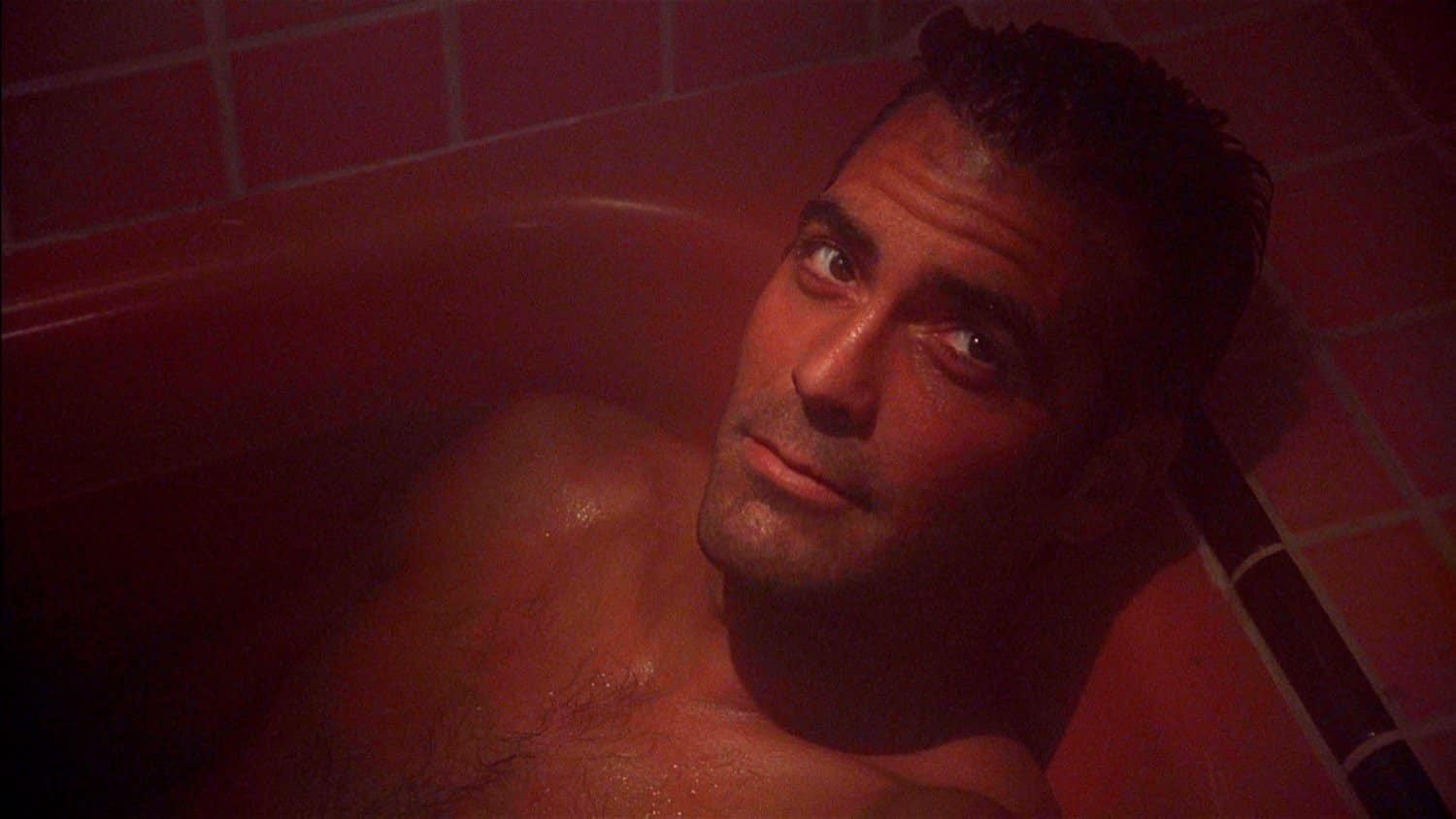
I saw Steven Soderbergh’s Out of Sight (1998) years ago, but the only scene I remembered before yesterday’s rewatch was the dream sequence. U.S. Marshal Karen Sisco (Jennifer Lopez), is tracking down bad boy bank robber Jack Foley (George Clooney.) She cautiously stalks into his apartment, gun out, and finds him soaking in his bathtub. “Hey you,” he says. She responds by putting her gun aside and getting into the tub, fully clothed. Then two of the hottest people in Hollywood precede to steam up the walls—until we cut to Karen in a hospital bed, waking from her (very sexy) reverie.
It’s clear why that sequence stayed with me while most of the rest of the film didn’t. Out of Sight is a fairly by-the-numbers genre heist film, inaugurating Soderbergh’s long, successful collaboration with Clooney and serving as a key turning point in his transition from indie auteur to reliable Hollywood helmsman of star vehicles. But the dream sequence, framing Clooney as an object of desire, harks back to Soderbergh’s Sex, Lies, and Videotape with its sympathetic, kinky exploration of women’s desire, filtered through (and enabled by) film. It’s worth the rest of the movie put together—not least because it reframes the rest of the film as a different kind of dream with different goals.
—
Everything Is Horrible is entirely reader funded. Please consider becoming a paid subscriber so I can keep writing essays like this one. It’s $50/year, $5/month.
—
Again, on first look, the picture is a pretty default exercise of its time. Jack Foley is a bank robber with a code who is almost immediately intercepted on his escape from a Florida prison by Karen Sisco. Jack and his partner Buddy (Ving Rhames), overpower Karen, and then Jack shamelessly flirts with her in the trunk of the escape car she is forced to share with him. She eludes him (and/or he eludes her), but they’re both increasingly attracted to each other, as they play a cat-and-cat game across the country, ending in Detroit where Jack attempts to make one last big score.
Like many a 90s heist outing, Out of Sight is powerfully influenced by Quentin Tarantino. Soderbergh borrows the achronological storytelling from Pulp Fiction, as well as Tarantino’s way with colorful, appealing, larger than life criminal fuck-ups—like White Boy Bob (Keith Loneker) a gigantic muscle of a man who keeps tripping over his own feet at inopportune times, or Glenn Michaels (Steve Zahn) a stoned petty thief who wears sunglasses even at night (with bad results when he’s driving.)
Tarantino’s 1997 Jackie Brown in particular is something of a sister film to Out of Sight; both are adapted from Elmore Leonard novels and both center on hard-as-nails women of color—Pam Grier and Jennifer Lopez respectively. Soderbergh even got Michael Keaton to briefly reprise his Jackie Brown role as FBI agent Ray Nicolette.
Jackie Brown is a superior film to Out of Sight in almost every way, from Grier’s performance to the much more originally and effectively imagined side characters, to the handling of racial dynamics. Jackie Brown capitalizes on the way that Black women are underestimated at every turn, while a range of white (and Black) men systematically and ludicrously trip over their own dicks. It’s a classic; Out of Sight, in contrast, is a pleasant knock-off of a classic.
For all its virtues, though, and for all its celebration of its title character, Jackie Brown’s erotics never exactly break from the action/heist male default. Men in the film are bumbling fuck-ups, except for the aging bail-bondsman Max Cherry (Robert Forster), who has a schlubby sexy cool, but is supposed to be very much overshadowed—in every sense, including attractiveness—by Jackie Brown. The movie is arguably an empowerment fantasy for women, but it’s not really framed as a romantic fantasy for women. That puts it on the same page with the rest of Tarantino’s oeuvre and with the generality of action films, in which strong men and strong women both tend to be eroticized with a male viewer in mind.
Out of Sight, though, works differently. George Clooney as Jack is appealingly masculine in a typical Hollywood hero way—competent, suave, well-dressed, charming. But while he’s certainly intended to seduce male viewers, the film makes it clear that it’s not mainly male viewers who he’s seducing. Jack is viewed over and over through Karen’s eyes, as she surveils him in multiple senses. In one scene, she’s staking him out in a hotel lobby when she sees him in an elevator as the doors open. He locks eyes with her and waves, and she freezes in what we’re supposed to read as an erotic fugue—the kind of frozen contemplation of beauty that Laura Mulvey describes as a quintessential hallmark of the male gaze.
In another even more telling sequence, Karen is in a hotel bar when a bunch of ad executives see her and, one by one, try to pick her up. She shoots each of them down with a mix of irritation and boredom. Then Jack shows up, looking like George Clooney, and she very much does not shoot him down.
This scene could be framed as a male empowerment fantasy; ie, you are the hero who gets Jennifer Lopez when all these other schmucks aren’t worthy. But that’s not how it plays. Karen’s perspective is prioritized, which means that you are with her as she’s turning down one guy after another. Most men, the film says—including surely most men in the audience—don’t rate. The fantasy is that you’re with Jennifer Lopez getting George Clooney, and only maybe secondarily that you’re with George Clooney getting Jennifer Lopez. The message for men, if they insist on seeing themselves as Karne’s suitors, is that only George Clooney is worthy.
It’s not that rare for an action/adventure films to deliberately offer eye-candy for women; the Daniel Craig Bonds were obviously very aware of women in the audience. But it’s unusual for a standard genre heist movie to so deliberately and insistently position female desire as its reason for being. Lopez’s largely flat affect doesn’t detract, in this sense, because, unlike in most romcoms, you’re not really supposed to fall in love with her. She’s just a stand-in for those watching, as the heist is just a pretext for a story about a woman—Karen on screen, the female viewer off—pursuing, catching, and possessing George Clooney.
You can see foreshadowing here, perhaps, of Soderbergh’s Magic Mike, or of the eroticization of Michael Fassbender in the recent Black Bag. In other films, though, like the execrable Side Effects, Soderbergh seems to virtually forget he’s got a female audience at all in his embrace of rank misogyny, while the Ocean’s films treat Clooney almost exclusively as a charming container for male bromance. Out of Sight is in that sense less a prototypical Soderbergh film than a happy confluence of some of his erratic interests—in heist films, in George Clooney, in the female gaze. It’s not an all-time masterful gambit, but to the extent the film smuggles Soderbergh’s indie film focus on female desire into a male big budget package, it does qualify as a suave and sexy sleight-of-hand.
—
I’m currently doing a series of posts on Soderbergh films at Splice Today. I wasn’t able to fit Out of Sight in , so I thought I’d write about it here. Check out the rest of the series though; last one is here.
"Jackie Brown capitalizes on the way that Black women are underestimated at every turn, while a range of white (and Black) men systematically and ludicrously trip over their own dicks."
This, of course, makes it similar to the many "blaxploitation" films Grier made in the 1970s, where her characters did very similar things. I expect that this was why film buff Tarantino decided to cast her as Jackie.
Good point about _Out Of Sight_
I'm curious if you've seen the Val Kilmer movie _The Saint_ which is not a very good movie but I remember being struck by several scenes which feel constructed as reflecting the female gaze, more or less.