

—
Everything Is Horrible relies entirely on subscription from readers. If you find my writing valuable please consider becoming a paid sub. It’s $50/yr, $5/month.
—
Genocide, we are taught by public discourse and Hollywood films alike, is a horrific, extraordinary crime, which describes extremes of human behavior committed by only the most evil individuals and regimes. Hitler and Stalin were bizarre psychopathic monsters; Hollywood’s Nazis in Schindler’s List or The Zookeeper’s Daughter are hyperbolic melodramatic villains, easily identified and condemned. Genocide happens over there, or in the past; it is a crime committed only in particularly terrible lands and times by people who are not like those of us living in more normal and decent milieus.
This idea of genocide as alien and uncommon is obviously both comforting and convenient. To recognize and condemn a genocide is to demand action to stop it. If genocides are distant and unusual, they have little relevance for our own politics and actions, and we don’t need to do much in response.
If you look at the actual definition of genocide, however, and start to think about cases, it is clear that genocides are not unusual and are not distant. Genocidal policies and acts are an accepted, and even celebrated aspect of US politics—certainly under Trump and Republicans but hardly confined to them.
Some have argued that recognizing a wide range of genocides dilutes the concept of genocide and distracts from the truly evil acts of atrocity we must focus on. But I think the evidence of ongoing atrocity suggests that limiting genocide to only politically convenient acts of horror simply normalizes violence and hate. It also allows us to demonize others and ennoble ourselves in ways that end up justifying further ugly and even genocidal acts. If we want to end genocide, we need to recognize genocide whenever it happens—even when it’s committed by allies, even if it doesn’t look like the Holocaust, even if it’s inconvenient.
The definition of genocide and Gaza
The UN definition of genocide is neither long nor complicated.
Article II
In the present Convention, genocide means any of the following acts committed with intent to destroy, in whole or in part, a national, ethnical, racial or religious group, as such:
Killing members of the group;
Causing serious bodily or mental harm to members of the group;
Deliberately inflicting on the group conditions of life calculated to bring about its physical destruction in whole or in part;
Imposing measures intended to prevent births within the group;
Forcibly transferring children of the group to another group.
Genocide requires intention and actions designed to destroy a “national, ethnical, racial or religious group “ group in whole or in part. The actions can include killing, harm short of killing, creating conditions designed to harm, preventing births, or kidnapping children. If you have those things, you have a genocide.
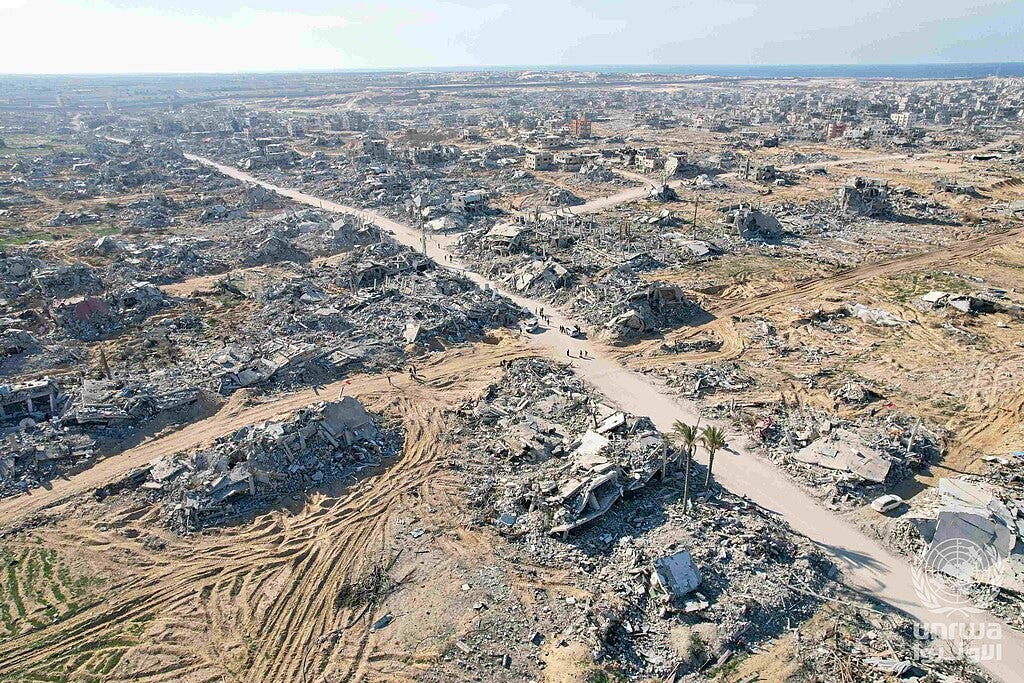
Based on this definition, Israel’s actions in Gaza are an open and shut case—and in fact, genocide scholars are in consensus that Israel’s actions in Gaza since 2023 constitute a genocide.
A UN commission laid out the logic. Israeli leaders clearly and repeatedly stated their intention to destroy the people of Gaza in whole or in part. Prime Minister Benjamin Netanyahu said Gaza was a “wicked city”—explicitly condemning the entire territory, not just Hamas or civilians. President Isaac Herzog said, “it’s an entire nation out there that is responsible. It is not true, this rhetoric about civilians who were not aware and not involved.” Brigadier General David Bar Khalifa told his soldiers, “We shall go out to it [the enemy] in war, we shall pulverize every accursed plot of land from which it came, we shall destroy it and the memory of it …”
These leaders frame Palestinian people in Gaza as evil enemies to be exterminated. When leaders use such rhetoric, it shows intent to commit genocide.
That intent has been backed up with actions. Israel soliders have killed tens of thousands of Palsteinians. As the report states.
From 7 October 2023 to 31 July 2025, 60,199 Palestinians were killed, of whom 18,430 were children and 9,735 were women. Reportedly, life expectancy (on average, both sexes combined) in Gaza decreased from 75.5 years for the year before October 2023 to 40.5 years during the first 12 months of the war, a dramatic decrease of 34.9 years of life expectancy (46.3 percent), almost half of the pre-war life expectancy levels.”
In addition to mass slaughter of noncombatants, Israel launched almost 500 attacks on healthcare facilities; it attacked evacuation routes and safe zones; it blocked humanitarian aid into Gaza. All this evidence, and much more, shows that Israel intended to destroy Gazans in whole or in part, and that it acted on that intent in bloody and horrific ways. That’s a genocide.
The “It could be worse” defense
Nonetheless, many Zionists and Zionist orgs—like the AJC—continue to deny that Gaza is a genocide. Often defenders will insist that Israel does not intend genocide—ignoring the actual statements of its leaders, or pointing to the designation of humanitarian safezones without acknowledging that Israel has often attacked those very safezones.
The AJC also suggests that most of those killed are in fact “terrorists”, and argues that the Hamas attack on 10/7 justifies a military response, no matter how brutal. Others insist that Gaza population figures have not fallen—an impossible claim to back up during the current chaos—and that it cannot be a genocide unless you have evidence of demographic collapse.
These defenses tend to spin off of, or run away from, the actual definition of genocide in order to argue from a kind of imagined limit case of genocide as completely successful and unaffected by any consideration such as, for example, efforts to finesse international condemnation. In a true genocide, the argument goes, more people must die; in a true genocide, there would be no effort to establish humanitarian zones, no matter how transparently bad faith; in a true genocide, all civilians would be dead; in a true genocide, the genocidal actors would never have suffered themselves in any way. This is not genocide because you can imagine more death, more mercilessness, more, more, more.
But the UN definition notably does not say, “genocides must be unprovoked.” Nor does it say, “to prove a genocide you must show population drops.” Nor does it say, “in a genocide, x number of people must be killed.” It doesn’t even say, “It’s not a genocide if you kill more terrorists than civilians.” All of these are irrelevant deflections which attempt to relativize atrocity by arguing that other atrocities—near or far—have been more genocidal. Genocide, from this perspective, is not defined by any particular characteristics, but by being worse.
What if we consistently applied that definition
Again, though, extremity is not in the UN definition. In fact, based on the UN definition, it is possible to have a genocide in which there is (relatively) little killing.
In California, for example, between 1909 and 1980, state institutions sterilized 20,000 people considered eugenically inferior on the basis of mental illness, disability, criminal conviction, or skin color. These people were defined as a eugenically inferior race, and the intent was to eliminate them in whole or in part by preventing births.
It is true that people were not killed; it is true that compared to other genocides (like that in Gaza) fewer people were affected. And it’s true that even discussions which condemn this atrocity (like this PBS account) generally do not refer to it as a genocide. But based on the UN definition, it clearly is.
Once you realize that genocides are not defined as, “the top few things I define as worst when done by someone else,” it’s clear that genocides are chillingly common. I’ve written before about why it makes sense to consider Musk’s cuts to USAID as a genocide.
As another example, the Lemkin institute has pointed out that the UK government and media have shown a pattern of intent to destroy trans and intersex communities, and have taken steps to isolate and eliminate them. The UN does not consider sexuality, queerness, and gender as group identities which can be targeted for genocide, but I would argue that that is a serious oversight. I think the Lemkin Institute is correct. The UK is moving towards, or already in process of committing, a genocide against trans and intersex people.
Trump’s policies towards trans people are similar. So are his rhetoric and actions targeting immigrants in general, and Somali immigrants and Haitian immigrants in particular. Trump has for example said that Somalis are “garbage” and that he doesn’t want them in the country. The terrifying ICE enforcement operation in Minneapolis was intended in large part to terrorize and expel Somalis, many of whom have been forced into hiding or who carry papers out of fear. That qualifies as “Causing serious bodily or mental harm to members of the group.”
Then there’s Trump’s genocidal threats against Iran, backed up by indiscriminate bombing of civilians. That’s intent coupled with killings. Again, people have referred to that as war crimes rather than genocide, but it seems you could make the case for the second as well as the first. And what about Trump’s refusal to provide disaster aid to Democratic states? That’s an intentional effort to inflict on a group (Democrats) conditions designed to bring about its destruction in whole or part. (Yes, Democrats aren’t generally seen as a racial or ethnic group—but racial and ethnic groups are largely culturally defined, and there are instances, like in Indonesia, in which political groups have in fact been targeted for what is generally understood as genocide.)
Nor are genocides confined to the US. Given Hamas’ past statements about Jews, the mass murder on 10/7 seems like it could count as a genocide. So does Israel’s treatment of Palestinians before 10/7.
This doesn’t mean that every atrocity or act of violence is a genocide. The coordinated right wing efforts in the US to prevent climate change mitigation will likely result in uncountable deaths, but the goal is corporate profits rather than eliminating any particular group. Mao’s Great Leap Forward killed between 15 and 55 million people through famine, but the intent was rapid industrialization. Though genocide scholars point out that those considered enemies of the state, like Tibetans, were often specifically denied resources, in what could be considered smaller genocides within a larger atrocity.
Too many genocides
I think there is a strong argument that genocides are quite common based on the formal UN definition. But what about the political implications? Would acknowledging genocide as a everyday evil make it less noxious? Does admitting the existence of more genocides make genocide harder to fight?
Debate around the Holocaust has sometimes centered on arguments such as this. Institutions, scholars, and Jewish leaders worry that labeling other atrocities as genocides dilutes the horror of the Holocaust. Thus, Israeli Foreign Minister Shimon Peres told Turkish journalists in 2001, “We reject attempts to create a similarity between the Holocaust and the Armenian allegations. Nothing similar to the Holocaust occurred. What the Armenians suffered was a tragedy, but not a genocide.”
Peres’ statement is now considered a notorious example of Armenian genocide denial. It was prompted in part by the fact that Israel wanted to retain Turkey as an ally, and also perhaps in part by Israel’s desire to use the Holocaust as unique validation for its own nationalist ambitions and actions.
The Holocaust was obviously unique in some ways; the scale of the carnage has rarely been rivaled. But using that uniqueness to deny other atrocities, or to refuse to recognize parallels with other atrocities, doesn’t reduce or combat further violence and genocide. On the contrary, as Peres’s comment shows, restricting the term “genocide” to a handful of iconic examples makes it (often intentionally) harder to recognize and condemn other genocides.
There is a parallel, perhaps, with discussions about rape and sexual violence. Everyone, just about, condemns rape. But what is rape? Rape denialists tends to insist that rape only occurs in certain situations and to certain people; it is only rape if a stranger assaults a woman who performs respectability in the correct way. To acknowledge that men can rape their wives or intimate partners, to admit that sex workers can be raped, to suggest that sexual assault is fairly common rather than the work of a few easily identified and punished individuals, supposedly dilutes the charge of rape. Thus, people will often shame or attack victims in the name of other, supposedly purer and more authentic victims, just as Peres denies the Armenian genocide in the name of a worthier and more authentic atrocity.
Feminists have used the term “rape culture” to express the way that rape is not an unusual aberration, but is instead broadly erased and accepted by government, law enforcement, elites, and families. Along those lines, we might think about the US (and obviously not just the US) as a “genocide culture,” in which massive targeted violence against demonized groups—defined by race, class, gender, sexuality, politics, nationality, carceral status—is broadly accepted and condoned.
I am not arguing that people should stop focusing on Gaza and should instead start focusing on some other genocide. I am instead arguing that part of the value of the Gaza protests has been that it has demonstrated just how resistant many people are to seeing very obvious genocides when those genocides are politically inconvenient, or target people that are seen as lacking moral stature, or are perpetrated by people with whom we identify.
We are often very comfortable with genocide. We should become less so—and that means in part recognizing that genocide is woven into our politics and our lives in chillingly familiar and intimate ways.
No mention of Russia and Ukraine?
You hit my primary thoughts regarding genocide and Gaza. First, the Holocaust is unique among genocides, largely because the killing was industrialized. The efficiency of killing sets it apart. Secondly, the situation in Gaza resembles the Armenian genocide more than any other historical event I can think of. Unlike less typical events like the Holocaust or California’s eugenic sterilization, what the Turks did to the Armenians is fairly textbook for historical genocides. Israel’s actions and apparent goals in Gaza are almost a perfect match for that.