

Mainstream blockbuster films are staggeringly unadventurous in plot, theme, and character development. This is no surprise; they cost the GDP of a small island nation. THe goal is to make back the money by giving people the things they have liked before in a new big shiny package.
It is what it is. But there’s something especially grating about it when the film insists that it is in fact exploring new vistas or rocketing off to new and exciting territory. That was the case with Christopher Nolan’s tediously smug Interstellar. And it’s the case with Interstellar’s spiritual successor, the tediously smug Hail Mary.
Like Interstellar, the plot here involves a near future apocalypse, this time caused by an improbable microscopic lifeform of uncertain origin that eats sunlight. And as in Interstellar, there’s one charistmatic white guy who can save the world—this time played by Ryan Gosling.
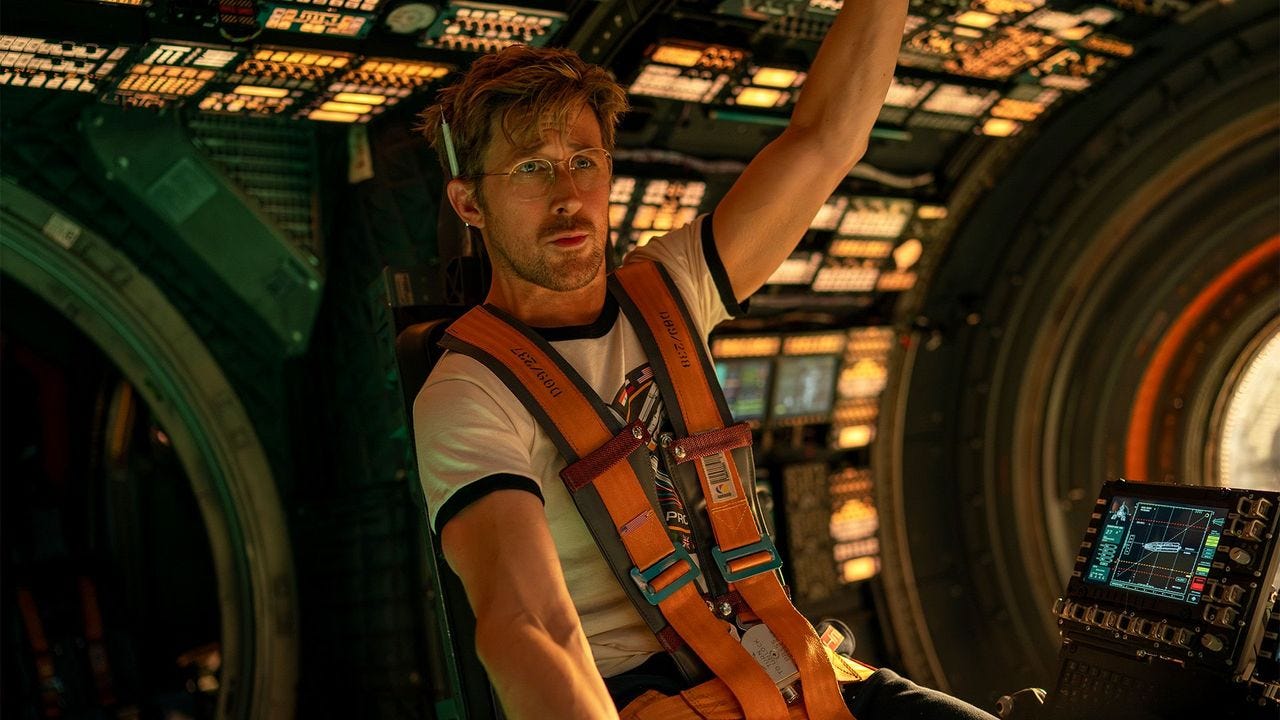
The film does sub in some different tropes. Gosling’s character, Dr. Grace, is not a he-man adventurer; instead he’s a wounded underachieving exo-biologist stuck teaching middle school science. The movie opens with Grace already in space; one of his first lines is, “Am I smart?” His time in a medically induced coma for space flight left him with the usual convenient plot amnesia. But the statement is also a succinct summary of his own charming self-doubts; as we see through the usual flashbacks, Grace doesn’t think he’s smart enough, or brave enough, to accomplish the mission on behalf of the oddly harmonious international save-the-earth science consortium.
Of course he’s wrong; despite his bumbling and whining, it turns out he is the absolute perfect person to engage in first contact with cute rocklike puppet alien Rocky (James Ortiz) and do all the science and stunt stuff needed to save multiple worlds.
Or I should say, because of his bumbling and whining. Hail Mary puts enormous energy into convincing you that Grace is an underachieving slub just like (white, male) you watching in the audience. The amnesia is part of the mechanism of identification; he doesn’t really know who he is or how he got here, which puts him in the position of you there watching the movie, finding out who he is (and who you are!) as the plot unfolds. In addition to this cognitive deficit, the film throws in his career failure, his lack of self-confidence, and his extended refusal to be a hero or accept the mission; he’s literally forced aboard, just like you are thrown into the film.
The remorseless pandering to the absolutely most stereotypical fan of SF adventure is dreary. So is the Golden Age Asimovian faith in the wisdom and courage of coordinated experts and leaders, as if the last ten years of world leadership never happened. So is the Spielbergian friendly extraterrestrial, who is visually and behaviorally no more disturbing or alien than a Disney mascot. Differences, even with a xenon-and-ammonia-based lifeform, are all surface—beneath that rocky exterior, every one of us is a rational good liberal, committed to the same mission of helping the white guy save the world and self-actualize. So committed that multiple non-white, non-male characters are killed off so Grace’s melodrama can be all the more dramatic.
The phrase “Hail Mary” indicates a last ditch, crazy ploy to save the game. It’s supposed to connote the excitement of extending yourself, doing something crazy and brave because there’s no other option. But in Hollywood, the hail mary is always the same, safe move, as movie after movie insists that forever in to the future, even at the end of the universe, the same hero will do the same thing over and over again, supported by uplifting music and a rotating cast of less important and suitably deferential companions. Hollywood keeps telling us this is bravery. No wonder now, when courage is so desperately needed to stand up for people who don’t look like Ryan Gosling, it is in such short supply.
As I watched 'Interstellar' I kept waiting for all the 'new ideas' everybody had been talking about to show up. They never did. Not even close. Just the same old dreck, as you describe here. I gave up hope that the movie would challenge me in any way (as, for example, space films as different as '2001' and 'Alien' — and even the absurd 'Silent Running' — did) during the montage when the interstellar space ship passes all the planets in sequence — they just happened to be perfectly aligned, imagine that! That was kindergarten stuff.
I wonder if you have any comment on two other fairly recent & much-hyped SF movies: Dune ('Rom-Com on Arakis') and the fascist & deeply stupid Blade Runner 2049. (Both were directed by Denis Villeneuve. I was surprised by how crappy they were, given how good I thought 'Arrival' and 'Sicario' were.)
"Hollywood keeps telling us this is bravery. No wonder now, when courage is so desperately needed to stand up for people who don’t look like Ryan Gosling, it is in such short supply."
This essay was so enlightening for me. Entertainment without challenging established social role/orientation assumptions = profit; not social change.
Time for another book?