

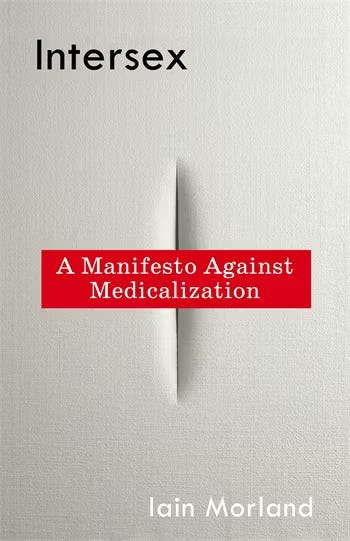
In his new book Intersex: A Manifesto Against Medicalization, British scholar Iain Morland remembers discussing his research and studies with his graduate school housemates. When he showed them papers on intersex surgery, the illustrations, he says, “elicited sharp intakes of breath” and other expressions of distress and pain. None of Morland’s housemates had had such surgery themselves. But they recognized it as violent and distressing.
For Morland, this recognition is something to think about and listen to. “A world in which intersex surgery happens,” he argues, “Is an uncomfortable world for everyone.”
Despite the fact that even the words “infant genital surgery” make people uncomfortable, despite the testimony of intersex people like Morland who have been advocating for decades now, and despite widespread condemnation of these procedures by human rights groups and medical organizations, intersex surgery continues.
—
This essay was written for another outlet, but they ended up not using it. This happens for freelancers; the newsletter helps ensure I can publish such things. But to do that I need your support; if you’re not a paid subscriber, and you find this piece valuable, please consider joining; it’s $50/yr, $5/month.
—
Statistics are hard to come by since there are a range of intersex conditions and no standard reporting requirements. But advocates and medical practitioners agree the practice remains common. “The medical management of intersex is ubiquitous and routine throughout the contemporary industrialized world,” Morland writes—and that medical management typically starts with genital surgery.
“It’s really frustrating,” Morland told me in a Zoom interview. “We’ve seen strides in adjacent areas, transgender care being the obvious one. And generally over time, societies get more liberal. Yet [intersex surgeries] seems to have just stuck in this 1970s doom loop, where the medical practices are largely continuing.”
Morland doesn’t have easy, straightforward answers to explain why it has been so difficult to change the practice. But in his book, and in his discussion with me, he pointed to a number of factors that has made it difficult to stop surgeries.
The first is the idea of “normality.” Parents and surgeons, Morland says, believe that children with intersex genitals will not be accepted or will face teasing or ridicule. Parents may also dread having to talk about genitals or sexuality with their child; they hope surgeons can simply fix things and then they will not have to think about it.
There are numerous problems with this framework, but one big one, Morland says, is that surgery cannot do what it claims. “The surgery is done, and [parents] think ‘our child is now normal,’” Morland told me. “And with that kind of frame in place, they don’t see the abnormality of what they’ve done. You don’t end up normal. It’s not normal to have childhood genital surgery. That’s a really abnormal thing to have happen to anyone.”
Morland writes in his book that in his case he was teased in a locker room because of his genital scarring—the result of the surgery that is generally defended specifically as a way to prevent locker room teasing. Surgery can also result in loss of sensation, Morland writes, and in other complications that require follow up surgeries.
In discussions about intersex surgeries, advocates tend to focus blame on doctors and surgeons; parents are often framed as ignorant or as being bullied into consent. But Morland thinks parents often bear some culpability as well.
Morland reproduces quotes from parents of intersex children: one parent says that the surgery is necessary because the child will never be “accepted for who she is,” another said they wanted the surgery because they did not want the child to “decide for his self.” In one case, a family had an intersex child who experienced numerous complications from surgery. Nonetheless, when they had another intersex child, they opted for surgery again.
Parents also continue to treat intersex as shameful, unspeakable, and dangerous after they leave the hospital. Morland quotes one parent who said after surgery, “we don’t even talk about it anymore.” But of course the silence does not make the surgery or the intersex condition go away. “Whether it’s medical examinations or surgery or yes, it could be comments in the locker room,” Morland told me, “there are experiences the child is having, and then they’re not given a framework for representing that to themselves or talking about it with others.” Children who know that there is something unspeakable about them may feel confused, mistrustful, or ashamed.
Part of the reason that evidence of harm is ignored is that parents want to ignore it. But part of the reason is that doctors handwave the evidence away by referencing what Morland describes in his book as a “narrative of medical progress.” Surgeries, they claim, are always improving; therefore past patient complaints are not relevant.
“The analogy I would use is around female genital mutilation,” Morland told me. “If you said, ‘I’m in favor of FGM,’ and someone said to you, ‘How can you possibly be in favor of FGM? That’s outrageous.’ And if you replied by saying, ‘Oh, mutilation is really good, now’— no one would say, ‘Oh, now you’ve won the argument.’” The narrative of medical progress doesn’t just defer any reckoning with harms, Morland says; it also makes the issue one of technical competence, rather than focusing on what Morland told me are “more fundamental questions around patient autonomy and rights.”
The idea that children have rights that exist separate from, or in opposition to, parental choice is always fraught. Children in the US do not have a right to vaccination for example; parents can deny their children tested, life-saving vaccines, and more and more of them are doing so—which is why we are in the middle of a terrifying measles outbreak. The Trump administration is currently attempting to block trans care even for children whose parents support them. But even absent state interference, parents can and do prevent trans children from receiving gender affirming care. They can even prevent them from receiving puberty blockers.
Parental and state decisions about medical care for children are powerfully shaped by ideas about normality. Hospitals have quickly retreated from offering trans care under pressure from the administration, starkly highlighting how impossible it has been to get those same hospitals to stop unnecessary infant intersex genital surgery.
Doctors (and often parents) are quick to embrace medical interventions when they involve upholding perceived gender normality. They’re quick to abandon them when they don’t. In either case, the assumption is that children have value to society, or to their parents, only if they fit into particular boxes. A child will not be “accepted for who they are” if who they are is outside the norm, so it is up to the state, parents and doctors to make them fit the norm, through surgery or denial of care, whichever is required.
The problem, as Morland’s book makes clear, is that neither state laws, nor parental desire, nor surgical intervention, can banish difference from the world, or from the individual. When only normality is acceptable, a lot of people, differing from one another in lots of ways, are going to suffer. That’s why as Morland says, a world in which intersex people are brutalized is an uncomfortable, painful world for just about everyone.
Not adding much here, but even circumcision is excused away as making a child look "normal."
Great piece. I do think parents want neat boxes that their kids fit into. Otherwise things are complicated. It’s also hard to stand up to doctors, who sometimes act like gods. At the very least, they act like they are the authority. If being intersex is presented as a deformity or disability, I can see parents feeling pressured to “fix it.” Everyone (mostly) wants their kids to be happy, healthy, and free of pain.
Our society will be much better off when we can recognize that children may not be in a position to make life-altering decisions when they’re young, but they will grow up, and can make the decision then. I stood up to my husband on circumcision, (we’re not Jewish) saying I’d pay for it if our son wanted it when he was old enough. (We were really young when we had him.) Later, my husband admitted that I made the right choice. Just because we’ve always done something isn’t a good reason to keep doing it!
There needs to be a reasonable line somewhere about non-life threatening medical conditions that parents don’t get to decide for their kids. I don’t see it happening anytime soon though. People act like they own their children.