

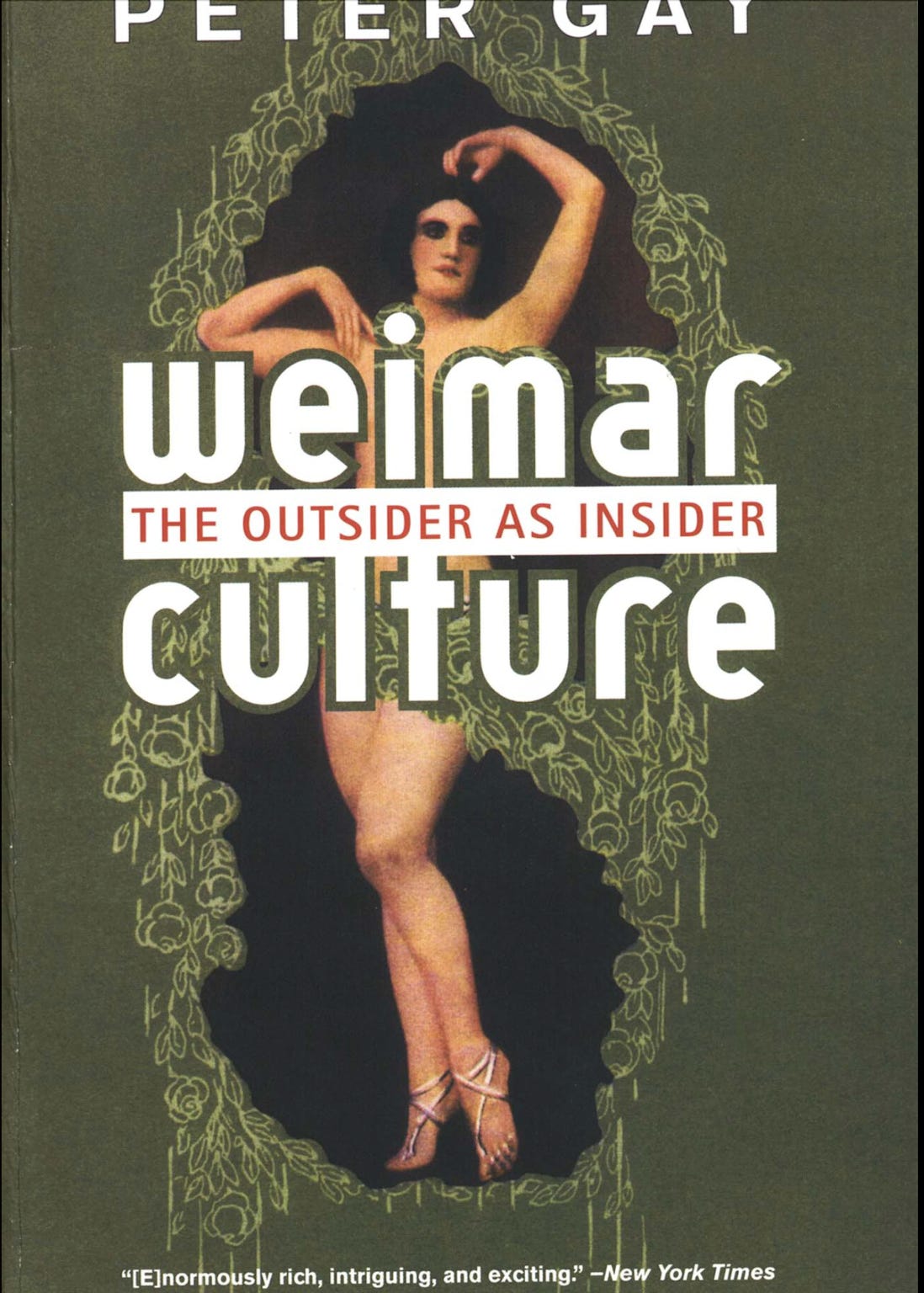
Peter Gay’s classic 1968 study Weimar Culture: The Outsider As Insider is, as you’d expect of a story about victorious fascism, a bleak read. But its very bleakness feels, in our current nightmare, at least a bit hopeful. We are facing some of the same dangers as Weimar did, and we have made some of the same mistakes. But we also have resources that Weimar didn’t.
Weimar Culture, then, is in some ways a warning. But it’s also hopeful, in that some of the things it warns against are pitfalls we have avoided—or at least, pitfalls we can see our way around from here, though the steering is, at best, likely to be rocky.
—
Everything Is Horrible is having a sale. It’s 40% off; $30/year. Please consider becoming a subscriber if you value my writing.
Coups then, coups now
Before we get to the potentially good news, though, we should grapple with the bad. Gay points to several failures that led to the collapse of Weimar, and they all sound chillingly familiar.
The first and perhaps most important mistake of the defenders of Weimar’s Parliamentary democracy was their treatment of the forces of reaction—a treatment that Gay characterizes as “suicidally indulgent.”
The German Empire’s collapse after World War I was chaotic and frightening. The organizers of the Weimar Republic were desperate to legitimate their rule and quickly stabilize the nation. Towards that goal, they negotiated with the army and with elements of the old regime, leaving broad numbers of the old guard in their positions in hopes that the prestige of the past would prop up the fledgling democracy.
The problem was that the holdovers remained in most cases implacable enemies of the newfangled democratic system, and pined for a return of autocracy, oligarchy and empire. This was the opposite of stabilizing. As Gay writes, the judges, prosecutors, and juries “had little pity for accused Communists but suave forbearance for ex-officers.” Violence by the left was treated with brutal severity by the courts, while violence by the right was coddled and all but encouraged. As Gay writes:
between 1918 and 1922, assassinations traced to left-wing elements numbered twenty-two; of these, seventeen were rigorously punished, ten with the death penalty. Right-wing extremists, on the other hand, found the courts sympathetic: of the 354 murders committed by them, only one was rigorously punished, and not even that by the death penalty. The average prison sentences handed out to these political murderers reflect the same bias: fifteen years for the left, four months for the right.
The most notorious, and most consequential, example of this right-wing bias was the treatment of Hitler. After his attempted putsch in 1923, Hitler was allowed to use the trial for propaganda purposes, loudly denouncing the government from the courtroom in a way designed to raise his profile and encourage his followers. He was eventually sentenced to only five years of easy detention; he was released after less than 12 months. The court also declined to deport him, as they should have by law since he was an Austrian.
The parallel here with Trump is hard to miss. The Weimar government refused to hold Hitler accountable for his coup; just so did Merrick Garland slow-walk Trump’s prosecution. The motivations were perhaps different—Weimar courts were themselves rightist, while Garland was afraid of looking partisan or provoking a backlash. But whatever the reasons, the results were the same. The government colluded in protecting fascist plotters, allowing them to regroup and smash the state which had coddled them.
Disarray back then…
The fascists and the reactionaries were determined and relentless in their efforts to bring Weimar democracy down. In contrast, Weimar’s defenders (or potential defenders) were disorganized and half-hearted.
The socialist workers parties were hopelessly divided between a Spartacist Stalinist far left which wanted to make Germany a Soviet Republic and a centrist wing that hoped to establish Parliamentary democracy. The feud between them was bitter and often violent. Per Gay:
Spartacists and moderate Socialists fought in Berlin and in the provinces, in politicians’ meetings and in the streets, in workers’ councils and at funerals for victims of right-wing thugs. There were many harsh words, words never forgotten or forgiven, and words were not all. Everyone was armed, everyone was irritable and unwilling to accept frustration, many had been trained and remained ready to kill, the widespread disorder encouraged irrational mass action and offered protective cover to political adventurers.
Centrists accused leftists of being Stalinist stooges; leftists accused centrists of selling their leaders out to rightwing assassins. On both sides, those accusations had enough truth to make unifying against the fascists virtually impossible.
Coordination was one problem; a related, and perhaps bigger one was the fact that virtually no one was passionately committed to Weimar as Weimar. The reactionaries had an inspiring dream of past glories and bloodshed. The left had a dream of social transformation and (at least to the considerable extent it was Stalinized) bloodshed. In the middle, Gay argues, Weimar’s strongest supporters were “rational republicans” who thought Parliamentary democracy wasn’t perfect or inspiring, but believed it was the least bad option. These rational republicans, Gay says,
acknowledged that nostalgia for the Empire was ridiculous, but they could not see that the Republic might deserve wholehearted support—or, rather, that it might become deserving if enough deserving persons supported it.
Gay himself is drawn to this vision of wholehearted rational decency, even as he acknowledges that this kind of passionless institutionalism is ill-designed to ignite the emotions that are required to defeat determined and vicious foes. Fascists claim that democracy is too vacillating and bloodless to survive. Gay doesn’t agree. But he doesn’t have a vision of unvacillating, unbloodless democracy to offer instead.
Maybe less disarray now?
Gay’s book does hint at a path to a more passionate democratic commitment, even if he doesn’t make the connections himself. The key is in the subtitle to his book: “The Outsider As Insider.”
Gay does not, surprisingly, explore that idea in great detail. But he does note that Weimar was a time when people normally excluded from society—Jews, avant-garde artists, and queer people— gained standing and status as culture workers, bureaucrats, and voters. Weimar was not a Jewish Republic, he argues, but it was a Republic in which Jews and gentiles worked together for common goals.
For the Nazis, obviously, this coexistence was anathema. The fact that Jews, queer people, women, and intellectuals could gain acceptance and even authority under Weimar was an attack on natural Christian Aryan hegemony, and fueled a passionate nationalistic hatred. Hitler insisted, with the force of long prejudice and violent status anxiety, that Jews should not replace Germans. And against that Weimar quietly insisted that Jews were just like us anyway and why shouldn’t they be? The energized advocacy for Jewish people as part of a liberal state does not seem, in Gay’s telling, to have been part of the intellectual landscape of Weimar. Germany did not have a Dreyfuss Affair; diversity and multi-racial democracy were abstractions, rather than commitments around which deeply felt German identity could coalesce.
In contrast, the US does have a long tradition of enthusiastic commitment to multi-racial democracy and equality, located most obviously in the long, ongoing Black freedom struggle. Obama’s election in 2008 was a movement for, and celebration of, a dream of multiracial democracy. The George Floyd demonstrations in 2020 brought millions of people into the streets to demand justice and racial equality. The 2022 Democratic overperformance was powered in large part by voters’ deeply held commitment to women’s bodily autonomy. Anti-ICE direct action in Minneapolis, Chicago, and other cities has been built on antiracist solidarity with immigrant neighbors.
In Weimar, in Gay’s telling, outsiders became insiders through a kind of accident rather than out of determined ideology. In the US, in contrast, we have seen again and again that multi-racial democracy, and a determined commitment to equal rights and equal justice for people deemed “outsiders,” has stymied and defeated the forces of fascism and reaction. Those victories have been difficult and they have not been decisive. But they weren’t accidents either.
Of course, the fascists and their allies would like you to think that 2020 was an overreach, that Minneapolis isn’t really meaningful, that what we need is dispassionate weighing of polls to defeat fascism, rather than those much-smeared “identity politics.” Don’t organize around or for marginalized people, we’re told. Don’t demand solidarity for outsiders in ways that make bigots uncomfortable. Be calm; be cautious. Don’t overdo it. Don’t be divisive.
But the lesson of Weimar, from reading Gay, is that the actual cause of division is not too much enthusiasm, but not enough.
You can see that in our own time too. Hakeem Jeffries is generally thought of as a centrist compromiser; he’s certainly not a leftist. But he’s been calling for radical blue state gerrymandering to defeat Trump and counter fascism. That’s because he, like most of the Democratic party, is invested in Black voting rights and power as a core expression of democracy and American identity.
Trump’s efforts, buttressed by the Supreme Court, to disenfranchise Black voters in the South is an attack on the republic which enrages both centrists and the left. The particularist commitment to Black voters pulls the foes of fascism together. Part of the reason that the various lefts in Weimar couldn’t coordinate is because they did not prioritize the rights of Jews and queer people. Because they did not extend solidarity explicitly to the fascist most direct targets, they ended up not being able to extend solidarity to themselves.
Again, none of this means that multi-racial democracy is assured of victory. Multi-racial democracy has lost many times before, and there’s no guarantee it will triumph, short term or long. What it does mean, though, is that we should see commitment to civil rights struggles—to freedom and justice for outsiders explicitly—not as distractions which undermine victory, but as an absolutely crucial prerequisite for antifascist victory. If we win, it will be because we are trained in identity politics and in solidarity in a way that Weimar was not.
Very clear review of Gay's explanation.
So helpful.
Thank you.
Yes, it's ironic. Black people were brought here by force in large part, but now they're the secret sauce to making the U.S. s multi-racial democracy. I have always said this.