

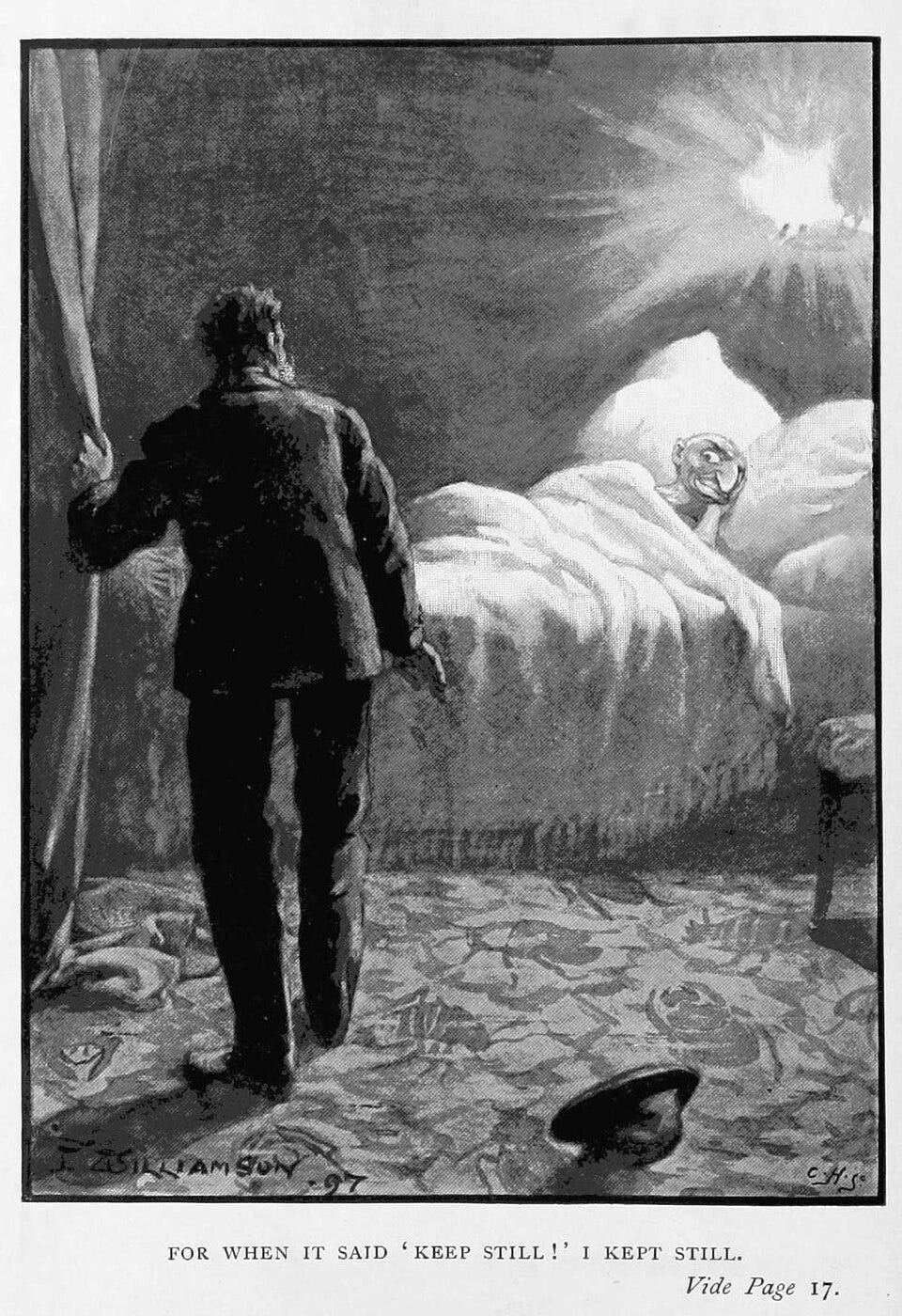
A consistent characteristic of fascism is the paranoid fantasy of losing bodily autonomy—through enslavement, rape, sexual violence, or some combination of all those things. Hitler built his power after World War I by (falsely) accusing French Senegelese soldiers occupying the Rhineland of widespread systemic violence and rape. Donald Trump accused Mexican immigrants of rape in the early stages of his first campaign for the presidency. Since COVID, it has become standard on the right to liken vaccine mandates to slavery. In each case, fascists claim that they and the people they identify with are in imminent danger of losing control of their own bodies.
A vivid, early version of this kind of sweeping disempowerment narratives in Richard Marsh’s 1897 gothic horror novel The Beetle. The book doesn’t have much of a pop culture profile, but it’s particular mixture of fear, hate, and prurience feels more relevant than ever in the age of Trump.
—
Everything Is Horrible is entirely funded by subscribers. I cannot scribble without you! I have a sale right now; 40% off, $30/yr. If you value my work, please consider becoming a paid subscriber.
“Those eyes robbed me of my power of volition”
Marsh’s The Beetle was released in 1897, the same year as Bram Stoker’s much better known Dracula. The books have a lot of parallels. In both a foreigner invades London, twisting helpless Englishmen and women to his will through mysterious mental powers as preparation for foul, unnatural sexual conquests.
If anything, the Beetle’s depictions of mesmerization and sexual perversion are more explicit than those in its more famous vampiric doppelganger. The titular villain, mostly referred to as the Arab, is a mysterious devotee of Isis who is characterized by great ugliness; an indeterminate ethnicity which may include Asian, Black, and Jewish elements; and an indeterminate gender. He (his most common pronoun) is also able to turn into an enormous beetle
The exact nature, and even the exact name of the “Arab” are obscure in part because he (or sometimes she) has great mesmeric powers. This allow him to cloud the minds of his victims, and to seize control of their will and bodies. As one victim describes the experience:
Those eyes of hers! They were a devil’s. I can positively affirm that they had on me a diabolical effect. They robbed me of my consciousness, of my power of volition, of my capacity to think,—they made me as wax in her hands.
To be wax in the Arab’s hands is to lose one’s autonomy; those ensorscelled must carry out the villain’s foul commands to the letter. They helplessly obey—undressing, falling down dead, cutting their hair, committing burglary. “For you are my slave,—at my beck and call,—my familiar spirit, to do with as I will,—you know this,—eh?” the Arab sneers at Robert Holt, an impoverished Englishman he has seized. To which Holt replies, “I did know it, and the knowledge of my impotence was terrible.”
This fantasy of impotence is so terrible in part because losing control of one’s body is horrifying. But it is also terrible because the wrong people are being enslaved. Holt is particularly chilled by the look that comes on the Arab’s face as he says, “a white skin you have,—how white! What would I not give for a skin as white as that,—ah yes!” Holt’s “sensation of shuddering repulsion” is linked not simply to his disempowerment, but to the way that that disempowerment violates the hierarchy of white supremacy. The Arab desires white skin even as he exercises the power of whiteness to seize, control, and command.
Similarly, the book’s most heroic protagonist, Sydney Atherton, is distinguished first by his ability to resist mesmerization, but even more importantly by his ability to subjugate the Arab himself. Sydney is a scientist, and after he displays his electrical mechanism, the easily overawed villain falls to his knees (like the Ewoks before C3P0) and whines “’My lord! my lord!...I entreat you, my lord, to use me as your slave!”
Not coincidentally, it is shortly after this submission that Sydney is able to see positively that the beetle “was not a man, but a woman”—or at least, he observes a body which is in the moment unambiguously female, though the text continues to shuffle pronouns indiscriminately.
“The contact of her lips oppressed me”
Slavery is twinned with rape; complete control over someone’s body inevitably includes the power to sexually assault them. Sexual violence was endemic in US chattel slavery; Sarah Baartman, Khoikhoi woman, was infamously kidnapped and shipped to France where she was displayed as an erotic spectacle in an extended round of public sexual abuse; British soldiers sexually assaulted women in colonial South Asia. More, the gendered nature of colonial control and violence was explicitly recognized in the language used to describe colonial conquest; Theodore Roosevelt said that the invasion of the Philippines and other territories was a “manly duty”.
Marsh in The Beetle is no more subtle than Roosevelt. The originating incident of the novel (chronologically, though not in narrative order) occurs when the young Englishman Paul Lessingham visits Cairo. There he contracts a fever (weakening his moral fiber) and in a back-alley café encounters a woman performer/sex worker, who seduces him with her music and other charms. Colonial adventure is sexual adventure.
The Woman of Songs (who is probably one form or persona of the Arab) mesmerizes Paul as she mesmerizes others throughout the book (“I had to stay whether I would or wouldn’t.”) Her control in this case is eroticized; she takes Paul to a secret chamber, the temple of Isis, and has her way with him for months.
Leaning over, she wooed my mouth with kisses. I cannot describe to you the sense of horror and of loathing with which the contact of her lips oppressed me. There was about her something so unnatural, so inhuman, that I believe even then I could have destroyed her with as little sense of moral turpitude as if she had been some noxious insect.
This is a borderline explicit description of sexual assault and the ensuing emotional turmoil. And, in fact, even after Paul escapes, travels back to England and becomes a respected member of Parliament, the turmoil continues; he is described as having something very like trauma or post traumatic stress. When anyone says the words “the beetle” to him he becomes “hysterical”, and crouches and cringes in terror. Paul is unmanned—which means when he is triggered his mastery falls from him and he returns involuntarily to the position of the colonized (female) victim of sexual assault.
Paul’s identification with, and symbolic transformation into, an assaulted woman is further emphasized when his fiancé, Marjorie, is seized by the Arab (and, not incidentally, forced to disguise herself as a man.) Paul saw the cult of Isis sacrifice young white Christian women; another character, police officer Champnell, mentions that the cult has a “special preference” for “young English women.” Fear for Marjorie’s plight becomes intermingled and transposed with Paul’s memories of his own past.
‘Mr Champnell, do you know that I am on the verge of madness? Do you know that as I am sitting here by your side I am living in a dual world? I am going on and on to catch that—that fiend, and I am back again in that Egyptian den, upon that couch of rugs, with the Woman of the Songs beside me, and Marjorie is being torn and tortured, and burnt before my eyes! God help me! Her shrieks are ringing in my ears!’
Paul’s gender indeterminacy mirrors, and is a reaction to, the indeterminate gender of the Arab. The villain is, or should be, a woman because he is a member of a colonized people, who are supposed to be subordinate and abusable. But he has reversed the righteous order of things, transforming into the masterful, mesmerizing perpetrator of sexual assault and thereby forcing Paul into the position of one who is womanish, weak, mastered.
“Living in a dual world”
When the right imagines the evil liberal government seizing their guns, or forcing health procedures upon them, they are, like Paul, “living in a dual world.” Like him, they are projecting themselves into the lives of the oppressed; the (at least iconically) white cishet male right-wingers are imagining themselves as queer, non-white, feminized bodies subjected to the discipline of enslavement, colonization, control, sexual violence, trauma. Again like Paul, they are part of the ruling class—but they imagine themselves sliding helplessly out of that security and into the lives and fates of those ugly, cringing, violated others.
The experience of identification or empathy does not lead to sympathy or solidarity. Instead it leads to panic, paranoia, rage, and loathing. “There was about her something so unnatural, so inhuman, that I believe even then I could have destroyed her with as little sense of moral turpitude as if she had been some noxious insect.” Colonizers and/or fascists revel in the imagined experience of enslavement in order to stoke their own hatred of enslaved people.
The Beetle is about how we, the good upright Englishmen, need to subjugate the disgusting feminized non-white other or they will subjugate us. To mingle with the other is, for fascists, to despise the other. Or in the words of Richard Marsh’s novel, “the soul of something evil entered into me in the guise of a kiss.”
One of the most undervalued privileges in this world is the ability to move about it freely unconcerned that one could be violated or dominated. When this privilege is threatened in any way, repercussions are fast and furious. A rich, white CEO of a hated company is killed and the reaction of other rich, white CEOs was so hysterical that a special 911 line was established just for them. Ridiculous photo ops were staged by the mayor so he could look tough on crime. I am willing to bet everything I own that during the same timeframe a woman was also murdered in an alley somewhere in NYC. But her death isn’t worthy of any hullabaloo because women are meant to be victims. Apologies to Margaret Atwood, but men’s greatest fear isn’t that women will laugh at them. Their greatest fear is the oppressed will gain power and control and want vengeance.
Excellent essay! Thank you for giving me a lot to think about this morning.