

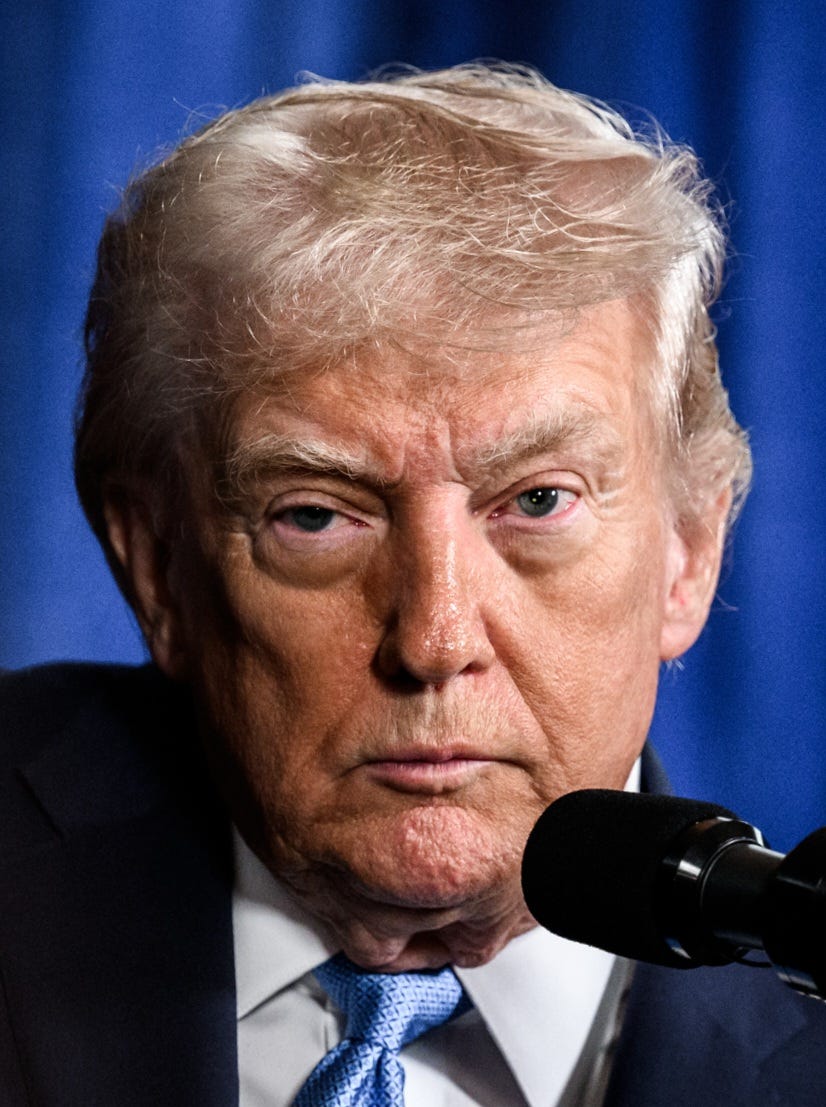
Political scientist Jonathan Bernstein often points out that Trump is extremely bad at presidenting.
This week, as an example, Bernstein highlighted Trump’s effort to charge employers a $100,000 tax when they try to hire immigrant workers for specialized roles. A federal judge ruled against him.
“Most presidents do not want a reputation of being easily defeated, so they don’t bull ahead with this kind of thing,” Bernstein writes. But, he adds, “There’s real cumulative damage to the rule of law *even if* Trump is defeated…Trump is a losing loser who loses…but the nation as a whole winds up severely damaged.”
I think Bernstein’s insights speak to a discussion which pops up in fits and starts around Trump—namely, is it better to have a competent fascist in power or an incompetent one?
—
Everything Is Horrible is entirely funded by readers. If you value my writing, please consider becoming a subscriber. It’s $50/yr, $5/month. (and/or tip me at Paypal!)
Incompetence bad
The argument that you’d prefer an incompetent fascist is pretty straightforward. Fascists want to do bad things. They want to silence, subjugate, imprison, torture, and exterminate political enemies and marginalized people. They want to enrich themselves with widespread corruption. They want to go to war to expand the sphere of their subjugating and exterminating.
Given those goals, you would rather have someone in power who was bad at achieving their goals. A fascist who is a brilliant strategist and efficient administrator would be able to do more mass murder and conquest. A bumbling fascist who constantly overreaches and loses, like Trump, will in theory be worse at achieving his goals of mass murder, subjugation, and violence. Given the choice, therefore, you should choose the bumbling fascist. Right?
Well, not necessarily right, as it turns out. Trump has been an object lesson in why incompetence can multiply the horrors of fascism and authoritarian rule rather than mitigating them.
The most obvious example here is Covid. When there is a natural disaster, you want there to be someone in charge who will at least make a good faith effort to respond to the natural disaster by trying to prevent huge numbers of people from being killed.
Trump, of course, mostly tried to pretend Covid wasn’t happening as long as possible. One early estimate suggested that if Trump had responded more like his peers in other Western democracy, some 100,000 American lives could have been saved. Global pandemic response also pre-Trump was predicated on the idea that the US would be a global leader, rather than a giant fascist barrier; it’s likely that the pandemic would have been much less destructive around the world if we had not elected a fucking fool to rule us.
But Covid is really only the beginning. Crisis response is part of presidenting. But another crucial part, as Bernstein notes, is canny assessment of risks and rewards.
A good president would know, for example, that staging a violent coup in the capital and attempting to murder the vice-president was unlikely to be successful. A good president would know that invading Iran without any preparation or rationale or effort to build public support could lead to extremely bad outcomes. A good president would know that bizarre vanity White House construction projects would be very unpopular. A good president wouldn’t just let Elon Musk make whatever decision he felt like about government funding. And so forth
But Trump is a bad president. He knows nothing and refuses to know anything. He is a giant orange globular bolus of entitlement and id. As a moral choice, he always believes that whatever he wants should be and is, and that he will be applauded for bringing it about. Other people either agree with him or else are traitors and demons deliberately thwarting his righteous progress. And so he barrels ahead with the coup, or the war, or the ballroom, insisting “it will all work out in the end” —because he simply refuses to imagine that he could ever be thwarted in any way.
The coup and the war and the ballroom all damaged Trump badly. But they also damaged the Constitution, the country, and the world. Trump’s failed coup lost him the Senate and turned the nation against him for a while. But it also led to a Republican party that is ready to double down, seemingly infinitely, on election denial and anti-democratic bullshit. The war in Iran has destroyed Trump’s popularity and the Republican brand—but it also led to the horrific murders of Iranian schoolchildren and to an apparently endless global energy and trade crisis. Elon Musk’s actions were an embarrassment that damaged Trump’s credibility in numerous ways—but that’s not much comfort to the 14 million people expected to die from malnutrition and preventable diseases thanks to the shuttering of US AID.
Don’t be afraid to get rid of him
One way this argument about competent fascists vs. the other kind still comes up is in discussions of impeachment. If Trump is actually removed, we would of course be faced with a president J.D. Vance.
Vance is a fool and quite incompetent in his own way. But he also seems more focused on fascist goals as fascist goals and less likely, at least, to fall asleep in meetings. You could argue that he would work towards certain evil outcomes—abortion and trans criminalization for example—with the greater fervor of a true believer.
I think Vance is an extremely dangerous figure, and he would be a horrifically awful president. But I also think he’s shown an ability to take in new information and to try to navigate other’s politics in a way that suggests he has a theory of mind that Trump just doesn’t seem to possess.
The most obvious example here is Vance’s decision to embrace Trumpism after his initial Trump skepticism. Initially Vance thought Trump was an evil ignorant clown. He was right! But then Trump won the presidency, and Vance figured out that licking Trump boot was the best way to advance his career. He was, unfortunately, right about that as well.
This does not make Vance a moral human being or a good human being. It makes him the opposite of those things; he’s a craven Nazi bigot. But it does at least suggest that he is able to figure out which way the wind is blowing, and that he attempts to adapt his views and his approach based on what is possible and what other’s thingk, rather than simply blundering forward.
If Trump is somehow removed from office by the Senate, Trumpism is going to be extremely unpopular to put it mildly. I think Vance will still try to do as much evil as he can—but he will probably be able to figure out that mass arrests of partisan enemies would, in such a situation, damage his popularity and isolate him. Whereas, whether Trump will recognize that that is the case after he loses the midterms is anyone’s guess.
This is not to say that Trump is the worst possible president, and that his Republican successors will all be better. The US is on a very ugly trajectory, and I think it is quite possible that we get a worse president that Trump absent real, sweeping transformations of our government and society.
But I think in opposing Trumpism, it’s important to understand why Trump is such a uniquely terrible president. It’s not despite his incompetence; it’s because of it. His incompetence—his ignorance, his refusal to learn in office, his contempt for allies and enemies alike, his blundering certainty that he knows best and that all his decisions are perfect—is inseparable from his evil. His evil is manifested, in fact, in his enthusiastic embrace of an ethos of incompetence.
Unfortunately, there are some who find that ethos appealing. There is an anti-establishment fandom for candidates who lack conventional credentials, who behave in unconventional ways, who demonstrate that they don’t know what they are talking about and don’t care. Certain people (especially on the right, but not just on the right) believe that maybe being bad at the job of presidenting is good.
But it is not. Trump’s failure at his job is a moral failure, as is his fascism. Indeed, they are, in him, the same moral failure. We must reject both.
I honestly can't imagine today's American fascists voting in a competent, canny villain. They fetishize inexperience and laud inefficiency so much
What can I say? I agree with everything in your essay.
I've had this discussion multiple times, in multiple ways with different people. I also used to be of the opinion that it might be worse to have a smart, capable, competent fascist in the White House. They would get more fascist-stuff accomplished. However, seeing how things are going with our incompetent fascist fool of a president I have changed my mind on this matter. Apparently a clueless, bumbling, dementia addled idiot can do a lot of damage given the most critical job on our planet. I do not know if we can recover from this.
Also, if Vance took over. he does not have the cult following and magnetism that our current dear megalomaniac leader has. That would hamper his ability to get things accomplished. Also, everyone hates him.