

Yesterday Disney released the trailer for its latest bloated crossover superhero extravaganza, Avengers: Doomsday. Over three minutes fifteen second, music swells and swells and then swells again as a range of more or less familiar fit and attractive people strike dramatic poses while spouting stirring boilerplate, swinging ominous weaponry, or trying to look like they see the computer generated special effects around them.
The narrative is foggy and garbled, but one thing is clear: what is happening is massive, important, and consequential. Big things are happening bigly and at great volume. The empowerment fantasy is maybe lifting the magic hammer and maybe emitting indeterminate force bolts. But beyond all that it is the proliferation of purpose—the dream of vicarious participation in a story that Matters.
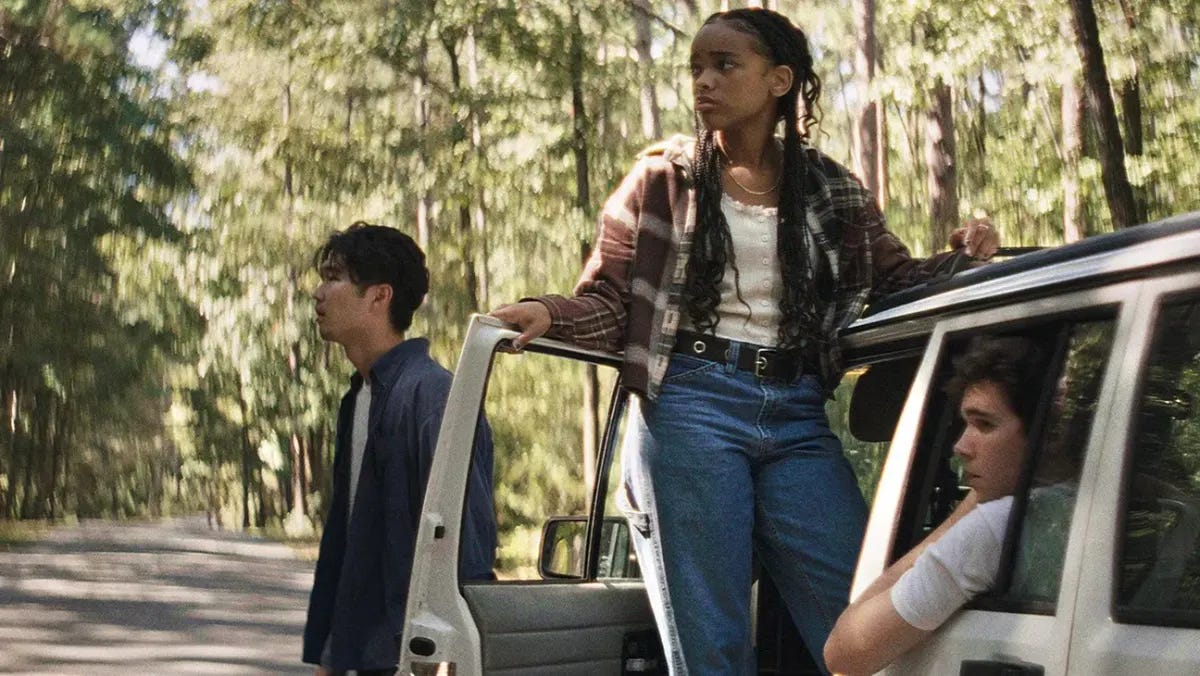
There couldn’t be much more of a contrast to the MCU’s top-heavy gigundabugeted swollenness than Alex Ullom’s It Ends. Combining the “young people wander through the woods” conceit of the Blair Witch Project with the absurdist emptiness of Waiting for Godot, the movie is quietly, determinedly committed to the purposeless journey to nowhere—a refutation of the cinema of betighted meaningfulness and an embrace of a view of film, and of life, where you don’t know where you’re going.
The film starts as four young people take a drive and discuss their post-college plans. They take a turn down a forest road…and then for inexplicable reasons, the rest of the world disappears, and there is only road. The gas never runs out; they never get hungry or need to sleep; they don’t seem to age. But if they stop the car for more than 90 seconds, desperate people run out of the woods and attempt to seize their vehicle. They drive on and on, through miles and miles and years and year, trying to figure out where they are, and/or simply trying not to succumb to despair, boredom, and mental illness.
At first the four travelers try to figure out some logical explanation for their plight. Are they dead? Are they in purgatory? Did one of them do something—hit a child, contemplate suicide, forswear religion—which has led them all to be punished? Are they in some sort of Groundhog Day type film where they need to follow a character arc for personal growth in order to be raptured out of this weird narrative cul de sac? (One of the funnier moments in the movie is when James (Phinehas Yoon) confesses how much he cares for his friends, waits a beat, and then says, damn it, I thought that would work.
Eventually, as the odometer ticks up and the clock ticks on, explanations become less important for most of the travelers. Instead of brainstorming, they start to establish rituals to break up the time—blocking out moments to listen to the few songs they have available, scheduling daily interludes to air out grievances, stopping for cathartic screaming sessions, rotating drivers.
The one exception is James, who continues to treat their plight as a puzzle and a challenge. If they just keep going and gathering information, he insists, they will eventually find a way out, or at least a rationale. His friends become more and more exasperated with him, more and more worried about him, more and more unwilling to be conscripted into his quest for new information or new interpretation. But he persists. When they find another car by the side of the road; when the attacks on the car cease—it must mean something, James argues. They must be going somewhere.
As many have noted, It Ends can be read a parable about what Gen Z expects from their lives and/or about life itself. Career, religion, family, relationships, all feel more amorphous now than perhaps they did in the past—or perhaps the transience, uncertainty, and inadequacy of any of those markers as guides is just clearer now than it once was. In any case it seems significant that the closest relationship in the film, that between Day (Akira Jackson) and Fisher (Noah Toth) is neither sexual nor familial. They love each other, and seem committed to spending eternity together. But their bond doesn’t fit into romance genre tropes, and not even really into found family storylines, inasmuch as they found each other before the film, and aren’t helping each other find refuge from more traditional mothers, fathers, or siblings. They are just there together, and together they stay, for as long as it takes.
If the movie refuses to be a romcom or a heartwarming indie drama, it also refuses the more heroic survivalist narratives evoked by a journey into a mysterious wood. The movie opens with the four young people engaged in a goofy, slacker-esque discussion about who would win in a fight, a guy with a gun or fifty hawks. It’s a conflict the film elaborately dodges; there are no wild animals in the woods, the protagonists have no guns. This is not a heroic journey of fighting and overcoming. It is a detour off the path of heroic journey, in which what passes for drama is a rainstorm after there has been clement weather for perhaps centuries. When the rain comes, James writhes in terror, barely able to remember what it means when water falls from the sky.
Director Ullom has said that James’ search for newness and explanation is “very typical of a genre audience member.” He adds that James, “can’t accept that relationships and the people you love are what give life meaning.” I think though, you could also argue that part of the meaning of the film is the world of the film outside of relationships and people. The endless unchanging road isn’t in fact exactly unchanging; forests are filled with different branches and leaves. For that matter, the interior of the car is transformed over time by the interaction of people and space; bric-a-brac piles up and dates and messages and in-jokes are scrawled on the upholstery and windows with sharpie. In contrast to the dark-gradient stuffed-with-stuff CGI of Marvel’s amorphous cosmic detritus, the no-place of It Ends feels grounded and specific. Tyler (Mitchell Cole) exits the film fairly early on by stepping into nowhere. But he exits into that nowhere by standing beneath a particular tree.
Stanley Cavell argued that the particular philosophical power of film is the way in which it presents a world that is whole in itself, without the intervention or presence of the viewer.
A world complete without me which is present to me is the world of my immortality. This is an importance of film — and a danger. It takes my life as my haunting of the world, either because I left it unloved (the Flying Dutchman) or because I left unfinished business (Hamlet). So there is reason for me to want the camera to deny the coherence of the world, it’s coherence as past: to deny that the world is complete without me. But there is equal reason to want it affirmed that the world is coherent without me. That is essential to what I want of immortality: nature’s survival of me. It will mean that the present judgment upon me is not yet the last.
The ugly visual computer vomit of MCU films intentionally vitiates this experience of a world without us; mega superheroes stretch and flex and energy blast their way into every portion of the screen and solar system; the world warps around them, so the only meaning is (bigger, badder) us. It Ends, in contrast, shows you a world streaming by outside the window that cannot be apprehended or fully inhabited. We are traveling through it, or spending time in it, not to impose our will or narrative on it, but simply because it is the world we have, and we have nowhere else to go.