

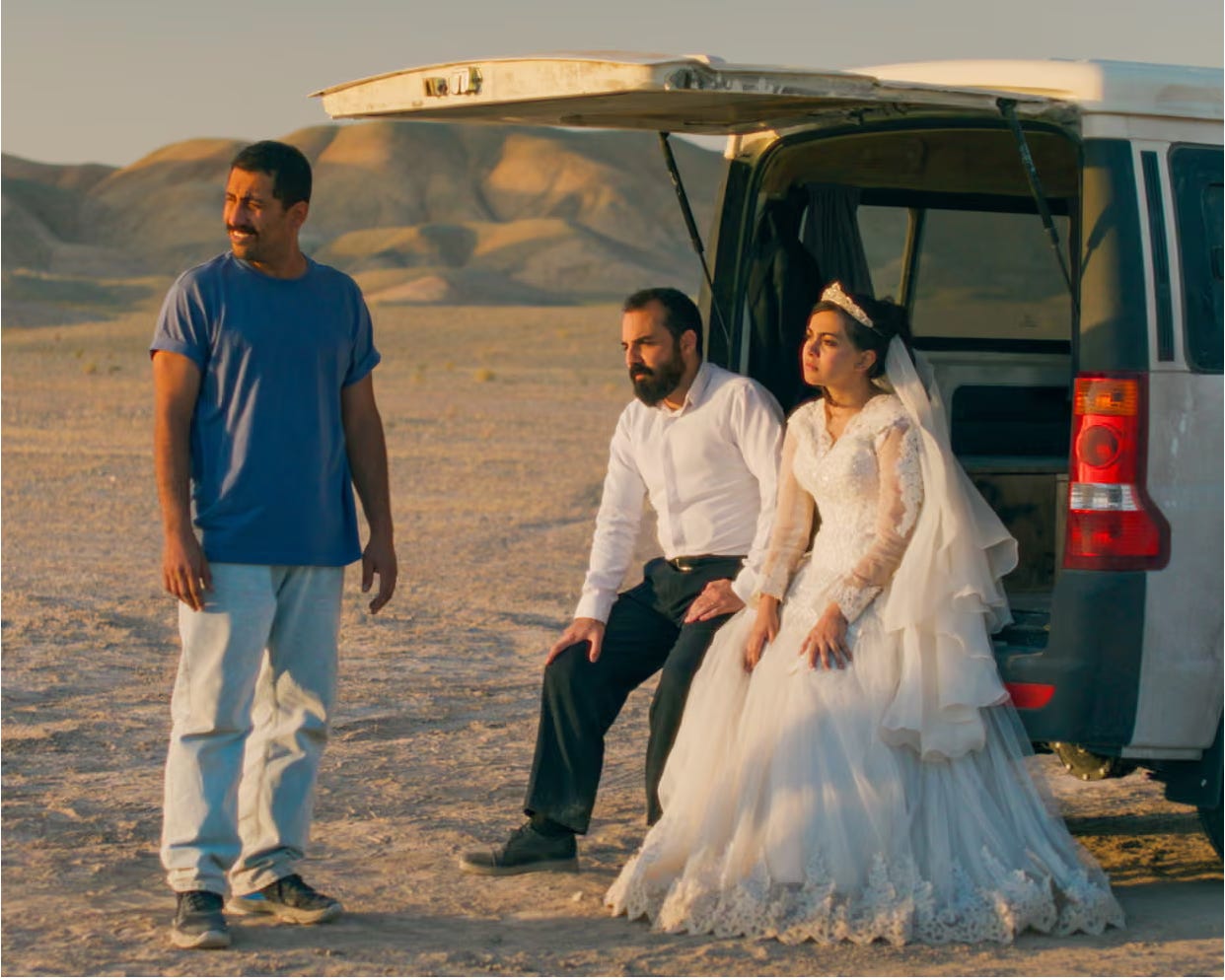
Jafar Panahi’s It Was Just An Accident is a courageous work of anti-authoritarian resistance, which unflinchingly condemns both the fundamentalist religious ends and the brutally violent means of the Iranian regime. As a political statement, it’s unimpeachable. It’s also been much lauded by critics as a work of art—but I have to admit I had some reservations.
The plot begins when a man with an artificial leg (Ebrahim Azizi) stops at a garage because his car has broken down. A mechanic Vahid (Vahid Mobasseri) hears the squeaking of the leg and believes he recognizes it as the signature of Eghbal, the man who tortured him after he took part in a worker’s action protesting withheld wages. He follows the man home and kidnaps him, planning to bury him alive. But when the man denies he is Eghbal, Vahid doubts himself. He tries to find someone who can corroborate Eghbal’s identity, eventually connecting with a range of survivors, all dealing with their own pain, grief, and desire for revenge.
Panahi’s cinematography is exquisite; the scene of Vahid burying the maybe torturer makes dramatic use of the desert’s flatness and emptiness as a metaphor for the universe as wasteland, and for a soul hollowed out of hope. He also makes canny use of what you can’t see, keeping the camera tightly on maybe Eghbal’s face in an early scene where he runs into a dog, so that you cannot see the blood or gore he’s witnessing.
That’s mirrored in the climactic interrogation, where Eghbal is tied to a tree blindfolded as Vahid and another survivor, Shiva (Mariam Afshari), stalk around him. He strains to see his attackers, but can’t, just as we try to catch glimpses of them but are blocked by the unwavering, unmoving camera. Part of torture is the unknowing—just as part of Vahid and Shiva’s ongoing abuse is that, because they were bindfolded, they still do not know who was responsible for their pain. Induced paranoia, revenge without a target, justice so impossible it doesn’t even have a target—the torture does not end when it ends. Shiva and Vahid are still experiencing it.
These elegant visual choices are, unfortunately, not exactly matched by the script. Much of the dialogue is stagey and even rote. One of the survivors, Hamid (Mohammad Ali Elyasmehr) feels like he is there just to have dramatic conflict; he’s angry and belligerent and berates the others for not being sufficiently bloodthirsty and paranoid. The arguments follow a predictable line: “we don’t want to become like them,” “he ruined my life and deserves death.” The plot is minimal, but somehow still comes across as forced. There’s an obligatory Waiting for Godot reference; car breakdowns are used to advance the narrative twice; through various contrivances Vahid ends up helping Eghbal’s wife get to the hospital and delivering her second child. It’s like Panahi started flashing a big sign on screen, “See?! Vahid is a good person!”
There are similar problems with the climactic scene, in which evil is exposed and judged, and the good demonstrate their virtue. It functions, again, as an affecting indictment of the regime. But state crimes rarely lead to such a straightforward catharsis—and the ambiguous, unresolved final twist that plays over the credits, which is maybe meant to complicate things, just comes across as a cop out. It’s hard not to compare the neat closure here with The Act of Killing, where the torturers’ remorse is both more visceral and more ambivalent, and where even the provisional justice of truth is, at best, a barely healed wound.
It Was Just An Accident has powerful moments as well, and its creation is an incredible act of bravery for a filmmaker who has been arrested multiple times by authorities and who still lives, at least periodically, in Iran. I can’t begrudge it the many accolades it’s received. But while I think it’s worth seeing, I was also in the end somewhat disappointed.
Nicely parsed.
If ambivalence is the natural human state, I have not encountered a better skill at articulating it with total candor.
Hats off.
Also for your iron stomach for movie scenes.
Yikes.
Well, I can see your points about the contrived elements within the storytelling.
But there's sort of a moral push-pull going on that's a bit more complicated than you're suggesting. I was in prison for eight and a half years. I know it's a broken system that needs to be fixed, it's failing the inmates, it's failing society. I suffered when I was down. We all did. Much of that suffering came from the active choices made by my captors, the decisions to hurt me, starve me, jeopardize my safety and health. There was an attempt on my life, and the ensuing medical care was carried out in a manner inconsistent with the Eighth Amendment. In other words, to teach a criminal that he was in violation of the law, they violated the law when my face was, in essence, broken in half (I am 100% fine now, thankfully).
In some ways, I blame institutions. In others, I see the faces of some of those men, cruel and petty fools who were hurting me and my unfortunate brothers in arms. I know who they were, what they believed in, who they thought they were. All of those pieces of their identity came together to deprive me of my rights, to hurt me, to extend my considerable suffering.
I know, today, years removed from the experiences, that the suffering of these men will not extend my life, will not bring me peace. I know that it will not somehow even the "eternal scales of cosmic justice" or whatever highfalutin' way you'd describe the karma to which we subscribe this week. Harming those men would be further injustice. Those that acted malevolently took an interest in elevating the pain I experienced. Those that stood by were participants in a broken system that is killing entire communities nationwide by sending them back broken, under-educated men who have learned nothing about justice and everything about revenge. They will not learn from their mistakes if they are manifested in cruel and violent treatment at the hands of men they harmed.
But that power seduces everyone. It's even sexier when not only do you not have it, but it was taken from you. And it's the power that comes from removing agency from someone who manipulated that same power to hurt you. Part of that power comes from being the manifestation of retribution. And part of it comes from years of having none of it, and now indulging those years of absence in one ac of self-righteousness. It's selfish. But it's impossible to ignore the allure of causing pain to those who earned a paycheck from the state to cause pain.