

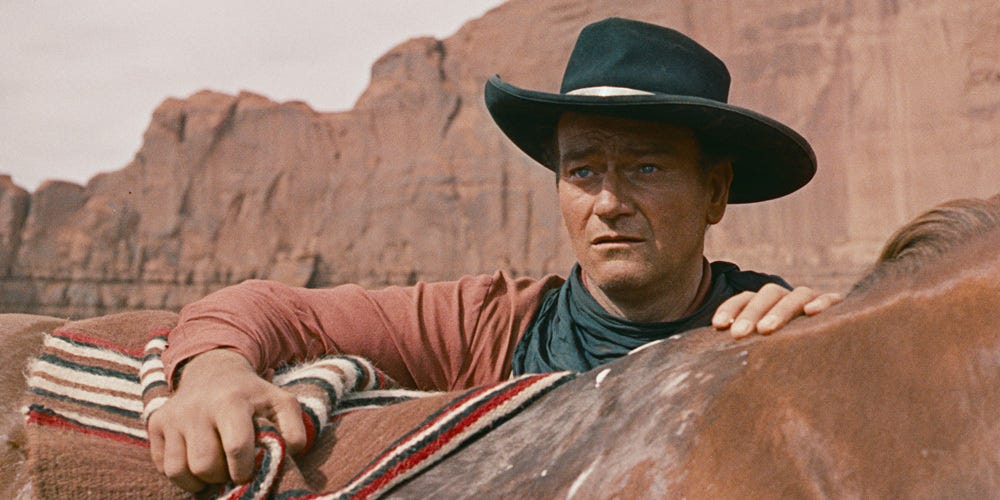
The Searchers turns 70 this year. So it seemed a good moment to re up this essay from a few years back. It first ran at the Escapist.
Also! This is the last full day of my sale. It’s 40% off, $30/year. Get in before it’s over!
—
John Wayne was a racist, homophobic ass. Why should we care?
A lot of people have been asking that question since comments from Wayne’s 1971 Playboy interview began circulating again last week after twitter user Matt Williams posted some screenshots. Wayne, in the screenshots, uses a homophobic slur, and says “I believe in white supremacy until the blacks are educated to a point of responsibility.”
Few reputable voices have endorsed Wayne’s bigotry. But many people have scoffed at the sudden interest. Some have noted that the interview has been available for a long time. Others joked about Wayne not being able to get work after these revelations (nobody can boycott Wayne because Wayne is dead, get it?)
Conservative Washington Post writer Sonny Bunch took this position to its logical extreme, and dismissed the criticism of Wayne as “witch-burning” and mere social media virtue-signaling. “Why should we be driven to apoplexy by words uttered in an entirely different context by a man none of us will ever encounter in real life? Is there not enough in our modern world to draw our ire? Do we really need to go searching for things to be angry about?”
Of course, one could reply, if you think it’s bad to go searching for things to be angry about, why get all upset about people criticizing a dead racist asshole? If you think people shouldn’t care, maybe be the change you want to be and don’t care so much, you know?
But hypocritical and confused as Bunch and his cohort are, I think they do, inadvertently, raise an interesting question. Why should we talk about famous figures past? Why does John Wayne’s racism, homophobia, and cruelty still seem to matter to people today?
I think they matter for the same reason that people like Bunch still want to defend Wayne, and for the same reason scholars and fans (including me) still watch John Wayne movies. Wayne was one of the most successful actors of his day; his portrayal of red-blooded American patriotism and heroism remains an iconic presence in the popular imagination. He’s been a huge influence on later filmmakers and actors, too. Kurt Russell, for example, built virtually his whole career on the space between John Wayne parody and John Wayne tribute.
Perhaps Wayne’s most celebrated film is John Ford’s The Searchers. The movie is frequently cited as the greatest western of all time, and regularly makes lists of best films of all time.
In the movie, Wayne plays Ethan Edwards, a Confederate Civil War veteran who returns to his brother’s home in Texas. Shortly thereafter his niece, Debbie (Natalie Wood), is abducted in an Indian raid. Ethan goes in search of her along with Debbie’s foster brother Martin (Jeffrey Hunter).
After five years, and much hardship and killing, they find Debbie living among the Comanches, who she doesn’t want to leave. Ethan almost murders her, but Martin prevents him. Eventually Ethan kills Debbie’s husband, Scar (Henry Brandon) and she returns with Martin to her home among white people. This is figured as a happy ending.
Part of the reason The Searchers is so highly regarded is that it can be read as a critique of the violence and racism of the Western genre. Wayne’s Ethan is appealing in his cavalier stoicism—when Martin wishes him dead, he casually responds with his favorite catch phrase, “That’ll be the day.” But his relentlessness is also frightening. He lives by a genocidal logic; all Indians are evil, and if his niece becomes an Indian, she deserves to die. In The Searchers, Roger Ebert says, “we can see Ford, Wayne and the Western itself, awkwardly learning that a man who hates Indians can no longer be an uncomplicated hero.”
Wayne’s comments in the Playboy interview, though, strongly suggests that he, at least never learned any such thing. Playboy specifically asked about his view of Native Americans, and he answers in a way that Ethan would have approved. “I don’t feel we did wrong in taking this great country away from them, if that’s what you’re asking. Our so-called stealing of this country from them was just a matter of survival. There were great numbers of people who needed new land, and the Indians were selfishly trying to keep it for themselves.”
Ebert sees The Searchers as a (somewhat conflicted) commentary on, and a rejection of, white people’s program of mass murder and theft. But Wayne’s comments show he did not see it that way. For him, murdering native peoples was justified by what he unapologetically refers to as “white supremacy.”
Did Wayne’s racism affect his portrayal of Ethan? Some critics have praised his performance. But others, like Xan Brooks at the Guardian, have been less laudatory.
Here was John Wayne just being John Wayne, waddling through the action with none of the nuance or conflict that Ethan is meant to embody. He says he wants to save Debbie. Then he says he wants to kill Debbie. And then he says to Debbie, “Let’s go home.” But he might as well be reading his lines off a cue card. I don’t think he understands the man he is playing or the story he’s telling.
Wayne’s comments tell us that he did not in fact understand the story he was telling. Critics and fans like to tell ourselves that the media we consume shares our values. We prefer not to believe that the people who made the movies we love were telling us “genocide is cool.” But Wayne very clearly said genocide was cool in 1971. It seems likely that that’s also what he was saying when he played Ethan in 1956.
And in many ways, Ethan is still telling us that, in his relentless march across the decades. The violent, brutal, driven man remains a popular hero, whether it’s Paul Atreides, James Bond, Dirty Harry, Jason Bourne, or any number of others.
Nor has Ethan’s racism disappeared. In the final scene of the second season of The Punisher, as one recent example, Frank Castle (Jon Bernthal) lures a bunch of young people of color to a warehouse. There, it is implied with a wink, he will murder them all. The victims are supposed to deserve it, because they are in gangs, just as the Comanches supposedly deserved death for trying to stop white people from taking their land. Frank is, like Ethan, a wounded, competent, brutal man, whose violence is inseparable from his ur-masculinity. If he and Ethan ever met, in some time-traveling cross-over, they’d chuckle in laconic recognition, clasp hands, and then get back to the business of slaughtering brown people.
John Wayne is gone, but his art, and his words, are still here. They aren’t irrelevant curiosities; they’re an ongoing part of what our culture talks about when it talks about heroism, and violence, and racism. John Wayne is still speaking to us, in his own movies, in the movies of his imitators, and for that matter in that Playboy interview.
Perhaps some time in the future, Wayne’s oeuvre will be forgotten, racism, bigotry, and hatred will be no more, and we won’t need to struggle with his legacy. That’ll be the day. But it hasn’t come yet.
IDK what to think about this, really. Wayne never struck me as an interesting actor or person. Westerns never held much interest either, although I knew they were very popular. My brother watched them all the time, but i never got it. The only things that ever interested me were the vast cinematography experiences, the land and sky, the intense beauty.
Clearly i'm in some minority of white folks though.
Isn’t this how it’s always been? Mainstream cinema pushing the political points of the ruling classes. I just recently rewatched an old Bond film with Connery, and I cringed over and over. The way he treated women and racial minorities was almost unbelievable.
As far as Wayne goes, I always found him a bit stiff and wooden. Whether as a cowboy or a soldier.