

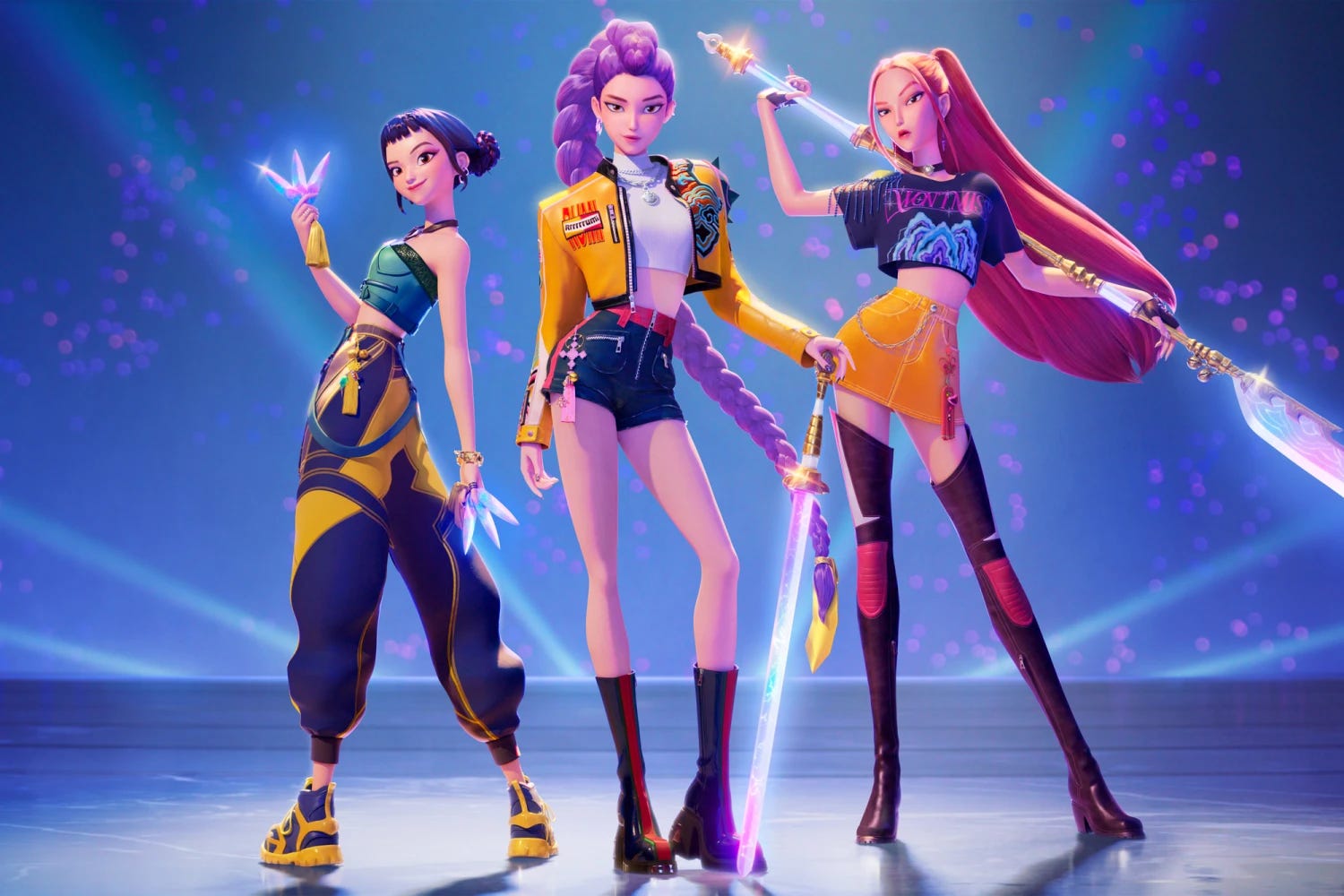
“My voice without the lies, this is what it sounds like” Kpop star/demon hunter Rumi (Arden Choi/Ejae) declares in the animated films showstopping finale “What It Sounds Like.” It’s a passionate call to honesty— a plea for art, and life, that is willing to embrace its flaws. And it unfortunately sounds like just another bit of anonymous corporate pop from which every vestige of individuality and personality has been removed.
This isn’t especially surprising; one of the core ironies of mainstream culture in the US is that it relentlessly and repetitively sells a sanitized message of individuality. Children, and adults too, are constantly being told they have to conform to the norms of a narrow nonconformity. Be yourself, and make sure that self is the same different self as everyone else’s.
Maggie Kang’s Kpop Demon Hunter provides few variations on the tropes. The Kpop trio Huntrix is a huge music sensation in public and then in private they fight demons in the best Buffy tradition. They’re all set to use the magic of their voices and the energy of their fandom to banish soul-sucking demon Gwi-Ma (Lee Byung-hun) from the earth forever. But then the demon Jinu (Ahn Hyo-seop/Andrew Choi) suggests forming a boy band to (seize power from Huntrix. Soon Jinu has discovered that Rumi is secretly half-demon herself—a fact she has kept hidden from her bandmates. Will this ugly secret break up the act and destroy the world?!
I’m sure you know the answer there, and far be it from me to begrudge the fans their happy denoument. I do, though, begrudge the ways in which the denoument rather betrays its own happiness.
The first of these, as I’ve already intimated, is through the art itself. If you’re going to create art about the awesomeness of individuality, you need the art to be at least somewhat individual. I’m not an unqualified fan of either Song Sung Blue or Into the Spiderverse, but they both at least couple their be-true-to-yourself themes with music and animation that are distinctive.
Kpop Demon Hunters, in contrast, offers lyrics, music, and visuals that are all blandly professional. The few moments of aesthetic panache—a three-eyed crow and a demon tiger who gets distracted from its mission by knocking over a flower-pot—are welcome, but serve mostly as a reminder of the prevailing roteness.
The timidity inevitably extends to the narrative as well. Rumi’s demon heritage, revealed by “patterns” or tattoos on her skin, is a marker of difference. But what kind of difference? The most obvious answer is that Rumi, half-demon by birth, is biracial. But the demons are soulless monsters, and the movie never seriously considers that Rumi’s demon heritage might be a source of pride or strength, or that the hatred of demons might be a flawed example of prejudice.
Rumi is only acceptable or good because she completely rejects her demon half, to the point of leading what would be a genocide if the demons were afforded moral status. Her friends do eventually accept her tattoos, but their acceptance, and Rumi’s acceptance of herself, is literally cosmetic. There is, and can be, no deeper reconsideration of who is human.
The one exception who tests the rule is Jinu. Jinu was once human, we learn, but four-hundred years ago he traded his soul for wealth, comfort, and great music-making prowess (shades of Robert Johnson). It’s never exactly made clear, though, if all demons are like this or if Jinu is a special case; Rumi briefly wonders before the movie sprints past the gaping ethical dilemma on its way to carnage and romance.
That romance could itself be a metaphor for difference; Jinu and Rumi are drawn to one another in an incipient love that cannot speak its name to either demon or human. There are parallels here with closeted queer experience, and also, again, with cross-racial romances—which you’d think would be a sympathetic storyline for a show about Asian heroes for a multi-racial (and probably majority white) audience. There’s also perhaps a nod to the ugly and controlling nature of Kpop contracts and fandom. Real life idols are expected not to date; if they do it can cause massive fan and corporate backlash and badly damage their careers.
Here again, though, Rumi’s potential difference is carefully, and then rather brutally, contained. The relationship with Jinu, like the exploration of Rumi’s demon heritage, is foreclosed; her primary relationship is with, and only with, her bandmates, who reaffirm their platonic collegial commitment to one another in the public baths before rushing off once again to meet and greet their fans.
Kpop idols, even in a cartoon aren’t allowed to have outside relationships, or time off, much less non-normative desires or backgrounds—unless they forswear any interest in those desires or backgrounds. The movie loudly insists that it’s okay to be who you are, but love outside proscribed channels is impossible and difference is only okay if it’s no more than skin deep.
I know lots of kids love this, and it’s great in this miserable moment of ascendant white supremacy to see a massive bona fide hit helmed by and starring Asian woman. But I can’t help but wish that the mega success had gone to Turning Red or Encanto, two films which actually do believe their characters should be celebrated for being messy and weird and different. The disjunction between message and follow through in Kpop Demon Hunters makes it hard for me to want to sing along.
"Children, and adults too, are constantly being told they have to conform to the norms of a narrow nonconformity. Be yourself, and make sure that self is the same different self as everyone else’s..."
Netflix has shown in the past that it would rather underwrite animation that follows this formula than any other kind, to the expense of animators doing more innovative work. And as long as they keep creating "hits" like this based on data metrics they won't share with the public, they are going to keep doing it.
For all that gen x has every right to be cynical, having been raised first on the corporate sponsorship of (XTREME) rebellious individualism, I gotta think this generation’s kids will have them well beat.