

Tom Tykwer’s Run Lola Run (1998) is set up as cheeky, techno-and-adrenaline driven exploration of the Butterfly Effect, as small choices lead to unexpected life or death consequences. If you push on those choices and consequences a little, though, they crash into various curbs and clocks. What spills out into the street is artifice and a lot of entertaining genre juggling.
The plot (plot plot) starts when angel-faced gangster bagman Manni (Moritz Bleibtreu) loses his 100k mark haul by forgetting his bag on the subway. Desperate, he calls his girlfriend, Lola (Franka Potente) and tells her if he can’t get the money in 20 minutes his boss will kill him. Lola (whose moped was stolen) sets off running to her father’s workplace at the bank to convince him to front her the money.
Alas, bad luck dogs her (in the form at one point of an actual dog), leading to tragedy. And then the film rewinds and she tries again. And then one last time, for the charm.
The fun of the exercise, as the minutes tick down, is watching how slightly altered timing sends the narrative off towards different tangents and targets. If Lola gets tripped going down the stairs she arrives at her dad’s slightly later, after he’s learned that his mistress’ baby is not his, leading to intensified conflict and inspiring her to rob the bank to try to get the money. If she fails to cause her dad’s colleague to crash his car on the way, dad leaves the bank before she gets there, and Lola’s forced to spin (literally) another plan.
Other choices lead Manni to run into the bearded bum who stole his bag. And in quick snapshots we see that slight changes in timing lead random people she encounters to marry or end up on the street, to win the lottery or join the church, to die or enter a satisfying BDSM relationship. Every moment is charged with potential narrative meaning!
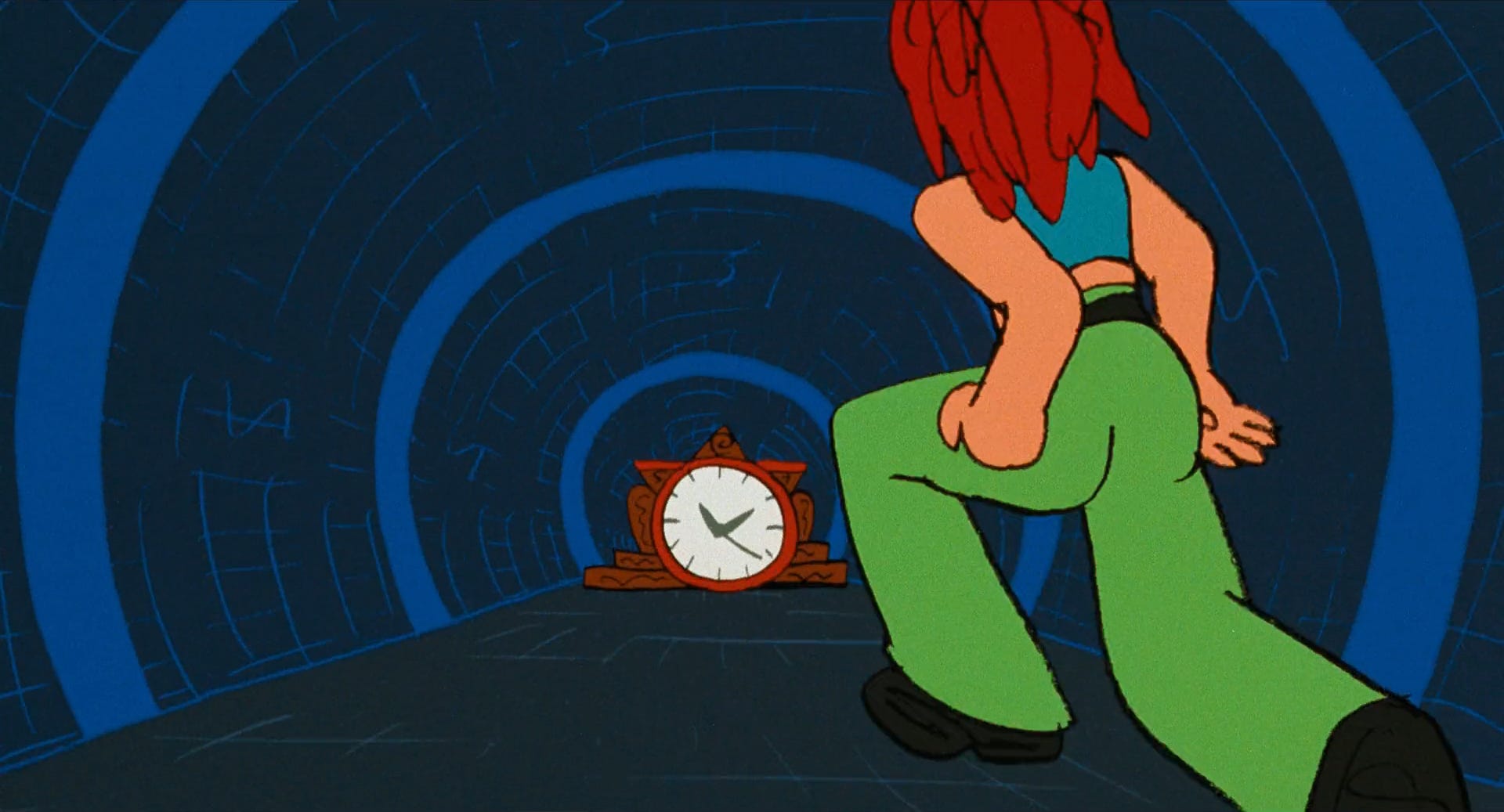
The exclamation marks are very much there in the pounding soundtrack, the swirling animated sequence, the bags tumbling through the air and the phone tumbling into its place on the hook. So much there that it’s hard not to notice that you’re not really in the hands of random chance. Maybe a butterfly wing can start a storm, but it strains credulity that a passing encounter with a stranger a moment or two before or after is going to lead to a profound transformation of character.
When Lola “solves” her money and narrative problems by winning twice in succession at the roulette wheel, the pretense that this is about choice and free will and chance all shatters like glass before Lola’s luck-altering scream. There is no chance here. What there is, is narrative contrivance and a filmmaker playing with genre tropes.
The genre in question is noir; Run Lola Run is a neo-noir, or a noir pastiche, depending on how you look at it. That’s because it’s a crime film, first of all. But it’s also because of the way it uses flashbacks and multiplies perspectives, and because of the way it obsesses over time.
Films like The Killers or Laura from the classic period of noir start in media res and then follow multiple investigators and narrators as they fill in the past and move towards the future, thematizing the disordered world of noir through disordered narrative conventions. This reaches a kind of quintessence in Kubrick’s 1956 The Killing, where the heist plays forward and back over multiple perspectives with split second timing, before finally deconstructing itself like some sort of dark self-destructive robot.
Tarantino, the Coen Brothers, and other filmmakers were inspired by these predecessors to even greater heights of fragmentation. Rul Lola Run is very much in that tradition. But it’s not really a film about the crazy random nature of life so much as it’s a film about the crazy constructed nature of film. Twyker runs Lola through her paces to demonstrate his mastery of a genre in which karma is a sadistic trap and dreams are doomed by countdown. There’s nowhere you can run in noir, because the universe contrives to run you to ground. Lola races across the city, and when she falls over, Twyker picks her up and turns the key in her back again. She despairs and dies for our amusement.
Part of the game Twyker is playing in showing that the despair and death is in his hands, though, is showing also that he doesn’t have to deal out despair and death. In classic noir, creators are further in the background, and the imposition of law and order and punishment is presented as the just or unjust dispensation of a righteous God or an indifferent universe, depending on the screenplay and your perspective.
Twyker’s pomo version, though, pulls off the Scooby Doo mask, which means that there’s no need to pretend that what’s under there is a death’s head when it’s after all just some filmmaker having a good time. Thus the improbable double (double) happy ending, where Lola wins twice on twenty and Manni gets the original money back anyway. It’s a movie not life, which means that all chance, and every butterfly, is yours to command. Even noir can end up dollar signs. Why not? You have as many tries as you need.
Brian De Palma did something similar in Femme Fatale a few years later, openly manipulating and repeating his narrative so that the standard noir ending—femme fatale and her patsy murdering each other—is whisked away down alternate paths and alternate pleasures. De Palma is a more baroque and more past-obsessed director, and Femme Fatale is much more ambitious in manipulating noir’s gendered tropes and narrative expectations than Twyker cares to be. Run Lola Run is ultimately just a goofy engine demonstrating that the artist can pull love and money out of noir. As critic Jonathan Rosenbaum says, that makes it something of a “no-brainer”. But it’s fun to watch, and to rewatch, even more than once.
Aside: Here’s an old blog post of mine about the translation and citation of a line in Lola rennt: https://111-words.ghost.io/football-lines/