

This weekend there were multiple mass shootings—one in Providence and one in Australia. Mass shootings in Australia are very rare because they have strict gun control laws specifically designed to stop mass shootings. Mass shootings in the US are very common because we have a large and politically powerful gun cult which feeds the great god “Freedom” with bullet-riddled human sacrifices.
Mass shootings are horrific, sudden, and traumatic. It’s understandable that they grab the bulk of the attention when people discuss gun violence. Nonetheless, mass shootings account for only a tiny fraction of gun deaths. The majority of gun fatalities—58% in 2023— are suicides. That means of the 46,728 people who died of gun related injuries in 2023, 27,300 were deaths by suicide. In contrast, mass shootings accounted for 105 deaths or 722 deaths, depending on the definition used. Guns were involved in 17, 927 homicides altogether.
The relationship between suicide and access to guns is rarely a subject for public discussion in the way that mass shootings are. Instead, suicide in public discourse has mostly in recent years been used as evidence of the neverending crisis of masculinity moral panic. Feminism, we’re told, drives men to despair and death—but the actual (supposedly) manly means by which people in despair kill themselves is carefully elided.
That’s because, as I’ve mentioned before, pundits and politicians are worried about masculinity, not men. In that context, pointing out that that icon of masculinity, the gun, is literally killing men is considered gauche and unhelpful. What if men chose their own health and well-being over manly guns?! Can’t have that.
—
I don’t write generic crisis of masculinity bilge, and therefore it is not easy for me to get mainstream freelancing gigs. You can help me write posts like this instead by becoming a paid subscriber. It’s $50/yr, $5/month.
—
Suicide, guns, and men
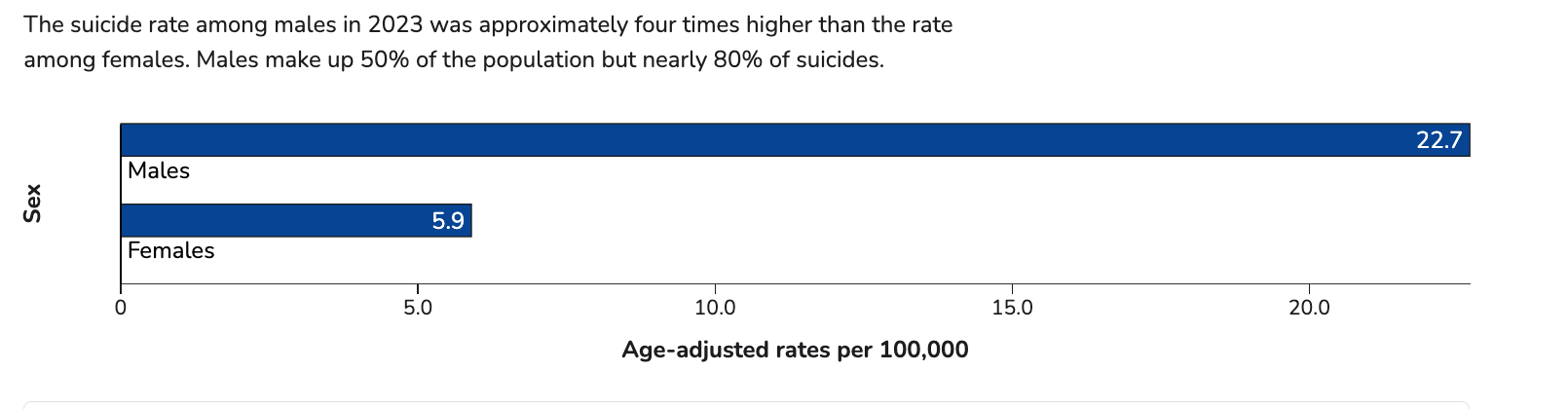
Male suicide rates in the US are four times higher than female rates; the CDC says age-adjusted male suicides are 22.7/100,000 as opposed to 5.9/100,000 for women. That means men account for about 80% of suicides, even though they are (slightly less) than 50% of the population.
Based on the discourse, you’d guess that the culprit in male suicide rates is the male loneliness epidemic. But when you look at actual health survey data, that epidemic—at least as a gendered phenomenon—is vastly overhyped. Men and women say they are lonely at about the same rates; 16% of both say they feel lonely or isolated all or most of the time; 38% say they sometimes feel lonely, and 47% say they never or hardly ever do.
There are some differences between men and women in looking at links between depression and suicide. Women are more likely to reach out to support networks when they feel isolated, for one. And for another, men are more likely to have guns.
In the US, 43% of men own guns to 22% of women; that’s double the number of male gun owners. Men also are much more likely to oppose stricter gun laws. Among people who own guns, 32% of men say they favor stricter laws compared to 40% of women; among non gun-owners, 69% of men favor stricter laws and 79% of women say they do.
In short, men own more guns and are more ideologically committed to guns. This jibes with a 2024 study which found that men who feel their masculinity is under threat are more likely to express positive attitudes towards guns. In our culture, guns are associated with men and manliness. Men feel like guns affirm their masculinity; many men think a gun makes them more of a man.
Men own guns. Men feel their identity is tied to guns. And as a result, men are a lot more likely to have a firearm available, and to pick one up, when they make a suicide attempt.
This is significant because firearms are statistically the most lethal suicide method, and because most people attempt suicide within 10 minutes of deciding to act, and will often not make an attempt if they cannot find a method immediately. If there is a firearm easily available, suicide completion is much more likely. And the people who are much more likely to have that firearm around are men.
There’s a lot of evidence that bears out this danger. Between 2007 and 2014, 60% of male suicides involved guns; only 30% of female suicides did. A study released this year found in people over 65, men were 13 times more likely to die by firearm suicide; 90% of individuals who died by firearm suicide were men. A study of suicide between 2017 and 2019 found that 55% of male suicides used firearms compared to only 30% of women. Again, that’s getting close to men being twice as likely as women to choose firearms to try to end their lives.
Masculinity is death
The disproportion here is slowly decreasing; many more women—especially Republican women—are owning guns. Very likely as a result, firearm suicide rates are rising among women.
These shifts show just how important identity is to gun ownership. Republicans have doubled down and doubled down again on guns as a symbol of partisan identity. Women who identify as Republicans buy more guns and when there is a gun in the home they are more likely to be a victim of gun violence.
Republican identity and male identity have a lot of crossover; Republicans consistently win male voters and Democrats consistently win women. Certainly, even if women’s gun ownership rates are creeping up, men continue to be the predominant gun owners, and they continue to see masculinity as allied with firearms. This puts men at hugely elevated risk of gun violence, and especially of gun-inflicted suicide. But despite all the discussion of men in crisis, this massive threat to men is mostly ignored.
Jordan Peterson tells men they need to clean their rooms, but he doesn’t ever suggest that maybe they shouldn’t have guns in those rooms. Scott Galloway bellows that there is no such thing as “toxic masculinity,” with nary a reference to the link between men and gun violence. California Governor Gavin Newsom rushes around praising right wing influencer Charlie Kirk for his outreach to young men, carefully avoiding any mention of Kirk’s veneration of guns and handwaving of gun deaths (“I think it’s worth it to have a cost of, unfortunately, some gun deaths every single year so that we can have the second amendment to protect our other God-given rights. That is a prudent deal. It is rational.”)
What does it mean when we praise as leaders of men someone like Charlie Kirk who glorifies guns? What does it mean when we insist over and over that Democrats, the party that overwhelmingly supports gun control, somehow has nothing to say to or offer men? What exactly are we doing here?
There’s no particular mystery. We’re telling men that guns are part of being manly, and that it’s better for them to be dead by gun than to be unmanly men without firearms. We’re saying, over and over, in bestselling books, on podcasts, in serious punditry, that masculinity is more important than men, and that we want masculinity to devour men and leave their corpses lying by the side of any convenient smoking barrel.
Men are not killed by feminism. They’re not killed by femininity. They’re not killed by women in the workforce, or by not cleaning their rooms, or by people pointing out that toxic masculinity exists, or by trans people, or by Democrats who dare to point out that Gavin Newsom sucks. They’re killed by guns. And anyone who talks about a “crisis of masculinity” and doesn’t mention guns is a fool, an unserious grifter, a ghoulish participant in a cult of death, or, quite possibly, all three.
Say it again for the people in the cheap seats. The statistical evidence is a nice touch. I enjoyed reading a fresh look at an old issue.
I will probably never be convinced that the ubiquitous presence of guns in TV shows and movies does not also make them seem more desirable and even necessary to men who see them as a masculine accessory. We now also have a Secretary of Defense who puts out a social media post saying, "We have only begun to kill narco-terrorists" and encourages maximum lethality.