

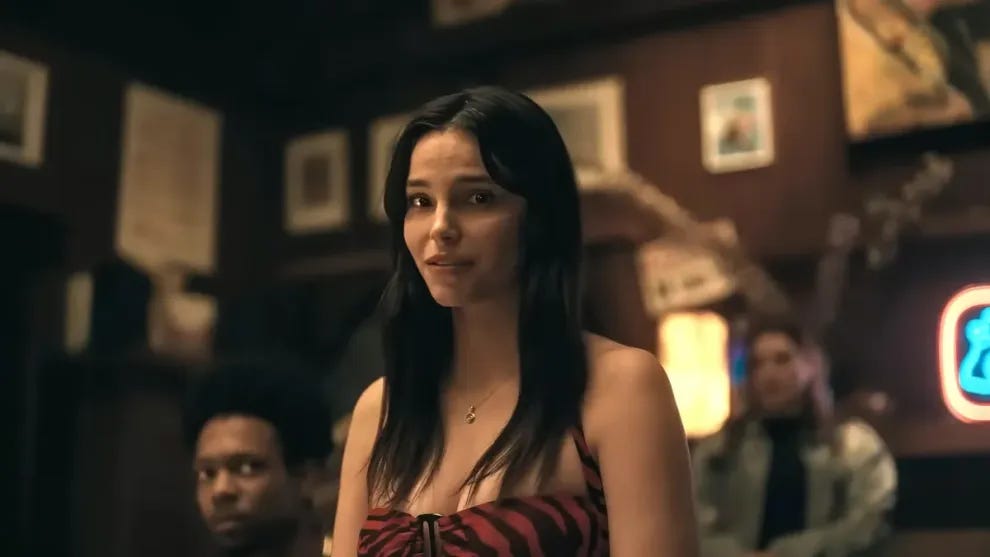
Early on in Curry Barker’s Obsession, Nikki (Inde Navarrette) tells Bear (Michael Johnston) that she’s writing a love story that is adamantly not a romance. It’s a meta-joke, since Obsession itself is a very unromantic horror story about love. But it also tells you that while this isn’t a romance itself, it is about romance—and particularly perhaps about the tropes of genre romcoms in Hollywood and popular culture which determine what love is supposed to mean, who is supposed to pursue it, and how.
The initial set-up is certainly romcom adjacent. Bear has a massive crush on his friend and music-store coworker Nikki, but can’t bring himself to tell her. He buys her a “One Wish Willow” stick as a gift, but is so gormless he can’t even hand it over—nor can he tell her when she directly asks him if he’s in love with her. In frustration, alone in his car, he breaks the stick and wishes that Nikki would be more in love with him than with anyone in the world. His wish comes true, turning Nikki into a psychotic obsessive stalker who flies into jealous rages when mutual friend Ian (Cooper Tomlinson) suggests a boy’s night out, or when coworker Sarah (Megan Lawless) mentions having feelings for Bear.
Nikki’s behavior grows increasingly erratic; she makes a shrine of his dead cat; she tapes the door of Bear’s apartment shut so he can’t leave for work; she stands in place all day waiting to come home, peeing and shitting on herself because she can’t even bring herself to go to the bathroom. As she escalates, Bear desperately demands, “Why can’t you be normal?”
But he doesn’t really want her to be the “normal” Nikki—the one who liked him as a friend. He wants her to follow the romance script he laid out. When her original self does somehow manage to speak to him while obsessed Nikki is asleep, he’s upset that she’d rather die than continue as his girlfriend, utterly ignoring her obvious, terrifying mental distress. He is angry, not that she has lost free will, but that she still has enough free will that she’s not fulfilling his fantasies correctly.
Bear’s frustration with Nikki is, perhaps, a mirror of the viewer’s frustrations with Bear. The romantic male lead is supposed to be the pursuer; often, in many classic romcoms, to the point of stalking and refusing to take “no” for an answer (“Say Anything” is one iconic example.) Bear’s passivity is intensely irritating in no small part because it goes against the gendered tropes. You want him to act, you want to punish him for not acting. And the universe (and/or the film) fulfills both wishes.
That fulfillment is through a kind of simultaneous process of doubling down and projection. Bear is pushed even further into the role of feminine passivity, as Nikki becomes the male-coded violent controlling stalker—screaming when he defies her, threatening to harm herself when he won’t do as she wishes, lashing out at others in jealousy. At the same time, though, Bear’s own creepy negation of Nikki’s agency is projected onto her; she ceases to be herself by becoming him, both in that she is inhabited by his desires and in the sense that she acts out the violent control for which his wish is a displaced metaphor.
The moral is obviously “be careful what you wish for.” But the film is so effective because the wish in question is a kind of cultural default—a story we tell ourselves about how love, and life, are supposed to go. And while romance is a genre associated with, and marketed to, women, the film suggests that is also a genre in which men have a great deal invested—and one which, at least as imagined or written through by men, erases both women’s identities and their experiences of horrific abuse and violence.
It’s intentional, I think, that Bear—who insists he loves Nikki, and who has pushed her into a living nightmare—never apologizes to her for his wish, or for destroying her life. And it’s also intentional, I think, that the viewer is encouraged to blame Bear, who is in the stereotypical position of abused domestic partner. The romance scripts can be bent and mutilated, but the ends snap around and can still cut you. Escape isn’t easy.
One of the best parts of the film is the bland affect with which the purveyors and manufacturers of the One Wish Willow respond to Bear’s desperate pleas for help. When he begs the store clerk at the crystal store to provide him with another wishing stick, the guy tells him he’s got too much negative energy. When he calls the number on the back of the box and demands the help desk respondent change the wish, the stoned voice on the other end tells him “we don’t really do that.” Then the voice asks if he wants to talk to Nikki, and you hear her screaming. Some portion of her, apparently, is at wish headquarters, standing by the help desk, losing her soul.
The people who create and distribute the wish fulfillment know that it works; they know it can go horribly wrong. But they don’t feel any particular urgency about it, just as, perhaps, the Hollywood writers who pen stalker fantasies as romance don’t feel any particular guilt or investment in what people do with those fantasies. If people follow the scripts to their doom, that just means they need to reset their vibes. But Obsession suggests taking control of those dreams isn’t so easy. For both men and women, love—or romance—can grab your brain and squeeze.
I wasn’t interested in seeing this but now I really want to.