

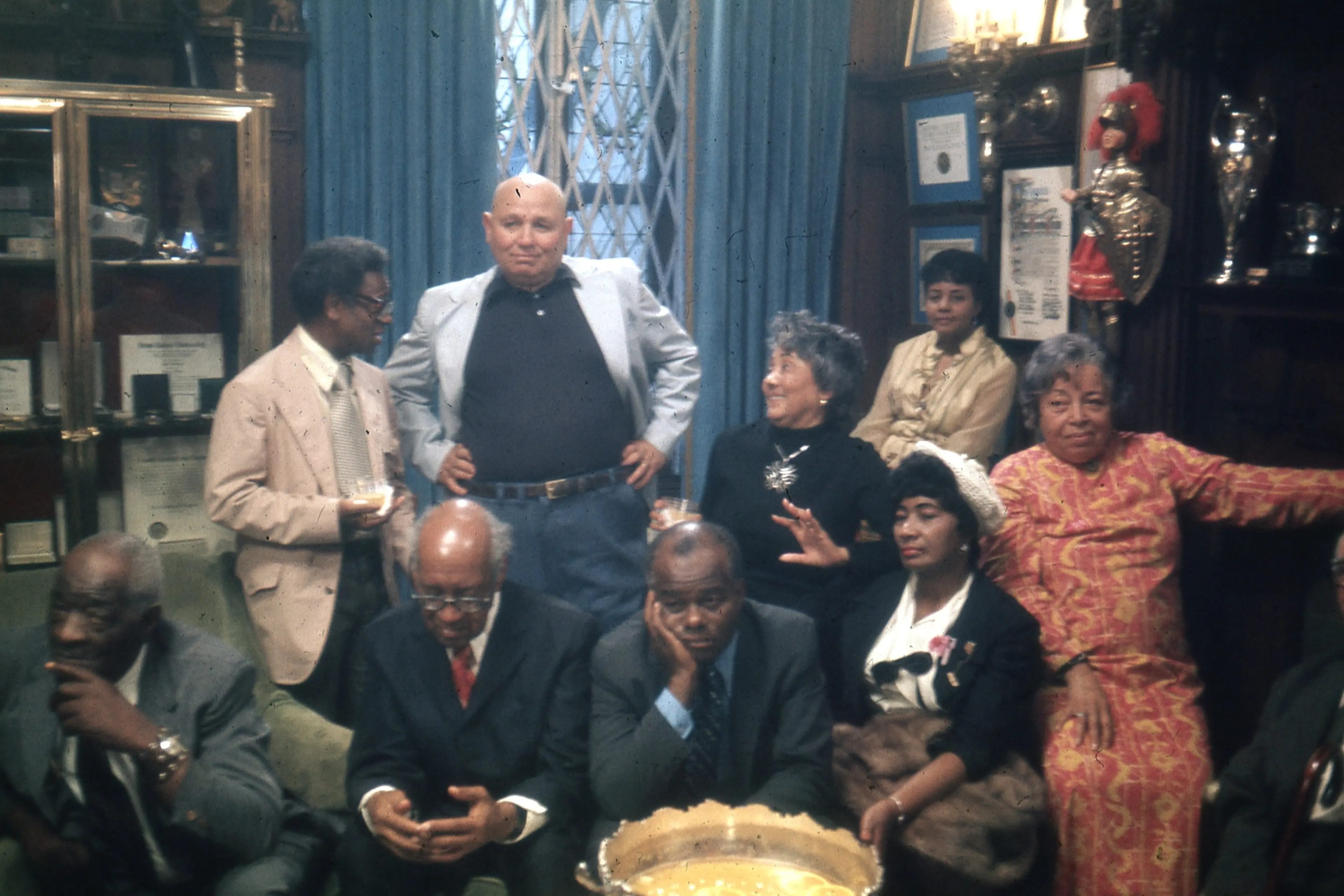
Once Upon a Time in Harlem documents a house party from 1972 hosted by filmmaker William Greaves at which the surviving luminaries of the Harlem Renaissance gathered in Duke Ellington’s apartment to reminisce, boast, argue, and remember absent friends. More than fifty years later, Greaves’ son, David, finally put the footage together, interpolating also older photographs and art, creating a sometimes breathtaking, sometimes clunky, always fascinating look at multiple pasts and histories. These seem, during our current racist assault on Black art and Black achievement, more vital and necessary than ever.
That assault on Black lives and voices is, as many of the anecdotes here remind us, of longstanding. One attendee talks about how Bill Robinson tried to shake Charles Lindbergh’s hand and was rebuffed because Lindbergh was, of course, a Nazi piece of shit. Society editor Gerri Major recalls being spat on by a white person when she attended the Cotton Club.
Sometimes, these acts of dehumanization inspired powerful art of resistance— Claude McKay’s fierce poem “If we must die,” as one example, which activist Richard B. Moore recites out loud as chilling images of the kinds of lynchings which inspired it appear on screen. Other times the responses are less direct, but no less telling—one attendee notes that the greatest tribute to Lindbergh was the dance the Lindy hop, performed by Black dancers with a joy and grace that defied the racist airmen who, hopefully, resented the hell out of it.
And then sometimes, art doesn’t necessarily get the last word. When Greaves asks Gerri Major how she responded to the white person who attacked her, she looks lost, even decades later, and says she was too shocked and hurt to do anything. That echoes with one anecdote about a young artist who visited the workshop of sculptor August Savage and was shocked to discover such an important and celebrated artist wedged into a room in the basement, behind a boiler. The power of Black creation and Black achievement exists alongside a white world which hordes resources and contempt. The film chronicles triumphs and pride, but not, unfortunately, a decisive victory.
The sense of shared struggle unites the dignitaries. But that doesn’t mean they don’t still have things to argue about. Ida Mae Cullen admonishes the throng that they haven’t paid sufficient tribute to her late husband, the poet Countee Cullen. Artist Romare Beardon tells a historian that his recent book about the Harlem Renaissance doesn’t spend enough time on the visual arts. Richard B. Moore loudly denounces poet and painter Richard Bruce Nugent for using the term “Negro”. Fierce old radical Louise Thompson Patterson speaks up (as was her wont) and insists that the group hasn’t devoted enough attention to women artists (someone else volleys back that Patterson should talk about herself—but alas, she doesn’t.) And, of course, many of the attendees enthusiastically denounce the younger generation for not remembering their elders—a universal complaint among aging people everywhere.
As interesting as the discussions we see, perhaps, are those we don’t. The legendary pianist Eubie Blake—85 at the time of the film—tells those around him, “To be here with all these intelligentsias, I’m afraid to open my mouth.” It’s a joke and treated as a joke—but it’s not just a joke. By 1972, ragtime and jazz were thoroughly validated as music and cultural expression in African-American artistic circles, but—as Blake clearly remembers—back in the 20s and 30s, their status was still contested. W.E.B. Du Bois (who is of course mentioned with reverence) saw jazz as déclassé and disreputable—so much so that he refused to let his daughter Yolande marry her boyfriend, the great bandleader Jimmie Lunceford. Instead, she became the first wife of poet Countee Cullen; their wedding was one of the major social events of the Renaissance.
That marriage ended in disaster, largely because Cullen was at that time more sexually interested in men than women. This is, presumably, not the aspect of her husband’s life that Ida Mae (his second and last wife) wanted to hear discussed. And, in fact, the closest anyone comes to talking about the importance of queer artists and queer identity in the Harlem Renaissance is a brief glimpse of Richard Bruce Nugent’s illustration of queer icon Salome. Nugent was one of the few Harlem Renaissance artists who wrote explicitly (not just implicitly) about queer desire at the time, which means that in tiptoeing around the issue, the film in 2026 is more timid about gay identity than Nugent was literally 100 years earlier when he published his classic short story, “Smoke, Lillies, and Jade.”
Perhaps the loudest undiscussed issue in the documentary is the political views of writer George Schuyler. During the Harlem Renaissance, Schuyler was a socialist with some contrarian views; in the documentary he talks about writing a piece in the Nation in 1926 in which he argued that there was no such thing as Black art, only American art. At the party, he is more dismissive than his peers of Marcus Garvey and the back to Africa movement.
But these minor squabbles don’t really hint at where Schuyler’s ideological journey had taken him by the 70s. He had become more and more conservative over time. In the mid 60s he denounced federal Civil Rights legislation as an attack on individual rights and joined the John Birch Society. He supported Barry Goldwater for president and argued that Black people shouldn’t fight against South African apartheid. The NAACP picketed his appearances; baseball legend Jackie Robinson called him a Judas. In this context, his rather bland statement on camera that it’s important to hear out differing points of view becomes much less anodyne; Schuyler is quietly saying that Black people in 1972 should be more open to racist advocacy such as his own.
Would the documentary be more illuminating or truthful if it had dealt more directly with issues which the filmmakers chose deliberately not to broach or engage with? Possibly. On the other hand, no history is entire; you’re bound to leave something else, be it the visual arts, Louise Thompson Patterson’s onetime Stalinism, or Countee Cullen’s queerness. Once Upon A Time in Harlem documents a music, an art, and a culture that America has at various times—like right now—tried to erase, forget, or defang. In that context, everything the movie says, and even everything the movie does not quite say, is valuable.