

—
Everything Is Horrible is entirely supported by readers. If you find this essay valuable, please consider becoming a subscriber so I can write more such. It is $50/yr, $5/month. You can also tip me at paypal.
—
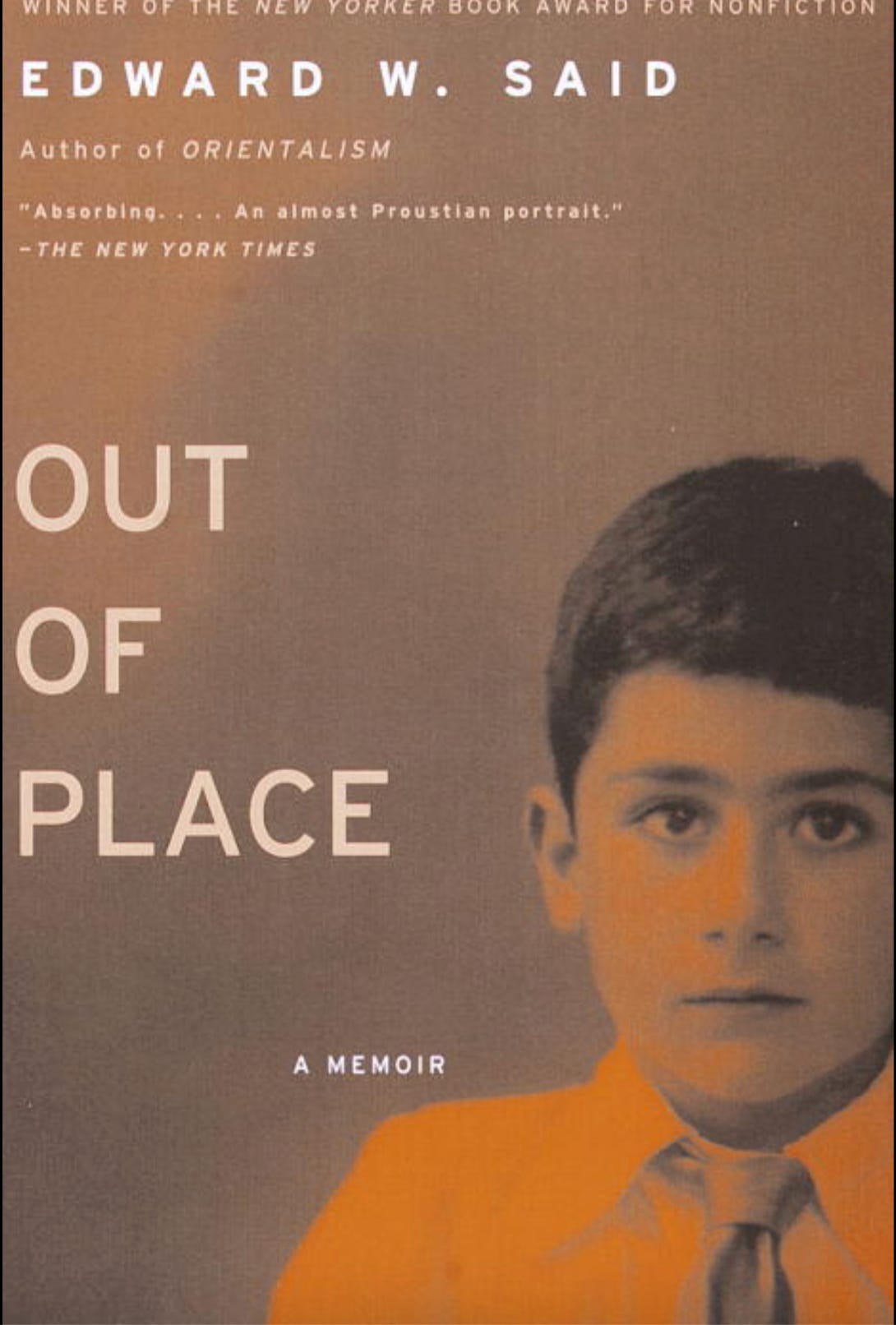
The title of Edward Said’s 1999 memoir, Out of Place, refers, most obviously and most directly, to his Palestinian heritage and to the history of Zionist, colonialist dispossession which shaped him and his scholarship. To a contemporary reader, though, and perhaps especially to a neurodivergent one, it’s hard to read the memoir without concluding that Said’s displacement involved, not just ethnicity and race, but disability.
Said did not identify or recognize his own neurodivergence, and (as far as I’ve been able to find) no other scholars seem to have discussed it either. But that only makes the pretty obvious markers of autism in his memoir more poignant, and at many points more harrowing.
Said was one of the greatest, most penetrating cultural critics in history, and he devoted much of his work to analyzing the intellectual tools with which the West dispossessed Arabs, Muslims, and Palestinians of their land, their rights, their heritage, their stories, and their humanity. He wrote out of a powerful belief that to right wrongs, you must first name and understand them. But his memoir makes it clear that he was never himself able to name or understand certain aspects of his own marginalization and of his own dispossession and abuse.
This does not make Said’s achievement less. On the contrary, I hope that discussing Said’s autism can help make that achievement clearer, and perhaps in a small way help to expand it.
“Some deep flaw in my being”
Again, in his memoir Said explains his sense of displacement in part through his unique family background. His parents were Protestant Christian Palestinian Arabs living and working primarily in Egypt; his wealthy father also had American citizenship. He grew up equally fluent in Arabic and English. These criss-crossing identities and allegiances left Said feeling removed from his peers and his milieu—and ever moreso in his tweens and later as Israel became established and cut his family off from his relatives and from his homeland.
But while Said highlights these factors, he also says, with ambivalence and confusion, that they do not seem to entirely account for his own sense of displacement. The opening of the memoir is typical in the way it emphasizes his alienation not from his nation or country or people, but from his own parents and siblings.
All families invent their parents and children, give each of them a story, character, fate, and even a language. There was always something wrong with how I was invented and meant to fit in with the world of my parents and four sisters. Whether this was because I constantly misread my part or because of some deep flaw in my being I could not tell for most of my early life. Sometimes I was intransigent, and proud of it. At other times I seemed to myself to be nearly devoid of any character at all, timid, uncertain, without will. Yet the overriding sensation I had was of always being out of place.
Said returns again and again, obsessively, to this “deep flaw in [his] being”—the sense of failing to perform his self correctly for his family, for his peers, for his teachers. He struggles to articulate what that flaw was or what it means, but its presence is the inescapable, painful defining fact of his life—an unspeakable, unseeable wound.
There is a great deal of evidence that that wound is neurodivergence or autism. Some of this evidence is straightforward. Said laments his poor posture and his insomnia—both very common among neurodivergent people. He also mentions in passing that he is extremely averse to looking in people’s eyes.
To be looked at directly, and to return the gaze, was most difficult for me…. When I began to teach as a graduate student in the late fifties I found it imperative to take off my glasses in order to turn the class into a blur that I couldn’t see. And to this day I find it unbearably difficult to look at myself on television, or even read about myself.
Other indications are perhaps less clear cut, but they take on an inexorable weight over the course of the memoir. Chief among these are Said’s special interests—areas of fascination which constantly distract him from his studies and his supposed social duties.
My ability to appear to be studying, reading, or practicing the piano and at the same time to be thinking about something completely different and completely mine… was one of the features of my life that irritated teachers and parents but impressed me.
Some of the things Said thought about, privately, where no one could see, were various, goofy—and often, for those familiar with neurodivergence, recognizable. While he was irritated and bored with his piano lessons, for example, he was increasingly fascinated and obsessed with classical music, listening to his few recordings over and over and scouring newspapers, printed matter and his one dog-eared encyclopedia for hints about the backgrounds and history of conductors and opera stars. just
Similarly, a book of Greek myths set Said off on a years-long fugue of private Greek myth fan fiction.
I thought about them when they were not killing lions or monsters. I released them for a life of easy grace free of obnoxious teachers and hectoring parents, Perseus talking with Jason on some airy patio about what it was like to see Medusa in his shield, Jason telling Perseus about the pleasures of Colchis, the two of them marveling at Hercules’ killing of the serpents in his cradle.
Said even turned his own isolation into opportunities for fantasy. He had few friends and rarely visited other’s houses; that led him, he said, to “One of my earliest and most long-lasting passions”— daydreams about how other people’s houses were organized, including meticulous speculation about what they kept in their drawers, how their night tables were arranged, what was on their bookshelves.
This inner life, for Said, was interdicted; he knew he was not supposed to express it or acknowledge it. He had to hide it—or, in neurodivergent terms, he had to mask. He describes this process with merciless clarity.
I began to notice the almost absolute separation that existed between my surface life at school and the complicated but mostly inarticulate inner life I cherished and lived through the emotions and sensations I derived from music, books, and memories intertwined with fantasies. It was as if the integration and liberty I needed between my selves would have to be endlessly postponed, although I subliminally retained the belief that one day they would somehow be integrated.
“Remember what Miss Clark said”
Perhaps the most convincing testimony to Said’s neurodivergence, though, is the way in which he is treated by others. His family, his teachers, and his peers all subject him to grinding, relentless, emotional and physical abuse.
In Said’s milieu (as in ours, unfortunately) corporal punishment—that is, physical abuse of children—was standard and accepted. That doesn’t change the fact that Said was beaten by both his father and his teachers specifically for neurodivergent sins—failure to focus, failure to observe social cues, failure to fit in. Said notes that his father’s physical attacks in particular “instilled a deep sense of generalized fear in me, which I have spent most of my life trying to overcome.” In other words, his PTSD lasted into adulthood and even into old age.
The physical abuse lasted into adulthood too. Said notes that his father had a “near obsession” with his posture, and that the elder Said was still attempting to straighten his son’s back in 1957, when Edward had just graduated from Princeton. Said writes that his father took him
to a brace and corset maker in New York in order to buy me a harness to wear underneath my shirt. What distresses me about the experience is that at age twenty-one I uncomplainingly let my father feel entitled to truss me up like a naughty child whose bad posture symbolized some objectionable character trait that required scientific punishment.
This was of course framed as an issue of health and correction. But it is also a literally corporal punishment for neurodivergence, which sparked in Said traumatized feelings of guilt, humiliation, self-recrimination, and regression.
Physical abuse was accompanied, as you’d expect, by emotional abuse. Said was very close to his mother, but he feels that she often used that closeness as an emotional lever to isolate or manipulate him. Much of that manipulation involved her telling him, over and over, in various ways that he was broken, wrong, and inadequate.
One particularly ugly example involved a middle-school teacher named Miss Clark. Clark watched Said during a field trip and noticed that he was distracted and inattentive. On the class return, she singled him out (to his complete and utter surprise), lambasting him mercilessly: “I have never seen anyone so unable to concentrate, so inconsiderate, so careless and sloppy.” Said, still obviously stung decades later as an adult, sums up the incident:
The power of what Miss Clark said about me was that it collected all the negative and critical comments that had loosely surrounded me at home and at [school], and concentrated the whole lot into one unpleasant steel container, into which I was placed, like Jell-O poured into a mold.
Miss Clark also contacted Said’s parents. They did not defend their child. Instead, they embraced her view of him, not just in the moment, but for all time.
What exactly was said about me I never knew, but it resonated in my mother’s speeches to me for years and years. “Remember what Miss Clark said” was the refrain used to explain both my lack of proper focus and concentration and my chronic inability to do the right thing. So in effect Miss Clark’s awful opinion of me was prolonged and given additional reach by my mother. It never occurred to me to ask my mother why she allied herself so unskeptically with someone who seemed to be moved not by pedagogical but by sadistic, instinctual imperatives.
One plausible reason for his mother embracing Miss Clark’s perspective is that she felt it codified and weaponized her own amorphous but deeply felt ableism. Said’s parents, like his teachers, saw that he was different, and that difference presented itself to them as inadequacy, immorality, perversion, failure. They were angry and disgusted by Said’s neurodivergence, and they wanted him to know they were angry and disgusted, perhaps to correct him, perhaps to distance themselves from him and position themselves as superior to him. They were keeping their autistic son in his place in that Jell-O mold—a place that he knew was not his, but that he could not ever fully escape.
“I began a lifelong struggle”
Said’s memoir is not (solely) an indictment of his parents. He is careful to acknowledge their support and influence, financial and emotional, even as he expresses bewilderment as to why that support was mixed with such vicious, sustained cruelty.
Recognizing Said’s autism can’t of course explain his parent’s behavior. But it does put it into a more coherent context. Neurodivergent children are often misunderstood by their families; they are often bullied by peers, teachers, and students alike. Said’s description of his encounter with Miss Clark—the way that her hatred and cruelty seemed to come out of the blue, framing him as a failure and a delinquent according to rules he didn’t understand and didn’t even know existed—is going to be very familiar to a lot of neurodivergent people.
Said’s responses to that bullying are also familiar—both in his bewilderment, and in his growing sense, across his life, of righteous rage. Neurodivergent people often struggle to navigate social cues and rules, in part because they feel that those rules should be equally or logically applied, and are acutely aware that they are not.
Said, for example, recounts how on the tennis court he was told never to give quarter and to force the other player to work for everything. Then, during one game, when he refused to pick up a ball which may have been closer to him, he was reprimanded for not picking it up and being a good sport.
This injustice—and other’s much more serious—filled Said with fury. He explained:
I began a lifelong struggle and attempt to demystify the capriciousness and hypocrisy of a power whose authority depended absolutely on its ideological self-image as a moral agent, acting in good faith and with unimpeachable intentions. Its unfairness, in my opinion, depended principally on its prerogative for changing its bases of judgment. You could be perfect one day, but morally delinquent the next, even though your behavior was the same.
It is easy to see how this passage is rooted in both Said’s experience as a neurodivergent child, and in his experience as a colonized subject. This is the boy whose father insisted he wear a truss to conform to his definition of normality. It is the man who brilliantly exposed the hypocrisies of centuries of Western Islamophobia and bigotry.
Thinking about Said’s neurodivergence also helps us see how the bigotry he (and not he alone) faced may have been intersectional or overlapping. During his time at Mount Hermon high school in the US, Said had one of the highest grade point averages, and should have been declared valedictorian or salutatorian. But he was not. He explains the school’s unfairness. He say on the one hand that he was discriminated against because he did not have “the right attitude.” And on the other, he suggests that at a white institution, at a time of rising prejudice against Arabs, he was “marginal, non-American, alienated, marked.”
Neither of these explanations need exclude the other. On the contrary, they are interlocking and reinforcing. Mount Hermon officials probably did not say to each other explicitly, “Edward Said is an odd guy and an Arab; he can’t represent the school.” Instead, they probably said something like, “Edward Said is not right to represent the school”—and by that they meant both that he was neurodivergent and that he was not sufficiently white. Perhaps if he had been neurotypical, and had fit in more seamlessly, they could have forgiven his Arabness; probably if he was white they could have forgiven some eccentricity. But someone who transgressed the boundaries of both whiteness and neurotypicality was simply beyond the pale (in various senses.) Disability here, as often, serves as an excuse and a trigger for racism. At the same time, racism, serves as an excuse and trigger for ableism.
Or, to put it another way, Said’s neurodivergence made him unable to successfully deploy respectability politics. His parents were upwardly mobile; Said’s father was an extremely successful businessman who had obtained American citizenship. His family attempted to leverage their social standing to combat and offset increasingly dire colonial and racist dynamics targeting them and their milieu. That’s perhaps why they were so frustrated with, and so abusive towards Said when he failed to jump through the hoops that were supposed to lead him to status, just as they were frustrated with and frightened by his increasing engagement with politics and anti-Zionism.
That engagement grew out of his own background and history—his child’s eye view of relatives, friends, and acquaintances left destitute and desperate by the nakba; his witness as his beloved aunt devoted her money, time, and life to aiding refugees; his sadness at being unable to return to his family’s home in Palestine; his own encounters with racism and condescension in British and American schools. It also, though, I think, grew out of a sense of displacement, and a hatred of injustice, rooted in his neurodivergence. As he says in the quietly defiant concluding line of his memoir, “With so many dissonances in my life I have learned actually to prefer being not quite right and out of place.”
This increases my regard for Edward Said even more. To achieve what he did, in the face of the odds against him, is even more admirable than I'd thought. Thank you, Noah, for this appreciation!
I didn't know anything about Said before your essay. Thanks for the enlightening words. I think you are spot on on your assessment regarding his neurodivergence.
I loved his analogy about being placed in a mold, like jello. It makes me think about Odo a character on Star Trek Deep Space 9 who is a shapeshifter and sleeps as a gelatin in a canister when he is not in his human shaped form. I believe Odo also represents neurodivergence. He was found by a human who raised him to "be human". Odo recounts the long hours it took him to achieve a human physical form and to eventually imitate human behavior and social norms. Even in his final form he was never able to perfect the human face. So his face looks noticeably different. This marks him as a non-human.