

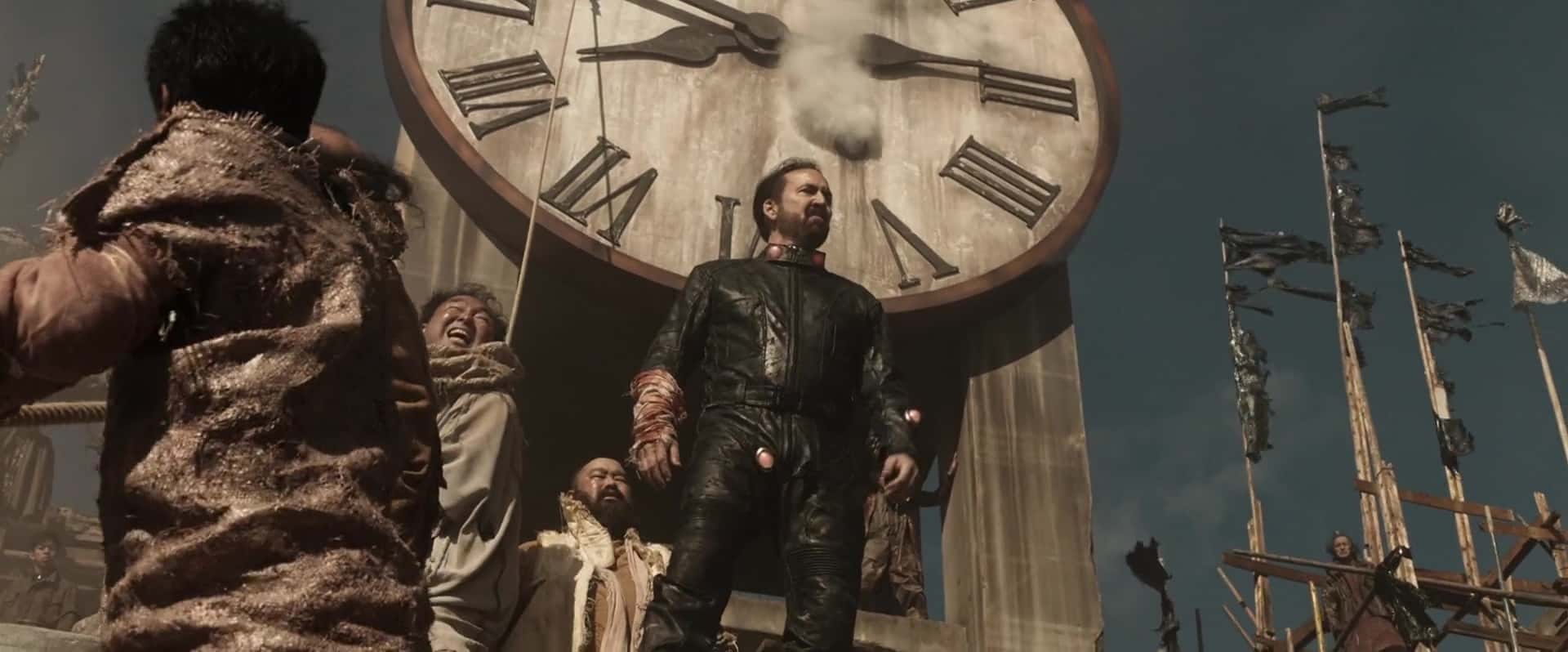
Sion Sono’s Prisoners of the Ghostland is one of those retro future dystopias that makes you nostalgic for an earlier, more stylish totalitarianism than the one we’re currently living through. It helps, too, that the narrative is largely incoherent, robbing it of both ominousness and tragedy. Instead, you are just supposed to float through the grimy, spurting pomo signifiers—Sergio Leone, John Woo, Mad Max, westerns, samurai flicks, Nicolas Cage ranting pointlessly as his testicle is blown off. You know the drill.
—
Everything Is Horrible is having a sale; 40% off, $30/yr. Please consider joining the newsletter so I can keep scribbling weird little essays about weird movies. And other things!
—
To the extent that there’s a plot, it seems to involve a notorious bank robber with a heart of gold, Hero (Cage), who is imprisoned in a frontier border town/Japanese village during a heist gone wrong, only to emerge into a post nuclear apocalypse. The ruler of what’s left of civilization, the white-clad Governor (Bill Moseley) orders Hero to find his “granddaughter” Bernice (Sofia Boutella) who has fled sexual servitude into the cryptically deadly Ghostlands. To ensure Hero’s compliance, the Governor outfits him with a leather ensemble which will blow his arm off if he attacks Bernice, blow his head off if he doesn’t return in time, and blow his testicles off if he attempts to sexually assault her.
The narrative summary is absurd in itself, but it doesn’t really get at the film’s determined, nonchalant strangeness. Sono only cares about the hero quest because it references other hero quests, or maybe because it gives him a melody to riff near and then abandon. Much of the film is given over to scenes of Hero having body bits blown off, falling over and experiencing long flashbacks before getting up and falling over again. Bernice is turned into a living mannikin, complete with plastic pieces stuck to her; the village leader who’s convinced that all is hopeless reads passages from Wuthering Heights; Ratmen scurry around with weird constructs taped to their shoulders. A phalanx of men strain at a rope as they attempt to keep a giant clock from advancing—which is maybe possibly related to the fact that the Governor’s minions sing “Grandfather Clock” and that he shrieks “tick tock!” as part of his general abusive creepiness.
The men at the rope say they want to stop time, and that’s perhaps the goal of Sono as well. This isn’t really a vision of a nightmare future, nor of an exciting adventurous past, Western or Eastern. Instead, Sono offers a series of tableaux deliberately set loose from chronology, narrative, and sense, though it casually references all three. Blood falls on a rose, nightmare, vaguely samurai-like figures rise from the mist; that clock rises against a purplish decaying industrial landscape, Nicolas Cage stands before a large group of women wearing very tight underwear to their delight and horror. And of course there’s a western shoot-out/samurai battle, including a machine gun massacre because someone left a machine-gun just standing there where anyone could use it.
It’s easy to dismiss this sort of thing as a decadent exercise in pointless and self-indulgent bricolage. And certainly I experienced at least a few moments of irritation while watching. But there’s also a pleasure in wandering around in a landscape, and a movie that is so deliberately refusing to go anywhere in particular, detached alike from its own heroism, its own destiny, and its own apocalypse. The prisoners of the Ghostland here are maybe the moviegoers themselves, trapped in that future-past that is aesthetics—romantic novels, people turning into mannikins, people trying to pull themselves outside of time.
Which is why, perhaps, Bernice keeps repeating “you’re free” over and over at the end with a certain desperation and why the last image is of her and Hero on a bench with another bloodied friend looking much more exhausted than joyful. The movie ends, and we’re liberated, which means and we’ve all got to go back to an unfortunately more coherent disaster. Part of the magic and beauty of movies, Sono seems to say, is that at least for a little bit they and you don’t need to make any sense.
i get the feeling that watching a production of a failson dystopia film is actually entertaining as we dwell within the current construction of such a failson dystopia… if we're lucky.
same vibe with BD McClay's film review today.