

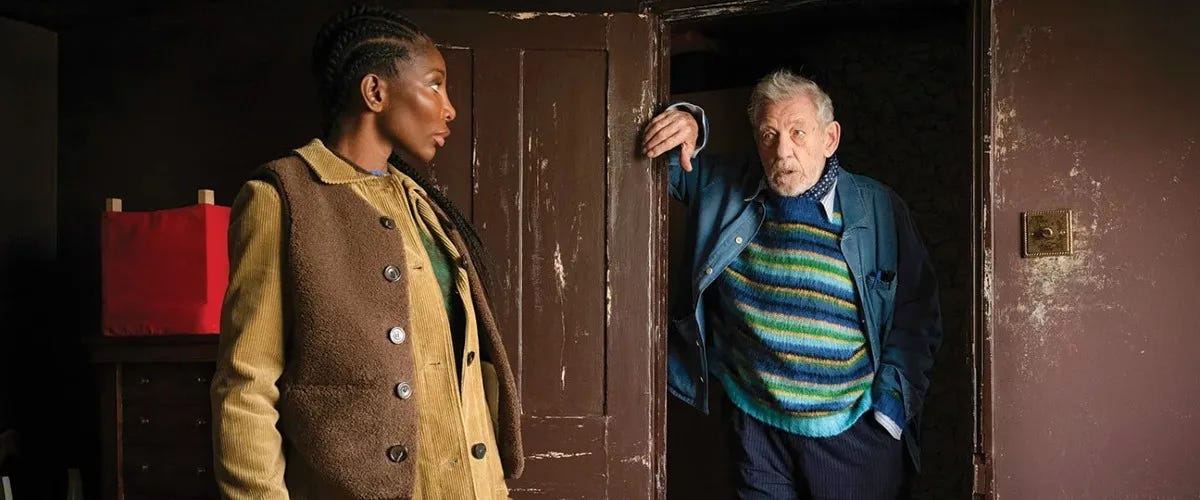
Steven Soderbergh’s The Christophers is a hackneyed and stagey two-hander in which a crotchety asshole first abuses and then is redeemed by a younger interlocutor. It is familiar and sentimental, with every twisty surprise falling into place with the dull thud of heartstrings being relentlessly pulled. If you needed confirmation that Soderbergh’s inspiration has burnt out, this is it—though there is, still, a lingering spark provided by the fact that the film is about an artist whose inspiration has burnt out.
—
Everything Is Horrible is entirely supported by readers. If you find this essay valuable, please consider becoming a subscriber so I can write more such. It is $50/yr, $5/month. You can also tip me at paypal.
—
That artist is one Julian Sklar, played with maximum irascible ham by Ian McKellen. Sklar was an art star once, especially noted for a series of paintings featuring his then-lover Christopher. When Christopher left him, however, so did inspiration. He ceased to create for the last 20 or 30 years of his life; for income he eventually was reduced to appearing on a crappy television reality show where he insulted the art of young hopeful’s for laughs.
Julian’s venal, useless, and estranged children Sallie (Jessica Gunning) and Barnaby (James Corden) hope to make up for the shamble of their inheritance by hiring artist and sometime forger Lori Butler (Michaela Coel) to “finish” the remaining nine Christophers in their father’s style. They will then sneak them back into the attic where they have languished for years, and when they are discovered after his death, the family will be able to sell them for millions.
To advance the plot (in various senses), Lori takes a job as Julian’s assistant. Much of the film from there is the two of them talking, with Julian spiraling off into rhapsodies of self-regard interspersed with revelations of pained self-hatred while Lori responds with quietly dignified amusement, irritation, and/or hurt.
Part of the conceit is that Lori was herself inspired to paint by Julian, and she is essentially the foremost (unacknowledged) expert in the world on his work. The two share a knowledge of art and a sensibility that connects them and elevates them above the gross banality of Julian’s children. By appreciating and admiring their emotional journey, you the viewer join them in connoisseurship. The film is in part about how Lori and Julian grow by appreciating each other, but it’s also about how you, as the viewer, grow by appreciating both of them.
This is all itself incredibly stock, not least in the way in which the hoary tropes and the maudlin celebration of the life of the artist are meant to tantalize audience members with the idea that they are participating in high-art appreciation rather than middle-brow schlock. The film itself has little real interest in art—either visual or filmic. You see only brief glimpses of Sklar’s work (actually painted by talented mimic Barnaby Gorton) and even less of Lori’s—certainly not enough to appreciate it on its own merits outside of its narrative position. Nor is the movie shot with the verve or experimentation that Soderbergh sometimes brings to his films; the cinematography is neither scrappily inventive as in Schizopolis, nor visually arresting as in Solaris. It’s efficient and competent, and that’s pretty much it.
And yet, it’s hard to miss the way that the movie’s failures are (intentionally or otherwise) thematized. Soderbergh is much younger than Julian, and his career has been much more consistently lucrative. But it’s also true that his young insouciant promise has been, if not squandered, then at least diluted by his (lucrative) compromises with Hollywood and (especially) by his apparent lack of interest in quality control over his scripts or projects. As I mentioned when I did a series of Soderbergh retrospectives for Splice Today, the director seemed like he could have had a career like the Coen Brothers or Tarantino, where his movies became a genre in themselves. Instead, he’s made some good movies (including last year’s Black Bag) and some bad ones (like the recent Presence) never settling on any one style long enough to really make it his.
The musings in The Christophers about what art is fake and what is real and who is the real painter are all pretty banal; the art world’s been exploring that discussion for over a century at this point, and yes, Andy Warhol (insulted in a brief aside in the film) has more interesting things to say about it than Soderbergh does. The question of what art is good, and of how you can even tell when you’ve sold out your own genius, on the other hand, takes on a certain poignance when it appears in a movie directed by a guy who is, arguably, while you watch, selling out his own genius precisely by hectoring you with no particular insight about the virtues of art. Equating inspiration with love, and its disappearance with the end of romance, allows Soderbergh to neatly circumvent any consideration of the kinds of career decisions and artistic choices which might lead you, at the end of a storied career, to blithely invest your time and effort in a film which lies about art-making in ways that you have to know are tedious and clichéd.
All of which is to say, The Christophers isn’t good, and it certainly isn’t so bad it’s good. But if you’re a Soderbergh completist, you might be somewhat diverted by a film that is arguably about the director’s failure to make a better movie—and about his failure to grapple with the better movies he could have made, and maybe still could if he wanted to. Which, this film indicates, he does not.
I'm a Soderbergh fan and was curious about this film even though it sure looked iffy. Thanks for saving me from watching it!
Could be interesting, in a bleak way, to do a comparison of trite depictions of artists and their process. I'm thinking of the movies Life Lessons and Girl With a Pearl Earring and the play Red, but I'm sure there are numerous other examples. (I've been told I simply saw a bad production of Red, but I'm skeptical.)