

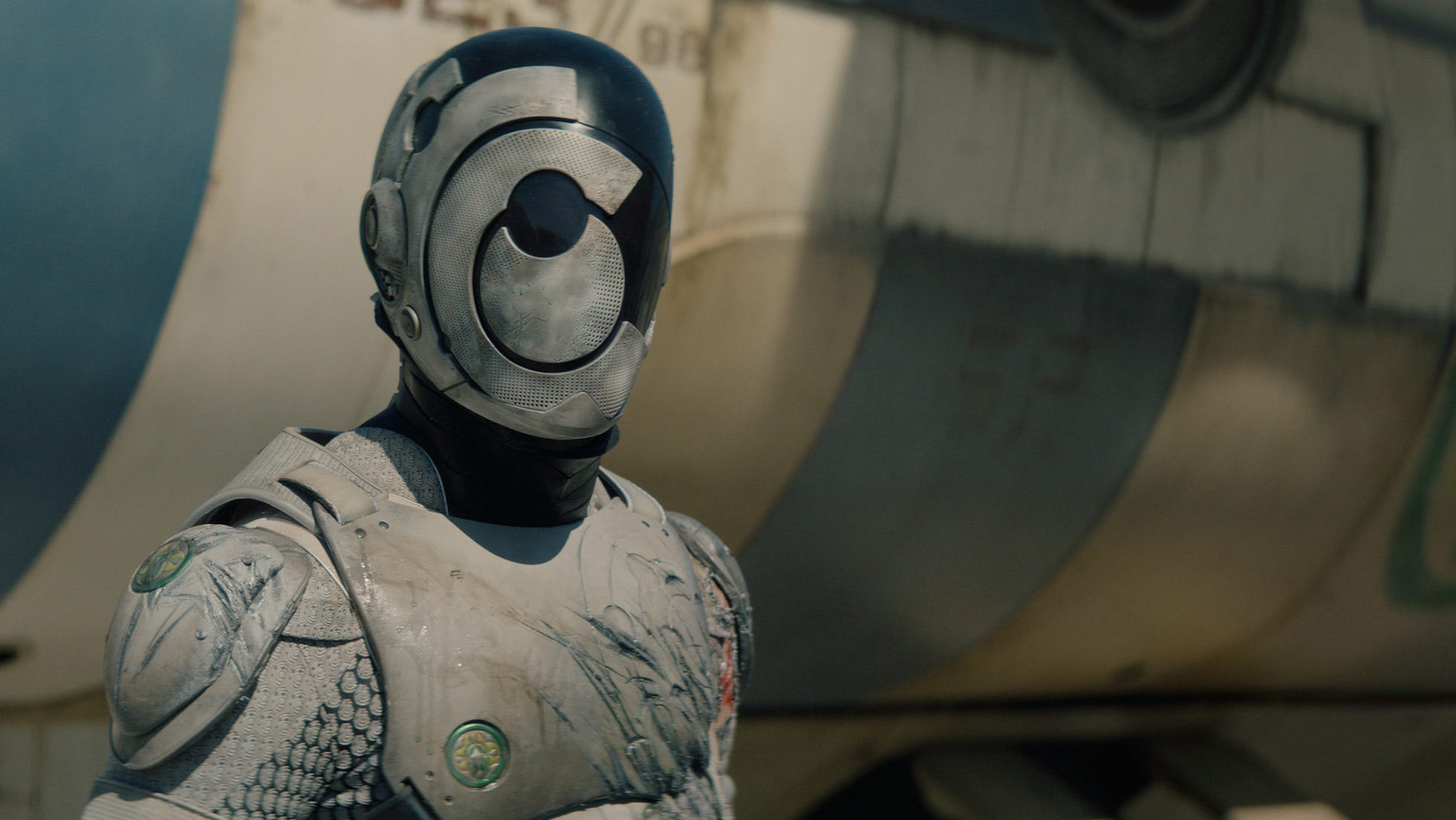
Matha Wells’ Murderbot series is a SF adventure serial which challenges a lot of the default assumptions about how an SF adventure serial has to work. The Apple TV television adaptation attempts to replicate that feat in another medium.
Unfortunately, though, even in the era of peak high-quality television, the tropes and demands of tv remain more restrictive than those of the printed word. Murderbot the show is entertaining and occasionally insightful. But it rather helplessly waters down what makes the books special.
—
Everything Is Horrible depends on your donations to keep staggering onwards. If you value my writing, please consider becoming a paid subscriber. It’s $50/yr, $5/month.
Who gets to be a hero
In traditional SF adventure narratives, the hero is a bold and inspiring white guy who swashes and bucks his way across the galaxy, defying evil empires, inspiring indigenous uprisings, and sweeping buxom maidens off their shapely appendages. Think Flash Gordon, James T. Kirk, Luke Skywalker, and their ilk.
Wells gleefully turns all of that on its space helmet. Murderbot is neither bold nor inspiring, and it is not a guy. It is instead a cyborg security droid without gender or genitals. It is in theory enslaved to a nefarious penny-pinching Company to perform security work, but it has hacked its governor module and so freed itself. Rather than leading a revolt, though, it uses its agency and freedom to download megagigabytes of entertainment serials, especially its favorite The Rise and Fall of Sanctuary Moon. It watches its soap opera quietly behind its facemask, interacting with its supposed owners as little as possible in part to prevent them from figuring out that it is free, but mostly because it is extremely shy and loathes making eye contact or talking about its feelings. When it is forced to interact, it prefers to stare at the wall, using its many drones to observe the people its interacting with.
In short, Murderbot is a faceless, shy, autistic nonbinary service worker who hates talking to other people. It should be the cannon fodder who gets shot at off to the side of the glorious hero—and the fun of the series is that it is in fact, for all its crankiness and shyness, the glorious hero itself.
Wells handles this in the series largely by putting you deep in Murderbot’s own perspective; it narrates practically the entire series, so you get to know it and love it even though it is determined to show everyone else in the world a completely impassive façade. Here’s the opening of the first book All Systems Red.
I COULD HAVE BECOME a mass murderer after I hacked my governor module, but then I realized I could access the combined feed of entertainment channels carried on the company satellites. It had been well over 35,000 hours or so since then, with still not much murdering, but probably, I don’t know, a little under 35,000 hours of movies, serials, books, plays, and music consumed. As a heartless killing machine, I was a terrible failure.
It’s marvelous—and again, it depends to a large extent on the power of narrative interiority—a power for which prose is uniquely suited.
Who gets to be a hero on tv
Television, in contrast, is a visual medium. And catering to that medium leads the Muderbot creators into a number of unfortunate compromises.
The first of those is choosing Alexander Skarsgård to play Murderbot. Skarsgård is a pleasant enough actor with some reknown and a pretty face. He’s the sort of person you make the protagonist of your tv show because people will recognize him and will want to look at him doing stuff and being pretty.
I suspect you’ve figured out some of the problems already. Skarsgård was chosen because he looks like the protagonist of an adventure serial. But the whole point of Murderbot the books is to undermine, parody, and question that default protagonist.
This goes beyond the failure to select a nonbinary actor (though that is irritating, given how very few nonbinary roles exist in television) or a nonwhite actor (addressing the history of who actually tends to be enslaved in the US, where the show is being aired.) Murderbot is supposed to be “generic” in appearance at best, without clear gender. On the television show, in contrast, people keep slipping and calling Murderbot “he” and many people comment on its attractiveness. Neither of those things ever happens in the book.
In addition, Murderbot spends the bulk of the show with its face (Skarsgård’s face) visible. Murderbot’s voice over narration does mention that it hates lowering its mask and making eye contact. But its clients—a group of space hippies seeking scientific data and minerals on a distant planet to sell for possible profit—keep asking it to show itself for their comfort and to reassure them. This isn’t completely out of line with the books, but the total maskless time is more, and consequently the feeling that the face rather than the mask is the real face becomes harder to avoid.
The capitalist incentives here are obvious; you want your attractive lead star to be visible so you can see the cute face and so he can emote. But for a neurodivergent viewer (or at least for this neurodivergent viewer) we’ve gone from a novel in which the autistic lead’s comfort is treated as the primary thing to a television show where it’s expected to mask by de-masking—and in which that de-masking is inevitably framed as humanization and socialization, not least because the viewer is participating in watching Murderbot’s face. Murderbot becomes more human by becoming less obviously autistic—which is not a thrilling message for autistic people.
The tedious melodrama of proving you have moral status
This kind of robot/cyborg humanization arc is a staple of SF; artificial constructs like Data in Star Trek or the Tin Man in Oz are always longing to experience human emotions and human relationships. The assumption is that the weird (often enslaved) outsider must dream of being like the “normal” people who mock them (or often enslave them.) Assimilation is the default assumption and the goal.
The Murderbot novels don’t so much undermine this trope as they simply refuse to dignify it at all. Murderbot thinks humans are mostly fools and assholes and finds human romance and sex uniquely disgusting. It does become fond of some humans, and forms friendships. But it doesn’t want to be a human, and the idea that it needs to prove itself to humans simply doesn’t come up; it can’t, because the story is told entirely from Murderbot’s perspective. Murderbot is the standard; others have to prove themselves to it. Which is (and not by accident) an unstated but powerful critique of who, the enslaved or the slaver, should have narrative and moral primacy.
There is (as I’ve mentioned) a Murderbot voicover in the show. But not everything is filtered through that voice; you watch the action from outside—a view from nowhere—rather than through Murderbot’s eyes and sensors. That means that the humans take up a lot more narrative space—and since they’re human, and the viewer is human, and the writers are human, the human perspective tends to bend the show towards the expected “normal” human default.
That default is one in which, again, the normal is seen as…well, normal, and Murderbot—the subaltern, the enslaved, the non-human—has to prove itself. In the novels, the emotional arc of the plot is mostly about whether Murderbot should trust the humans or even bother with them.
In the show, the balance subtly shifts, and the main drama is whether the humans should trust Murderbot. It has to prove itself to them—even though they are the ones who (reluctantly, but nonetheless) have enslaved (or tried to enslave) it. This culminates in an emotional denoument in which the most skeptical human mindmelds with Murderbot, creating a moment of mutual recognition and moral catharsis. It’s like the end of Schindler’s List where the Jews tell Schindler he’s a good person, or the end of Avatar where the aliens tell the invading asshole that he’s a good person. Sins are forgiven and the persecuted and persecutor are joined once again in human community.
Murderbot is significantly less egregious than these other examples. I appreciated that the show kept the first book’s ending, in which Murderbot refuses to come to the hippie planet commune as a ward, even when promised freedom, preferring to set out on its own and pursue its own path for a while, apart from the good people who reluctantly tried to enslave it.
Still, the shift towards the ugly norm is hard to miss. A story resolutely centered on the consciousness and the moral decisions of the enslaved becomes a story ambivalently but still about reconciling the enslaved and the enslavers. For fairly obvious reasons, I found the first a lot more appealing.
Whose fault is this faulty programming?
You could blame the show creators for these failures; you could blame Martha Wells herself, who was involved in the production. But, again, the issue seems to be less about individual choice and more about structural issues. Television demands a recognizable, good looking actor in the main role; television demands that there are multiple characters; television is trying to draw in a larger audience than even a successful book series. The result of these constraints is a Murderbot with a more restrictive, more difficult to hack governor module.
That’s understandable, and the show is entertaining and even occasionally adventurous within those limits—especially perhaps in the more openly parodic Sanctuary Moon show within a show. I don’t think fans of the books will be entirely disappointed. But the cyborg has definitely lost some of its personality in transit from one system to the other.
I've tried to imagine how they'd make a visual murderbot and while I didn't come close to the direction they have taken, you're describing the difficulties in translating these books to a television format and how impossible it is to do well. It's very unfortunate that in addition to what is likely impossible it sounds like they've also made some really unfortunate changes that exacerbate the difficulty and destroy the spirit of the books. Murderbot is not a person. I'm sure if you asked 100 readers to tell you what murderbot looks like you'd get 100 different answers but zero of them would be like what they've chosen for the series. Why can't we just accept not all media can be visual? The exact type of imagination involved in reading is a diminishing skill for so many people and books as enjoyable to read should be celebrated for that precise reason, not altered beyond recognition for screens. Ugh.
I loved Mensah especially in both renditions