

I saw the original Resident Evil film adaptation of the video game earlier this year and was impressed by the way its soulless staggering at the whims of its apparently brain-rotted corporate overlords mirrored the film’s narrative of soulless corporations vomiting out soulless zombies. Or as I put it in the review:
The fact that the film can be read as a metaphor for its own callous lobotomized greed doesn’t change the fact that it is a vacuous cash-grab. It’s difficult to believe this beginning spawned a whole series of sequels—but then again, zombies do not need much in the way of beauty or even sentience in order to proliferate.
The latest reboot, helmed by honest-to-God auteur Zach Cregger, is infinitely better than that—while also, somehow, still really in important respects being that. Rather than a tedious, vacuous insult to the viewer that doesn’t need to exist, Resident Evil 2026 is an entertaining exercise in fan service which doesn’t need to exist.
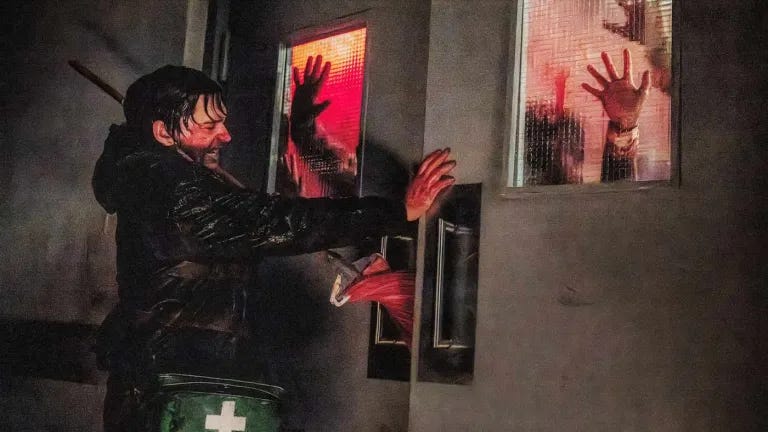
Cregger’s main character is (deliberately) as different from sexy superspy Alice in the first film as a protagonist could be. Bryan (Austin Abrams) is a nerdy guy who, as he says, “sucks at guns.” He’s a hospital courier and takes a package up into the mountains during a snowstorm, little knowing that he’s toting the vital cure for a zombie outbreak. He hits one of those zombies with his car, tries unwittingly to get her to the hospital, and things spiral from there, starting with oozy tentacled dogs out of the Thing and escalating through shoeless hi-rise shenanigans out of Die Hard—plus a final rooftop confrontation lifted from that grandaddy ape of all monster movies, King Kong.
Much of the fun of the film is that Bryan looks like the stereotypical video game geek, and acts much like you’d imagine the stereotypical video game geek (or action/horror fan) would if they were dropped in the middle of their favorite gamplay. He can’t find the safety on his weapons; he’s constantly stymied by fairly simple puzzles—like padlocks—and he reacts to each new horror with a mix of exasperation, panic, paralyzed shock, and profuse profanity. When a little girl with a tentacle leg begs him to pick her up and help her, he gives a weak smile and reaches to do so very much despite himself. When he sees a bunch of rat things reforming after he’s machine-gunned them, he literally nopes out and scurries for the nearest exit.
Bryan is not ready to meet the moment—and neither is anyone else. One of the film’s running gags is that Bryan keeps meeting authority figures—cops, super-competent mercenaries, scientists, even (shades of Aliens) that little girl—who in many a movie would be able to stabilize the narrative and provide needed information and firepower. They all are all almost instantly murdered or devoured in preposterously bloody gouts of viscera.
Creggar has a gift for surprisingly repulsive, and repulsively suprising, set-pieces—like the sequence in which Bryan runs down the middle of a street as zombies through themselves at him from the surrounding high-rises, detonating like bloody bombs. He also has a painterly sense of landscape—as in one wonderful scene where Bryan looks out over snowy dark fields from an upper window and sees a zombie running towards him from the distance. It takes a moment for him to see her, and a moment for the viewer to see her as well—a kind of wide-angle, slow-motion jump scare.
For all its wit and visual acumen, though, the movie still lacks a core feature of the post-Romero zombie genre: theme. Shaun of the Dead—a key predecessor—is fascinated with the way that humans are just zombies waiting to emerge, both in the sense that we’re all pieces of meat preparing to fall over and in the sense that we are just pointless habits and appetites wandering through convenience stores and old routines. Evil Dead 2, another influence, is (like Duck Amuck) a giddy cartoon exploration of the parallel sadism of the director and of God. Zombie films sometimes look like inarticulate brainless fun, but the best ones do generally have something to say.
Creggar is aware of the expectations, and he makes a half-hearted attempt or two. Bryan’s girlfriend calls him at the beginning of the film to tell him she’s pregnant. He’s very ambivalent, and you could if you wanted see the rest of the film as a kind of psychotic break as our hero imagines himself running from mutating, metastasizing evil birth—his autonomy leaching away as he is sucked into cancerous multi-limbed hives of flesh.
The movie doesn’t exactly commit to the bit, though. The maternity ward scene is not the climax, and after a tearful goodbye to Bryan’s girlfriend about two-thirds of the way through, you don’t hear anything about her again. It isn’t Die Hard where McClane circles around his extrangement from his wife through the runtime, or where their relationship defines the peak moments and the end of the film. Instead,the girlfriend (who is never onscreen) feels like a throwaway subplot—a feint towards meaning, rather than the purpose of the endeavor.
In the end Creggar defaults to the original’s casual anti-corporate boilerplate. The movie, like the first, is ultimately about how the Umbrella Corporation is reckless, arrogant, and incompetent, and how it has unleashed a nightmare in the name of some combination of profit and arrogance. The proliferating consuming zombie bio-glorp is the proliferating consuming glorp of corporate greed and acquisitiveness—and also the proliferating consuming glorp of the corporate game/film franchise itself, which dies only to rise again in more horrifying and efficient form.
Resident Evil really is a much evolved and improved version of this particular franchise, and as mindless entertainment, with a touch of meta-critique, it makes for an enjoyable 90 plus minutes of giggles and shrieks. But I’m a cranky zombie purist, and I just can’t be fully consumed by a zombie film without a soul.