

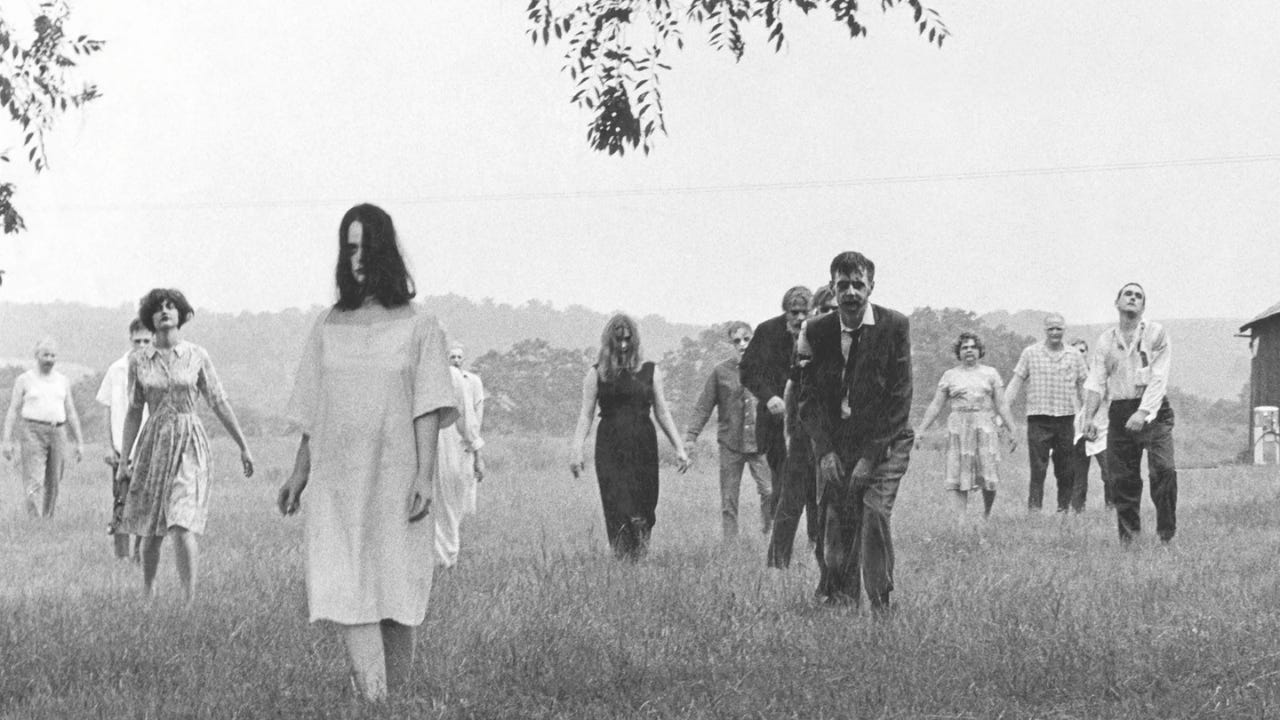
“They’re us, that’s all,” Peter (Ken Foree) says of the zombie attackers in George Romero’s masterpiece, the 1978 original Dawn of the Dead.
That’s a succinct summary of the horror and allure of the zombie genre, which has overrun and consumed much of the media landscape in the last 20 years. George Romero, created something new in horror with his first zombie film, 1968’s Night of the Living Dead. Rather than powerful monsters, terrifying in their difference, Romero’s zombies were simply people, shuffling around doing people things, like shopping, grunting, and eating each other. The greatest horror, Romero realized, was just human beings.
The “just” is important there. Horror before Romero was fascinated with the terror of human beings turned into evil, dead, nightmare others. Fear of what people might become after death and of the uncanny otherness of corpses is a staple of horror practically since the genre’s inception. The staggering, awkwardly bent, groaning zombie who wander across the graveyard at the opening of Night of the Living Dead recalls—no doubt intentionally—the staggering, awkward, groaning Boris Karloff, assembled from mismatched body parts and sent out to wreak havoc in James Whale’s classic 1931 Frankenstein. And Romero got the vision of an entire population transformed into the living dead from Richard Matheson’s 1951 novel I Am Legend, in which one loan human survivor stands against a world given over to the rising vampire hordes.
Whale’s monster may have been inarticulate, but he had massive strength—the human corpse, reanimated, returned to life with supernatural potency. Matheson’s vampires don’t have the fiendish invincibility of Bram Stoker’s Dracula, but they are as capable and smart as their former human selves. If Matheson’s vampires are just human, then humans are fairly competent.
Romero’s innovation was to present “just humans” as almost comically inept and clumsy, devoid of reason or any higher brain function beyond appetite. The zombies in Romero films are, as single adversaries, shockingly unformidable foes. They move slowly, do not communicate or plan, and can use only the most rudimentary tools. Once you know to shoot them in the head (information helpfully provided by the remarkably calm newscasters in Night of the Living Dead), they’re not hard to dispatch. In fact, in most later Romero films, humans murder the zombies for sport. Vampires are sexy, hypnotic, fascinating sophisticates; werewolves are virile, animalistic, uncontrollable beasts. Both are fearsome predators. Zombies are just decaying doofuses. Humans should be able to handle them easily.
The catch here is that, in Romero films, humans are decaying doofuses too. If zombies are dumb and can’t figure out how to work together—well, humans are the same way. In Night of the Living Dead, the human characters bumble and stagger towards defeat. Barbara (Judith O’Dea) spends most of the film in catatonic shock, little more responsive than the zombie attackers. Harry (Karl Hardman) and Ben (Duane Jones) attack each other with repetitive, senseless aggression, tearing at each other like they’re already risen corpses.
And of course, famously, in Dawn of the Dead, the human protagonists and the zombies are equally drawn by the consumerist charms of the shopping mall. “Why do they come here?” Francine (Gaylen Ross) asks. “Some kind of instinct.” Peter responds. “Memory, of what they used to do. This was an important place in their lives.” That could apply just as well to Peter and Fran, racing around the mall filling shopping carts with goodies, as to the zombies, staggering into the mall fountains as tinny Muzak plays over the speakers.
Dawn of the Dead presented brainless, consuming mall-going zombies as a metaphor for capitalism. And that metaphor has only gotten more relevant as mall themselves have been consumed by Amazon and the rampaging Internet forces of toothy-mawed creative destruction. As late capitalism shambles on, and commodification of everything becomes ever more omnipresent, abstract, and clickable, zombies have become increasingly inescapable. Edgar Wright’s brilliant 2004 Romero tribute/parody Shaun of the Dead captures the banal zombie present perfectly. Lazy, useless slackers stuck in dead-end jobs wander from video-game console to the corner bar. It’s a world in which human beings are so unmotivated and uninteresting that you can’t even tell when the zombie apocalypse starts.
Death by demon or witch or alien is generally exciting, suspenseful, different—humans are possessed, assaulted, annihilated by beings of great power and purpose. In The Exorcist or Predator, some monstrous, terrible something finds humans interesting enough to want to destroy us. It’s a compliment of sorts. The genius of the Romero zombies, though, is that they conquer through sheer indifferent inertia. The zombies that walk through The Walking Dead or Colson Whitehead’s Zone One are blandly unmotivated losers, with barely enough energy to keep their eyes in their sockets. They defeat humans through sheer shuffling weight—and because humans are blandly unmotivated losers, too.
Romero’s zombies aren’t about the persistence of life after death. They aren’t even, really, ghosts haunting the present, or a return of a terrifying buried past. Rather, Romero’s zombies embody the awfulness of nothing special. They don’t mean anything because we don’t mean anything. Romero’s is a horror not of dramatic, apocalyptic change, but of inescapable, slogging slow-motion decay—a modern world that shambles purposelessly nowhere, with ugly skin suits devouring themselves as they go.
Romero’s legacy continues to walk and groan and rock across multiple media properties. But it’s not quite true to his legacy to say he’ll live on forever. Rather, the director might say, we live in a world where no one lives. Those Romero leaves behind are all just hungry, disgusting, ridiculous corpses, waiting to fall over.
—
This first ran at Playboy on Romero’s death some years back. It’s no longer online, so I thought I would re-share.
Nice parsing of the significant difference.
Reminds me of James Baldwin’s observation that Americans don’t know who they are.
Might as well go shopping, eat some people, and fall over.
I forgot that you published in Playboy. Alex Haley spoke to Our anthropology 101 class in the 70s when he was working on Roots. He explained Hugh Hefner had provided him the use of his giant yacht for the time needed to draft the book. Haley lived on the boat out in the ocean and just wrote.
He chain smoked the entire hour in our small classroom. Not an issue back then.
Things you remember…
This is timely for me as I had zombie dreams 2 nights ago. That’s not unusual for me if I’ve seen a recent zombie film, but this time it’s been months. I really enjoyed this piece.