

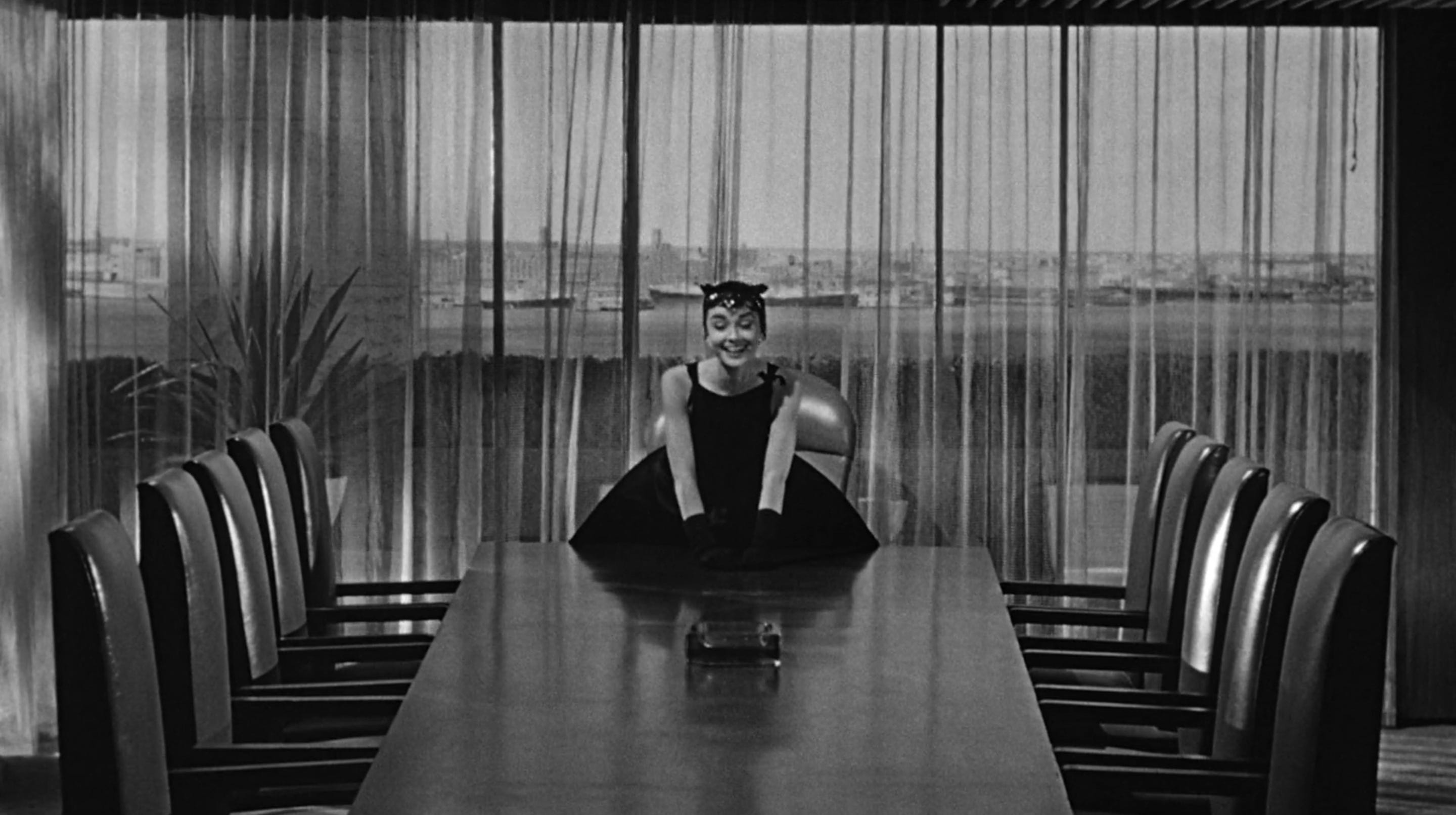
Billy Wilder’s Sabrina (1954) is a delightful romcom balancing worldly cynicism, elegance, and starry-eyed romance. The only problem—not unusual in romcoms of the time or today—is that the male lead is obviously a bounder and you don’t ever believe for a second that the woman will be happy with him.
—
Everything Is Horrible is entirely reader supported. Please consider becoming a subscriber; it’s $50/yr, $5/month.
—
The plot is one of those Cinderella/50 Shades of Grey poor-girl-dazzle-the-patriarch things that remain a staple of the genre. Little Sabrina (Audrey Hepburn), the chauffeur’s daughter, is infatuated with the wastrel scion of Long Island royalty, David Larrabee (William Holden). David is impervious to her adoration, and indeed to her existence, until she comes back from two years at a Paris cooking school, with new hairstyle and foofy little dog in tow.
Struck with her sophistication and her legs (not necessarily in that order), David wants to throw over his engagement to a sugar cane heiress and set her up to be his fourth ex-wife. That would overturn the merger plans of older brother Linus (Humphrey Bogart), however, and said older brother swoops in, pushing David out of the picture and dating Sabrina himself. He plans to let her down gently and ship her back to Paris. But how can he resist Audrey Hepburn singing La Vie En Rose?
From some directors, Sabrina might be a story about youth and innocence overcoming jaded old age. But Wilder has no truck with that. The young Sabrina, sitting in a tree longingly watching David flirt with the debutantes at the lavish Larrabee parties, is prettily pathetic, but has no appeal. It’s only after she has been taken under the wing of an elderly French baron, granted a new wardrobe, and learned to flirt like nobody’s business, that the scion screeches his car to a halt at the sight of her. Her dad warns her not to reach for the moon; she laughingly replies that she won’t, since now it’s the moon who is reaching for her.
One of the film’s many winking highlights occurs when Sabrina’s despairingly upright father (John Williams) informs her on her return that David is engaged, He thinks that she’ll be upset and heartbroken after he’s flirted with her. But she cheerfully tells dad that she knew already. “He’s not married yet,” she says as she goes off to put on her most stunning dress and seduce him right out of his wife’s embrace (more or less literally on the dancefloor.)
David is of course ready to seduce her right back, until Linus tricks him into sitting on a couple of champagne glasses, requiring 23 stitches and a lengthy recovery. Linus sardonically sets about winning Sabrina by intimating past heartbreak—he claims to have contemplated suicide (probably inspired by his having rescued Sabrina pre Paris when she tried to kill herself by carbon monoxide poisoning for love of David.)
Sabrina for her part touche his heart not with naivete, but by telling him of the mores of Paris and giving him pointers on how to look less like a fuddy-duddy (turn your hat brim down, Linus.) And while Sabrina refuses Linus’ initial offer to buy her off with $25k when she is pursuing David, she eventually does accept significantly more than that as a payout/apology when Linus reveals he’s been trifling with her. Yes, her heart’s been broken, but all the more reason to make bank.
Sabrina’s cheerfully European amorality makes her idealism and romanticism more charming, and vice-versa. Unfortunately, it’s hard to understand how all that amorality and romanticism add up to an infatuation with Linus. Bogart was 30 years older than the 25-year-old Hepburn at the time of filming, and he looks even older than that (he died of cancer only three years after the film was released.)
Bogart does embrace Linus’ crusty materialism with crotchety verve. But never finds his way to making you believe that he has actually fallen in love with Sabrina. Partly it’s the script, which frames his every interaction as calculated until suddenly he’s confessing everything. But partly it’s his own limited range. Hepburn puts every nuance of joy and hope and disappointment and woundedness on her expressive face, working those amazing eyebrows for all they’re worth. Bogart, for his part, shifts between amused and dyspeptic. You can see why Sabrina grows tired of David, that shallow heel. But it’s a little baffling that she then rushes immediately into the arms of the cold fish, even if he does have a ton of money. Aren’t there any younger millionaires on Long Island?
Again, this isn’t necessarily an unusual flaw in the genre. Romance adores the humanize-the-distant-patriarch trope, and while a genius like Jane Austen did manage to pull it off, most of those patriarchs end up looking more like duds than Darcys. Billy Wilder is a genius too, and Sabrina has many attractions. You can’t help thinking at the end, though, that its star would have been better off if she’d taken that boat to Paris alone after all.
Totally agree on Bogart. I liked the movie but couldn’t believe she would fall for a not so handsome man who was old before his time. Very distracting.
Thank you! I rewatched this recently after many years, and two things struck me that I hadn't sussed before. First, that Sabrina was sent to "cooking school" (apparently a rigorous French culinary acadamy where sauces take 2 months of study) and other than pretending to make an omelette with crackers in Linus's office, there's not even a hint that she has marketable skills, or should or will be seeking a job. Of course that's just a plot device to give her a Parisian glow-up; in 1954, snagging a man was more a woman's job than doing paid work, even kitchen-based work. (I'll have to watch the 1995 version uuuugggghhh to see if they updated that trope.) Then there's marriage. Neither David - whose fiancee is planning his fifth(?) Bezosian wedding extravaganza - nor Linus even hints at marrying Sabrina. When Linus arranges for her to go back to Paris but (unbeknownst to her) without him, David puts a gossip item in the newspaper about Linus Larrabee and Sabrina "taking adjacent deck chairs" on the steamer to Paris, to push Linus into action. David has arranged a police escort to the docks and a tugboat to take Linus to the departing ship, but not an officiant to marry them, or even a marriage license. (The elaborate discussion of the two cabins Linus paid for though he didn't intend to go is for the censors; we know there's an unlocked door between them, wink-wink.) I also have a few things to say about the rapaciousness of the Larrabee family and the ungodly mid-century celebration of extractive wealth, but I'll leave that for another time.