

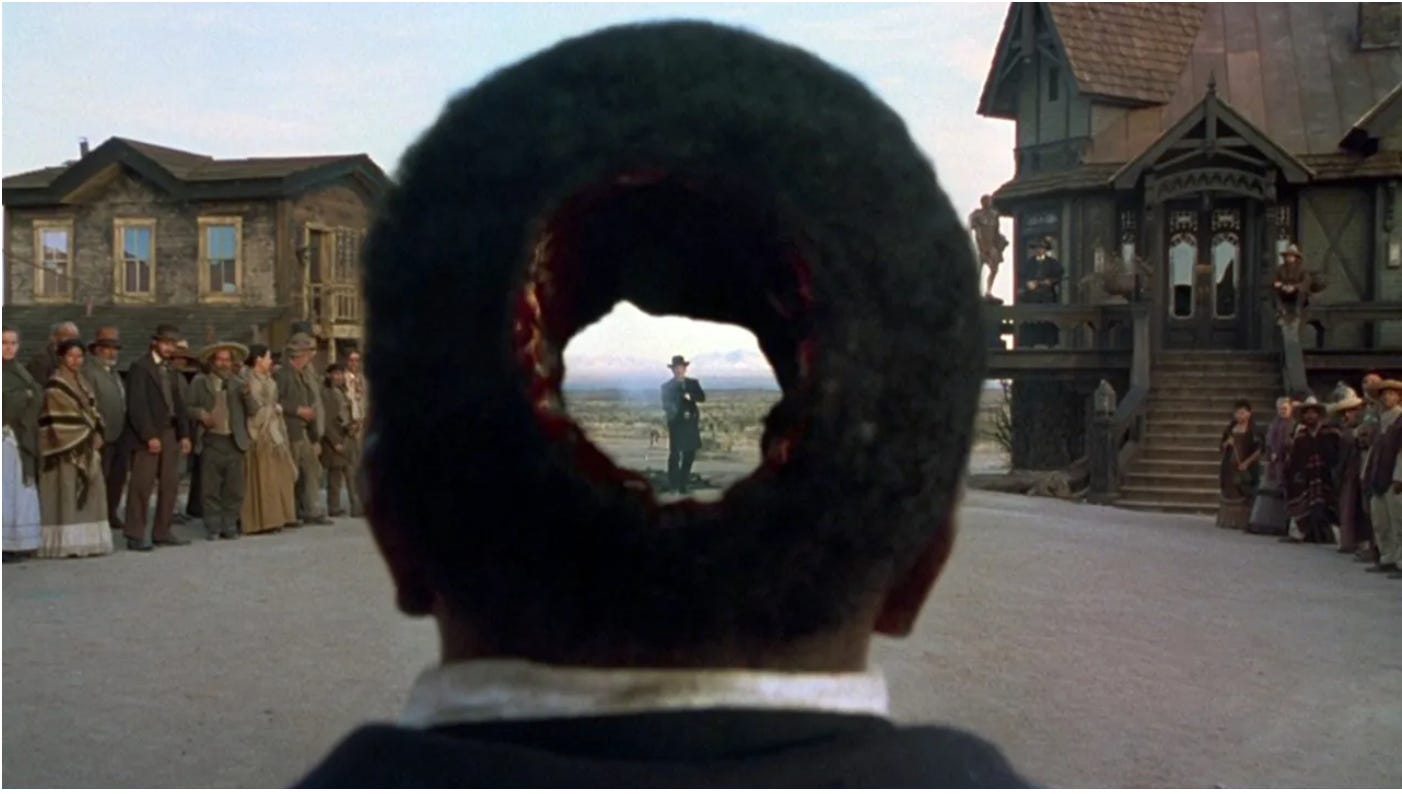
One of the (many!) quick-draw shoot-outs in Sam Raimi’s 1995 The Quick and the Dead features the villainous town despot Herod (Gene Hackman) vs. a hired gun Sgt. Cantrell (Keith David) paid by the townspeople to take out said despot and relieve them of their misery. Herod’s quicker on the draw, though, and Cantrell staggers and almost falls—but tries to keep shooting. Herod aims his gun again, fires—and the camera swings around behind Cantrell as the bullet opens a huge hole in his head. Through that gaping ragged circle in the brain matter you can see Herod standing triumphantly before Cantrell falls.
—
Everything Is Horrible has a sale today. It’s 40% off; $30/yr. Please consider contributing so I can continue to write about politics and occasionally about movies!
—
It’s a quintessential Raimi moment—the speed and slapstick of a Warner Brothers cartoon but with much, much more explicit gore. The sequence is brief, but for the seconds it last, it holds up well next to the Ash-vs.-his-hand battle in Evil Dead 2 from 1987. If you asked me what I wanted from a Sam Raimi western, this would be it.
There’s only one problem; the death of Cantrell is almost (not quite, but almost) the only time in the film that Raimi strips off his bloody gloves and pulls on that ravenous clown mask. For the most part, the film is a much less over-the-top endeavor, relying on Hollywood tropes and standard storytelling rather than on Raimi’s particular unhinged genius. There’s a revenge narrative; there’s an evil badman; there’s a heroine who must find herself and self-actualize. The film’s central conceit—a round robin one-on-one quick shooting (and quick killing) contest, is pleasantly goofy, but is mostly played straight and with few surprises. You can figure out who’s going to win each fight pretty easily based on narrative primacy and whose name appears higher on the marquee.
That doesn’t mean that The Quick and the Dead is bad exactly. Raimi is obviously a fan of Sergio Leone, and with the help of cinematographer Dante Spinotti he captures some of the master’s magic, complete with sweeping vistas and extreme close-ups. Hackman is in his element as a megalomaniac sadist with an odd sense of honor and even the occasional scruple about murdering his son, the Kid (an impossibly young and insouciant Leonardo DiCaprio.) Russell Crowe as Cort, a former outlaw turned preacher, smoulders on cue, and other fine character actors (Lance Henriksen, Mark Boone Junior) are scattered about.
Sharon Stone struggles in the lead, though that’s more a problem with the writing than with her talent. “The Lady” is supposed to both be an iconic force of nature like Eastwood’s “Man With No Name” and a frightened, traumatized young woman coming of age to learn how to kill and how to renounce killing. Sometimes she seems utterly reserved and unstoppable; other times she seems to be coming apart, and the tension seems like it has less to do with her internal state and more to do with the film being unable to make up its mind. Her final plans seem both thin and unnecessary; her final victory more a default than an actual measure of her grit or skill.
The movie also is unsure how to navigate The Lady’s ladyness. Her romance with the Kid really makes no sense—a fact which the film itself seems to nervously recognize, since it shuffles most of it off-screen. Similarly, her brief switch out of dusty cowboy attire to high glam femme gown seems meant to remind you that Sharon Stone is hot, rather than to illuminate character. There are some gendered insults and some references to the way women are exploited in this milieu, but they never really cohere into a critique of toxic masculinity or a quasi-feminist statement. The movie flirts with the idea that maybe heroism is not about having the biggest phallic gun—but then shrugs and decides it is after all.
It’s not exactly unusual for Raimi to bury his Raimi-ness in mainstream genre. Dr. Strange and the Multiverse of Madness from 2022, for example, is a mostly terrible Marvel movie with one spectacular scene, in which the Scarlet Witch murders her way through Mr. Fantastic, Black Bolt and a bunch of other Marvel heroes in spectacular and, again, gloriously cartoonish fashion. The films in which the director lets his warped perspective rip for the entire run time—like this year’s Send Help—are comparatively rare. In his career long duel with the industry, Raimi ends up lying in the dusty road as often as not. It’s always worth cheering when he gets a shot or two in, though.
Every few years if I’m on a Gene Hackman or Russel Crowe kick I’ll pop this one in, but I always want it to be better than it is so I’m always a bit disappointed.
I have the memory of a goldfish, which is a gift and a curse; a gift when re-watching/reading anything, a curse at all other times.
Oh, I think I’ll watch Send Help tonight…
"It’s a quintessential Raimi moment—the speed and slapstick of a Warner Brothers cartoon but with much, much more explicit gore."
Something like the cartoon-like gags former Warner animator Frank Tashlin used in his live-action films as a director- though unlike Tashlin, Raimi is not necessarily playing it for laughs.