

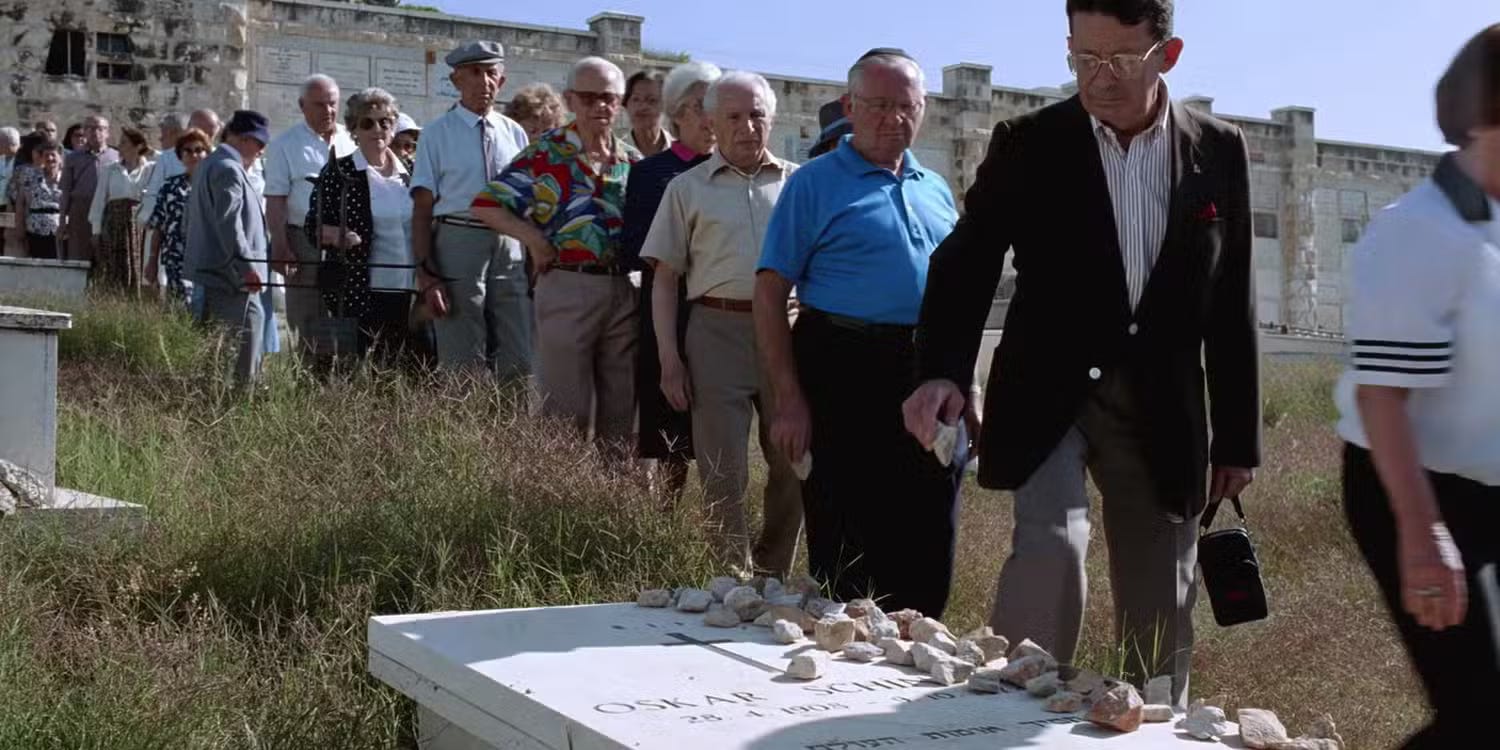
Schindler’s List is a Zionist film. It’s ending frames Israel as a refutation of and a solution to the Holocaust and as a righteous rebuke to hate. More than that, though, Schindler’s List is specifically a film designed to foster a liberal Zionism for American gentiles.
As such, the movie illuminates the extent to which for many liberals (Jewish and non-Jewish), Zionism is an expression of liberal American identity. That conflation of liberalism and Zionism has been crucial in creating a bipartisan consensus for supporting Israel—more crucial, in many ways, than Jewish Zionism or even than evangelical Christian Zionism. Many people do not see Zionism as a dual loyalty. They see it as continuous with, and central to, their identity as Americans committed to democracy. Schindler’s List is a key statement of that ideological vision.
—
Everything Is Horrible is entirely funded by readers. If you find this essay valuable, please consider becoming a paid contributor. It’s $50/year, $5/month.
Israel as sequel
Schindler’s List as most readers will know, is based on the true story of Oskar Schindler, a Nazi industrialist who saved around 1200 Jews from the Holocaust by hiring them to work in his factories and protecting them from deportation to the camps. Director Steven Spielberg filmed the three-hour plus movie in black and white to show that it depicts serious past events.
However, the film’s final sequence is in full, and deliberately warm, sunlit colors. It is set at Schindler’s grave in Jerusalem, where survivors depicted in the film and their descendants place rocks on Schindler’s headstone as a gesture of respect and mourning. A final text says that there were when the film was released fewer than 4000 Jewish people left in Poland. The descendants of those Schindler saved numbered 6000. Through a straightforward numerical calculus, Schindler’s moral action overbalances the evil of all of Hitler’s minions.
Claude Lanzemann, the director of the major Holocaust documentary Shoah, was no fan of Schindler’s List. But he was particularly horrified by the ending. “Although many take me for a Zionist,” he wrote,
I would never dare to give such sledgehammer blows as those Spielberg gives at the end of Schindler’s List. With that great reconciliation, Schindler’s grave in Israel, with its cross and the small Jewish pebbles, with the colour which insinuates a happy ending ... Israel cannot buy off the Holocaust. The six million did not die to justify Israel’s existence.
Lanzemann believes that putting a happy or uplifting end on a film about the Holocaust is glib and insulting. He has a point. But it’s also worth asking why glibly uplifting Zionism is at the center of the most iconic and critically acclaimed American Holocaust film. Who is this glibly uplifting Zionism for, and what it is meant to do for them?
On the side of Schindler
Steven Spielberg is Jewish himself, but Schindler’s List is not primarily about Jewish people. Instead, it is about a gentile and a Nazi. Schindler (played by Liam Neeson) is given the most screentime by far, and he is the one character who is given a legible character arc, as he transforms from a greedy self-centered womanizer into something very like a saint. The most prominent Jewish character, Schindler’s accountant Itzhak Stern (Ben Kingsley), tells us little about himself, and mostly seems to be there to assure Schindler that he is a virtuous person. Art Spiegelman, creator of the graphic Holocaust memoir Maus, accused Spielberg of turning Jews into “bit players” in their own annihilation.
In its focus on a morally compromised gentile won over to the good, Schindler’s List echoes that other iconic World War II film, Casablanca. Like Schindler, Bogart’s Rick at first is focused on grabbing what he can from the chaos of war. He’s amoral and deliberately neutral, paralleling America itself during the early years of the war. Eventually, though, the crimes of the Nazis and the example of courageous dissidents leads Rick to make a Choice against Fascism, just as America did. Or just as America would like to tell itself it did, in any case.
Rick’s story is an early example of America discovering, or asserting, its own virtue through its participation in World War II. The US, after all, was on the right side in the war, and that side only looked more and more right as the full extent of Hitler’s genocide became apparent with the liberation of the camps. Dwelling on historical treatment of Black people, or Native Americans, or immigrants, or LGBT people, or the Vietnamese, or numerous other marginalized people, does not necessarily redound to the glory of the United States. But the US fought this one time for Jewish people when Jewish people were persecuted. You can see why that would be an appealing topic for Americans.
At first, American memory of World War II focused mostly the US military role. But after the Civil Rights Movement raised white mainstream America’s awareness of racism as a core evil, fighting against the Holocaust became seen as a quintessential example of American goodness. Elie Wiesel’s Night was published in English in the US in 1960; NBC aired a popular Holocaust miniseries in 1978; the United States Holocaust Museum was established in 1980; Maus was released in 1985; Lois Lowry’s hugely successful young adult Holocaust novel Number The Stars came out in 1989. And Schindler’s List followed in 1993.
In this context, Schindler’s List is not just about commemorating those lost and honoring one good man. Nor is it just about modeling virtuous behavior and trying to teach people to recognize and resist fascism. Rather, like Casablanca, it is an exercise in a certain kind of patriotism, which asks Americans to see America as a nation about fighting fascists and saving Jewish people.
Obviously, Schindler was not himself American. But the film makes him a very American-like hero. The intertextual reference to Rick, and to other bad men gone good like Han Solo, is pronounced. Another point—so obvious that it’s likely to be skipped over—is that Schindler throughout the film speaks English. This is for the convenience of the audience; Spielberg does not want to force them to read subtitles. But it is also a way to make Schindler seem more familiar, more like us. Other Germans in the film do occasionally speak German, or else speak with a notable accent, like sadistic concentration camp commandant Amon Goeth (Ralph Fiennes). Schindler, though, always talks like, and to, the Americans in the audience..
It’s also notable that one of the key moments of the film takes place on horseback, as if Schindler is riding out of a cowboy drama. He and his woman of the moment ride their horses out for the day and stumble upon a view of the1943 liquidation of the Krakow ghetto.
We switch between the carnage in the ghetto and close-ups of Schindler’s face as he reacts with concern and horror to what he is seeing spread out below him. His reactions cue the audience what to feel about what they are seeing. But his position as viewer, and stand in for the audience, also makes him an honorary American, one of us. He picks up the iconography of many an American western, and in so doing he teaches us to be Americans, or teaches us what America is supposed to be. Schindler is on the right side; America was on the right side, we are on the right side. By fighting for Jews, America becomes its best and truest self.
Zionism as Americanism
This formula—by which America becomes America through its liberal championing of Jewish causes—is not just a movie. It’s a powerful narrative which has created passionate Zionism among many American liberals (Jewish and non-Jewish) who see American identity as validated and morally confirmed by Zionist commitments.
This is why President Joe Biden—a longtime Zionist, who disgracefully facilitated Israel’s genocide in Gaza—talks about Israel not only as a security ally, but as a moral calling. “You don’t have to be a Jew to be a Zionist,” Biden said in 2024, “and a Zionist is about whether or not Israel is a safe haven for Jews because of their history of how they’ve been persecuted.” Similarly, former Michigan Senate candidate Haley Stevens in 2023 declared, “America is a place for the Jewish people….Israel comes to me in my dreams, I see Israel’s future and I know that Israel will continue.”
Biden and Stevens are not Jewish, but their rhetoric is similar to that of Jewish Zionists. That includes Spielberg, who made a film which calls Americans to liberal American-ness through support for Jews. And it’s true of Senate Democratic minority leader Chuck Schumer, who has said, “My job is to keep the left pro-Israel.” This has sometimes been interpreted as a dereliction of his duty; isn’t Schumer supposed to work for his constituents in the US, not for some other country? But in the context of the sort of liberal Zionism displayed in Schindler’s List, there is no contradiction. To be truly American, like Schindler, is to fight for Jews. Therefore, Zionism is the truest core of America.
Unfortunately, despite the dreams of Stevens, Biden, Schumer, and other liberal Zionists, standing with Jewish people is not a certain path to liberal virtue. Jewish people are just people. They are capable of good and evil, like everyone, and while as a group they have often been persecuted, currently Jewish people in Israel are in a position to persecute others, especially Palestinians.
Treating the Holocaust as an iconic opportunity for moral instruction and identification with virtue turns atrocity into melodrama and urges viewers to admire themselves for choosing the right moral path in a context where the right moral path is sufficiently distant in time and place to be obvious and easy. It costs Americans little to denounce the Nazis in the past.
For its intended US audience, Schindler’s List functions in large part as a smug exercise in self-congratulation, allowing Americans to remind themselves that they, like Schindler, did the right thing when someone else, over there, was committing evil. Zionism has served as a kind of shortcut to self-congratulation for similar reasons; it’s a lot easier to ally yourself with a powerful country and call that virtue than it is to confront the injustice you yourself are committing at home and abroad.
If we actually want to prevent atrocities, we need better films, better ideologies, and better analysis of the evils we faced in the past and of the evils we face now. For starters, it might help to recognize that patting ourselves on the back for fighting someone else’s fascism doesn’t actually help us to fight our own. Schindler won’t save us; neither will Zionism; neither will fetishizing the virtue or suffering of Jewish people. It might help, though, to look at the uglier parts of our history more closely, rather than obsessively replaying, or trying to replay, the parts that we can convince ourselves we should be proud of.
This is a clear, fine explanation of how deeply Zionism is embedded in American liberalism. People like Biden, Stevens and Schumer must avert their eyes from the suffering of the Palestinian people at the hands of Israel. And it follows that when the left takes up the Palestinian cause, we are regarded a extremists and even un-American. So the lefties and the liberals fight, instead of all of us fighting American fascism.
Really interesting. Thank you. I also saw The Last of the Unjust, at the Music Box in Chicago of all places, which was profoundly moving and has stayed with me over the years.