

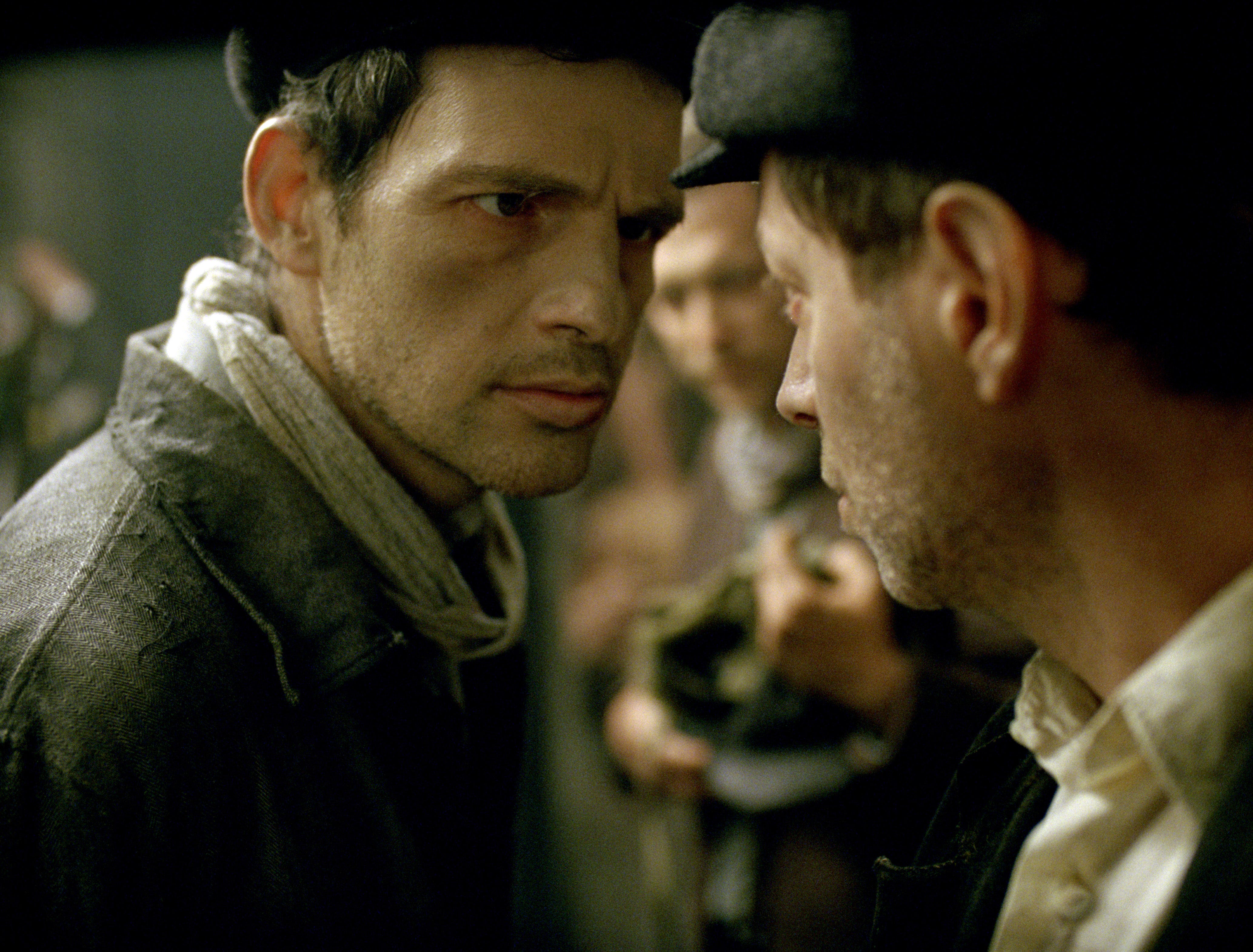
László Nemes’ Son of Saul (2015) is often praised as a harrowing depiction of the horrors of the Holocaust. I don’t disagree—but at the same time, one of its most striking, and harrowing, features is its refusal to provide the beats we expect in horror, or war films, or Holocaust films. The movie’s bleak accomplishment is to refuse to place the Holocaust in a comforting, or even coherent, narrative frame. It is a film which refuses not just sentimentality, but sense.
Son of Saul is set in the Auschwitz concentration camp, where its protagonist, Hungarian Jew Saul Ausländer (Géza Röhrig) is a member of the Sonderkommando work unit. In the initial scenes, Saul’s unit is preparing new arrivals for the gas chamber and cleaning up after their death. One boy survives the gas, however; a Nazi doctor has to personally strangle him to death and then orders an autopsy to find out why he was more resistant. Saul spends the rest of the film trying to steal the corpse and find a rabbi who will say prayers over the child and help to bury him.
At various points in the film Saul insists that the dead boy is his son. But no one seems to believe him, and he barely seems to believe himself; he never says the boys’ name, or seems to know it. While his motives may be obscure, however, they are overwhelmingly powerful. His quest leads to a at least one death directly; it also distracts him from his own crucial role in a camp rebellion. He has, as one of his exasperated fellow prisoners says, chosen the dead over the living.
While some of his companions condemn Saul, the film itself does not. Indeed, Nemes constructs the movie so that there is no distance from which it is possible to judge Saul. Throughout the runtime the camera is either in extreme close-up on his face or positioned behind his head. The viewer is looking at Röhrig angular, worn features, largely unexpressive through exhaustion and shockor is trying to peer around him to try to figure out what is happening. The events and action that would usually keep you invested in Hollywood narrative—murders, rescues, rebellion, clandestine meetings—have to be interpolated or caught in obscured glimpses. In one intensely unpleasant scene, Saul is swimming with the body and the camera sits at water level, staring into his face as he gasps, sinks, and struggles. Nothing else is visible—not his body, not the shore, not anyone else. Drowning is all there is on earth.
If the filmmaking is frustrating, Saul is perhaps even more so. There are suggestions that he was at one point a more satisfying lead character: he appears to have been actively involved in the resistance, and there are vague suggestions of a romantic arc. But by the time we meet him he seems utterly divorced from most recognizable drives, including self-preservation. The horrors around him barely register; appeals to help others or consider their desperate circumstances are similarly ignored—Saul has no compunction about taking advantage of the prisoner-doctor who pities him and tries to help him within limits. There is a flicker of guilt when his rash actions lead to the death of one rabbi, but then he’s immediately back to searching for another willing to risk all to bury this one child while the corpses mount around them.
More than once viewers are going to be tempted to shake Saul or give him a swift punch in the gut, as one exasperated plotter does. But his inert recalcitrance—his grim dedication to an idiosyncratic, meaningless, and even harmful sense of decency and right—functions as a refusal of Nazi dehumanization and of Hollywood’s confused collaboration in that dehumanization alike. Saul isn’t a grateful bystander who expresses gratitude to gentile saviors on cue. Nor is he a brave survivor and resistor embodying a vengeful heroism a la Tarantino’s Bear Jew. He doesn’t even express solidarity—except towards one boy, who he probably does not know, but whose dignity he decides, for spontaneous and mysterious reasons, is the most important thing in the world.
It’s not really a spoiler to say that the movie does not have a happy ending. How could it, when it begins with the mass murder of naked people shoved into a gas chamber, with Saul standing outside waiting for their screams to die down so he can get in and clean the floor? Yet many Holocaust films are framed as uplifting moral messages—focusing on the few gentiles who were heroes and the few Jews they saved. You’re supposed to walk away from Schindler’s List or The Zookeeper’s Daughter feeling good about humanity, secure in the knowledge that you would do the right thing in extremis, just like the photogenic people on screen.
There are no such reassurances in Son of Saul. No one shows up to help the victims, and their efforts to help themselves are mostly futile. As in the actual Holocaust, the vast majority of Jews in this world are brutalized and then die. Nor is Saul decorous, or noble, or heroic as the worst happens around him and to him. He is broken; he is cruel, he is petty; he disregards the safety and lives of others; he betrays others love and friendship and trust.
And yet, stripped of dignity and hope, Saul continues to insist that he is a moral actor, and that his sense of right and wrong, and the family he claims, through blood or whim, matters. That’s not inspirational; it’s not inspiring. It is a reminder, though of what we lose with the death of every son and of every human being.
This is profound. Thanks for sharing this story. It feels a bit familiar. The sheer number of atrocities we have been witnessing since Oct. 7 is so hard to bear and most of us are so helpless to stop it. It is agonizing and we are outraged, but numbness creeps in.