

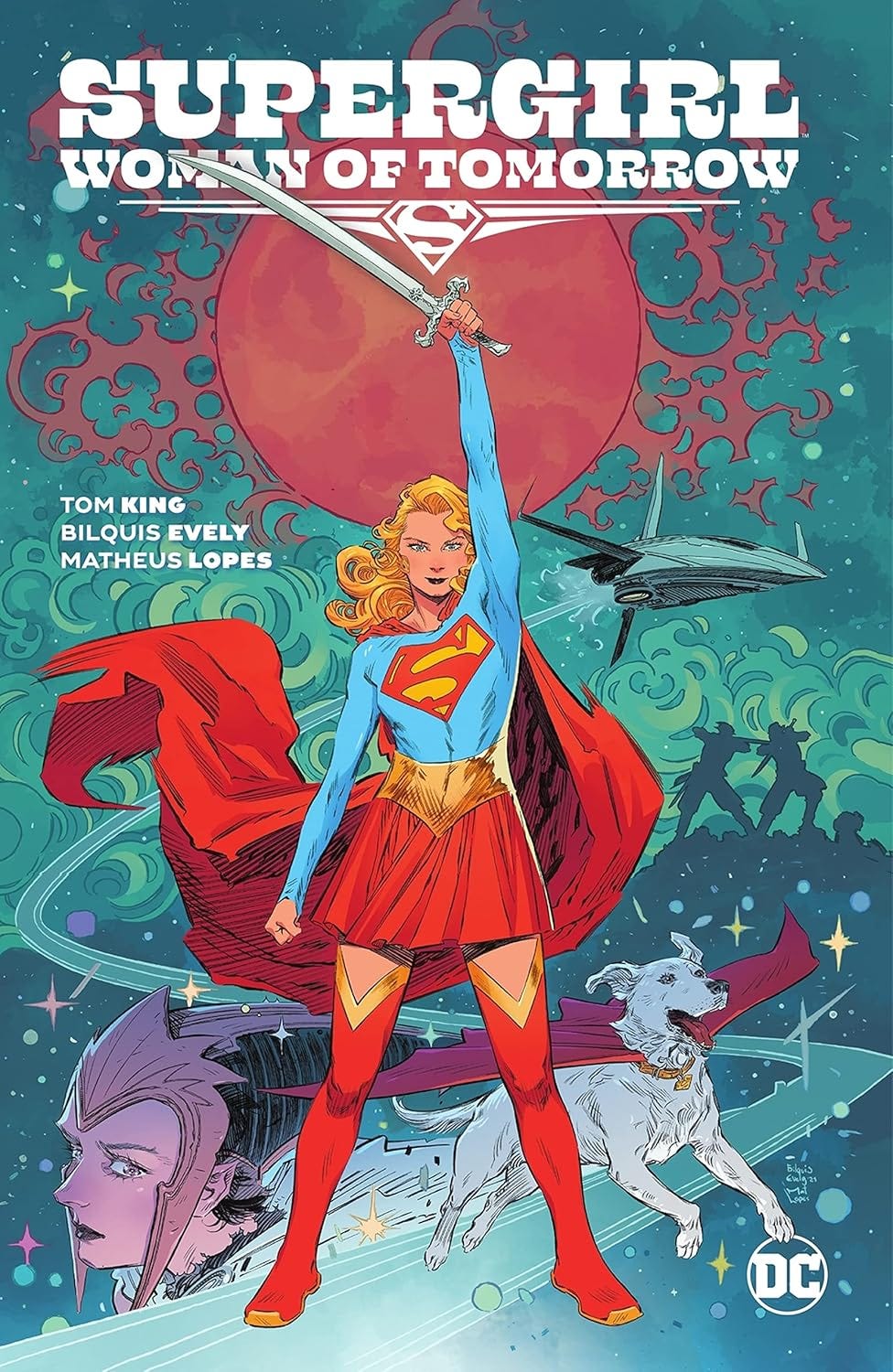
In preparation for the new Supergirl movie, I read the Tom King/Bilquis Evely Supergirl: Woman of Tomorrow miniseries on which the film is based. Having seen the trailer, I was somewhat surprised to discover that the source material is less fun bad girl adventure, and more an extended engagement with trauma and genocide.
As pop culture heroic genocide stories go, Women of Tomorrow could certainly have been worse; it thinks, with some heart and intelligence, about complicity and prejudice, and about the costs of trauma. But (in a very Hollywood move) the need to find redemption and uplift in atrocity ultimately leads to a sweeping and offensive glibness—and to a validation of order and justice which uncomfortably cosigns the fascism, and the patriarchy, we’re supposed to be fighting. Despite Evely’s lovely art and King’s enjoyably unexpected storytelling choices, I ended up hoping that the film goes in a different direction than the source material.
—
Everything Is Horrible is entirely funded by readers. If you find my writing valuable, please consider becoming a paid subscriber. It’s $50/yr, $5/month.
You can’t separate genocide from hate
First the positive. When mainstream superhero narratives evoke genocide or fascism, they often do so by deliberately erasing the core of fascism, which is disproportionate violence and hatred. Avengers: Infinity War, for example, imagines a genocide which is egalitarian—the evil Thanos erases half the people in the universe “at random” with what he calls a “dispassionate” fairness. He is evil because he is targeting everyone, rather than because he targets particular people—like, say, Jewish people, or Black people. We’re all in the same boat, and can all identify with the victims—a dynamic which elides the way that fascism specifically leverages hate against some as a way of buttressing the power, and sadism, of others.
Woman of Tomorrow at first seems like it’s headed in a similar direction. The plot starts on a distant planet where Supergirl has gone to get drunk and celebrate her 21st birthday. (Alcohol only affects her on a planet with a red sun where her powers are limited). While intoxicated she meets up with the narrator, a young girl named Ruthye, whose father was killed by a mercenary asshole named Krem of the Yellow Hills. Krem ends up poisoning Supergirl’s dog Krypto, and she and Ruthye follow him across the galaxy, the second for revenge, the first to try to get the antidote.
Evely’s colorful illustrations evoke fantasy art, and the story has a lot in common with high fantasy tropes, including a spectacular cameo by a space dragon. In line with those epic dynamics, danger comes from outside the communal fortress. Krem joins up with a gang of intergalactic raiders (Barbond’s Brigands)—which is where the egalitarian atrocity comes in. The bad guys are nonideological pirates who just happen to have the force strength to murder entire planets. As with Thanos, the enemies are outside alien invaders who kill all insiders indiscriminately; it’s stranger danger, but for genocide.
King is smart enough to refuse this easy binary, though. In issue 3, Supergirl and Ruthye track Krem to Coronn, which seems like a lovely little planet. (“Welcome to Maypole!” the motel keeper says. “We are happy as peach pie to have you!”) But it quickly becomes apparent that the town is keeping secrets. Specifically, the blue majority collaborated with the space pirates; in exchange for sparing the planet as a whole, blue people allowed brigands to mass murder the purple minority.
In some ways this looks like a white savior story. Supergirl (an honorary blue, according to the motel keeper) swoops in and uncovers the truth and punches some of those who committed atrocities.
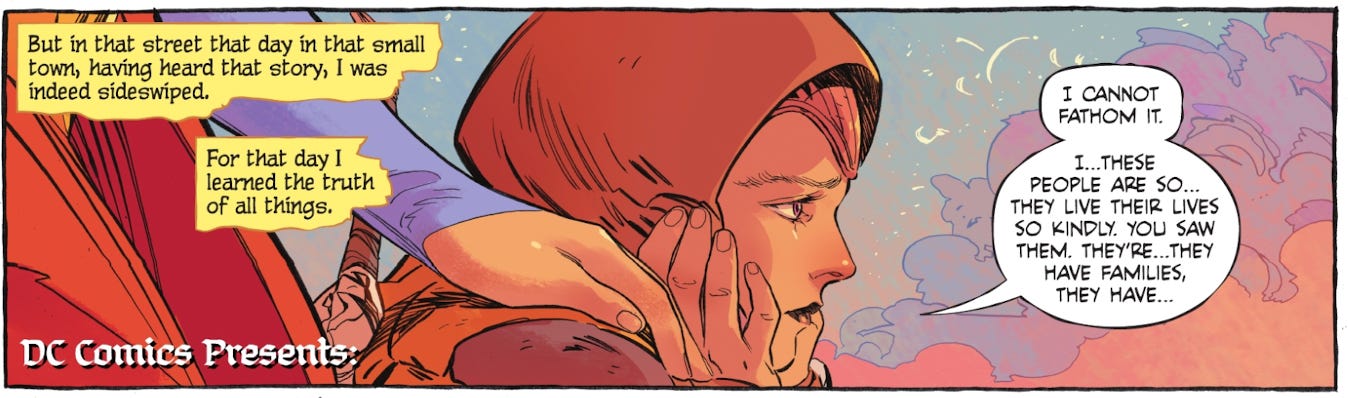
If this is a white savior story, though, it’s a good bit more grim than Hollywood often manages. In the first place, the story underlines the normal everydayness of those who commit atrocities.” These people are so…they live their lives so kindly…they have families…” This is more like Zone of Interest than Schindler’s List—it’s a story about how the people you identify with, who seem like the salt of the earth, who have families and speak in motherly tones of peach pie, are capable of doing horrific things.
The other difference with Hollywood is that Supergirl doesn’t actually save anyone. The purple people have already all been killed. There’s no one to rescue. And she and Ruthye continue to show up too late to rescue other planets too, so their quest turns into a recurring, traumatic encounter with horror and grief. Supergirl’s power are useless except that they allow her to (literally) dig lots of graves—and to identify bodies.
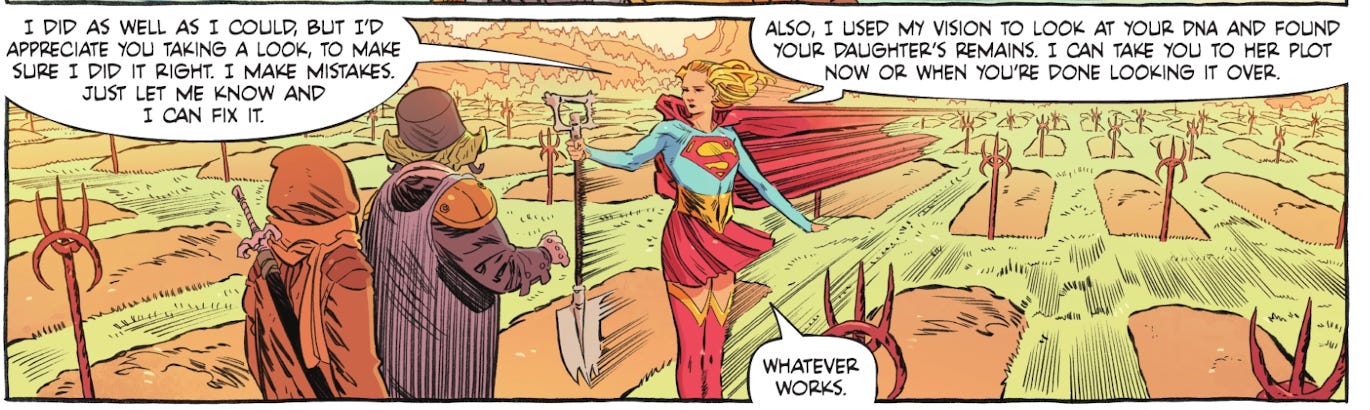
It’s a remarkably bleak vision for a superhero comic, not least because the violence and atrocity is connected to Supergirl’s own history. As a survivor of the (natural) destruction of her homeworld of Krypton, she watched helplessly as her world and her community die horribly, over years. That helplessness is repeated—and then underlined by Ruthye’s hero worship. The younger girl is starry eyed as she praises Supergirl’s strength, courage, and kindness (the last demonstrated in one lovely scene where Supergirl teaches her how to wash her hands.)
Ruthye is cuing readers to see Supergirl as an empowerment fantasy. But then the empowerment is blocked. No matter how wise and strong you are, atrocity and violence are still irreconcilable. Evely’s light, pretty, intricate landscapes start to feel ironic, and then desperate, an effort to weave a glamour over an abyss.
Melodrama is not an answer to genocide
Of course, you can’t have that kind of despair stand as the final word—at least, not in a mainstream superhero comic. Supergirl and Ruthye have adventures and overcome trials; they even eventually catch up with the brigands and there’s the epic battle you’d more or less expect. Supergirls’ physical and more strength ultimately defeat evil and end atrocity, repairing the universe through the power of her right arm/goodness.
The genre tropes are the genre tropes; it’s a rare mainstream superhero comic that fails to resolve its problems through superheroing. Woman of Tomorrow seems more glib than most of its peers in part because its depictions of atrocity and violence are more convincing. The genocides feel like they at least gesture towards real genocides. In that context, the suggestion that hitting bad guys is some sort of recompense ends up looking deeply inadequate.
Worse, the last pages of the comic turn into an extended parable about the moral salvation of those who commit genocide. Should Ruthye kill Krem? Will that be bad for her soul? It’s not just that we’ve seen this dance before; it’s that after you’ve shown us trillions and trillions killed, the whole exercise just comes across hopelessly inadequate—not least after a space battle in which Supergirl knocks people into space, which sure looks like it has to have killed someone.
King simply doesn’t have the resources to confront the moral issues he’s raised within the narrow confines of the genre he’s using. That results in what is easily the worst sequence of the comic, which also, not coincidentally, happens to be the moral climax.
(Spoilers if you care about that sort of thing.)
Ruthye finds she can’t bring herself to kill Krem, neither in revenge for her father nor in revenge for his other victims. Instead, Supergirl puts him in the Phantom Zone, an extradimensional prison, for 300 years. This is somehow supposed to be a merciful option. In any case, it has a transformative effect, as the completely unrepentant Krem miraculously repents, thanking Supergirl for imprisoning him (for 300 years!) and begging Ruthye on his knees for forgiveness.
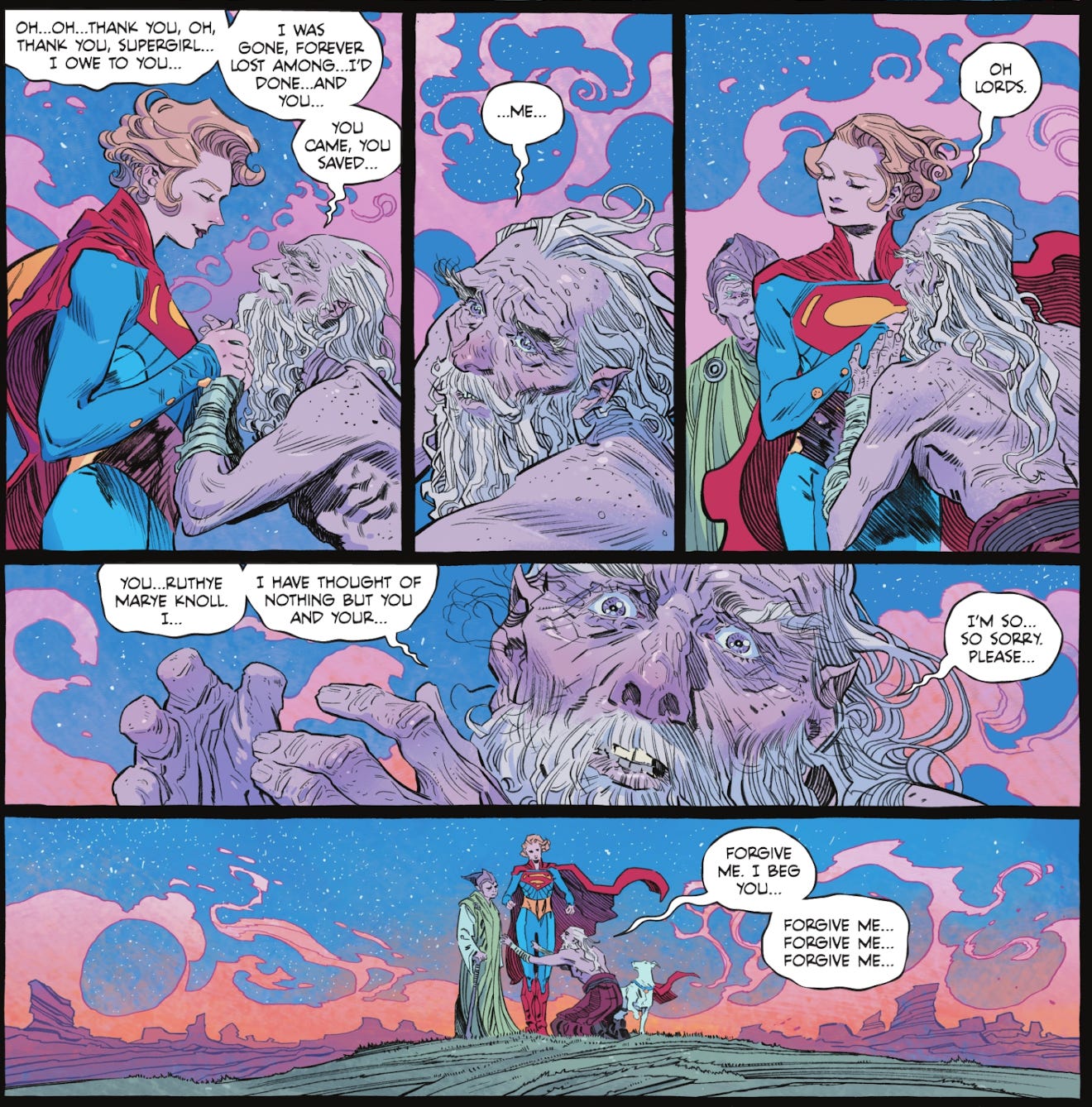
This man, again, is supposed to have killed trillions of people; he’s Hitler or Stalin. Can you imagine Hitler or Stalin being transformed by being tortured for 300 years? (And a 300 year prison sentence is definitely torture.) Would you find it enlightening or elevating to see a comic portraying Hitler or, say, Trump, undergoing a moral transformation in this way? Who is this supposed to comfort or inspire? Not victims of atrocity. Not people who actually spend decades in prison (which would be an atrocity itself, not least since it’s portrayed as mercy.)
The problem (again common to Hollywood) is that mass atrocity is simply not an occasion for uplift. Sweeping violence diminishes everyone. Stories which treat genocide as a lesson (and Supergirl repeatedly says she is teaching Ruthye a lesson) are fundamentally immoral. Killing Krem, sparing Krem, imprisoning and torturing Krem for centuries—none of these things repair the moral world. The victims are dead. You cannot make their deaths meaningful through melodrama. It’s an insult to suggest you can.
Supergirl for patriarchy
The confused restoration of moral order through melodrama also, perhaps inevitably, leads to confused special pleading for traditional hierarchy—and in particular for patriarchy.
You’d think that a Supergirl comic about genocidal violence might be in a position to think about the links between patriarchy, toxic masculinity, and war. But these aren’t the original Wonder Woman comics, and the feminism on offer is mostly of the “women can be badass fighters too” variety.
To the extent patriarchs are mentioned, they are presented in a strikingly positive light. After Supergirl’s mother dies, her father, who saved her from Krypton sends her out into the universe reminding her, that no matter what happens to her or what horrors she sees, “you are still my little girl.” It’s touching, but it also ends up positioning Supergirl as forever infantilized, always someone’s daughter, rather than someone’s mother, someone’s lover, or herself.
Similarly, Ruthye’s relationship with her mother is distant, but she is very close to her father, Elias. Krem is a royal spy, nad we initially are led to believe that he kills Elias for mocking the king. But Elias is, it turns out, too virtuous to question the big patriarch. He chastised Krem for making a joke about the king, and only then did Krem murderhim. It is Krem, not Ruthye’s father, who disrespected legitimate authority. It is Krem who is the rebel, while Ruthye’s father is an honest man who knows his place in an (at least implicitly) totalitarian hierarchy.
In short, this could have been a story set on one planet about two women fighting an entrenched and unjust patriarchal totalitarian system in which protestors are murdered. Instead, the creators go (very far) out of their way to tell a story about two women inspired by good fathers to combat threats to authority. We see the blue collaborators, but they are determinedly distant from Ruthye’s father, whose support for a King who employs violent spies is presented as a virtue that underlines the unjustness of his death, rather than as, itself a possible suggestion of complicity in injustice.
Woman of Tomorrow,, takes place in a universe of great cruelty and violence, in which ordinary people can be complicit and cruel, and in which goodness and kindness have little power to mend great harms. And then at the same time, it takes place in a universe of good fathers and righteous authority, in which compassion and justice unproblematically make all right between them. Those contradictions are supposed to feel like fantasy or like hope. I’m afraid though that, in our current bleak context, they feel more like a lie.
This is a great essay, Noah!
I am a fan of the book and planned to do a reread before the movie. Great argument here, and it's going to weigh pretty significantly in how I assess the book on reread. Thanks for the critique.