

—
This is the sort of piece that I could never write as a freelancer. I am grateful to paid subscribers for making this sort of thing possible. And if you are not a paid subscriber but value this sort of writing, consider becoming one! It’s $50/yr, $5/month.
—
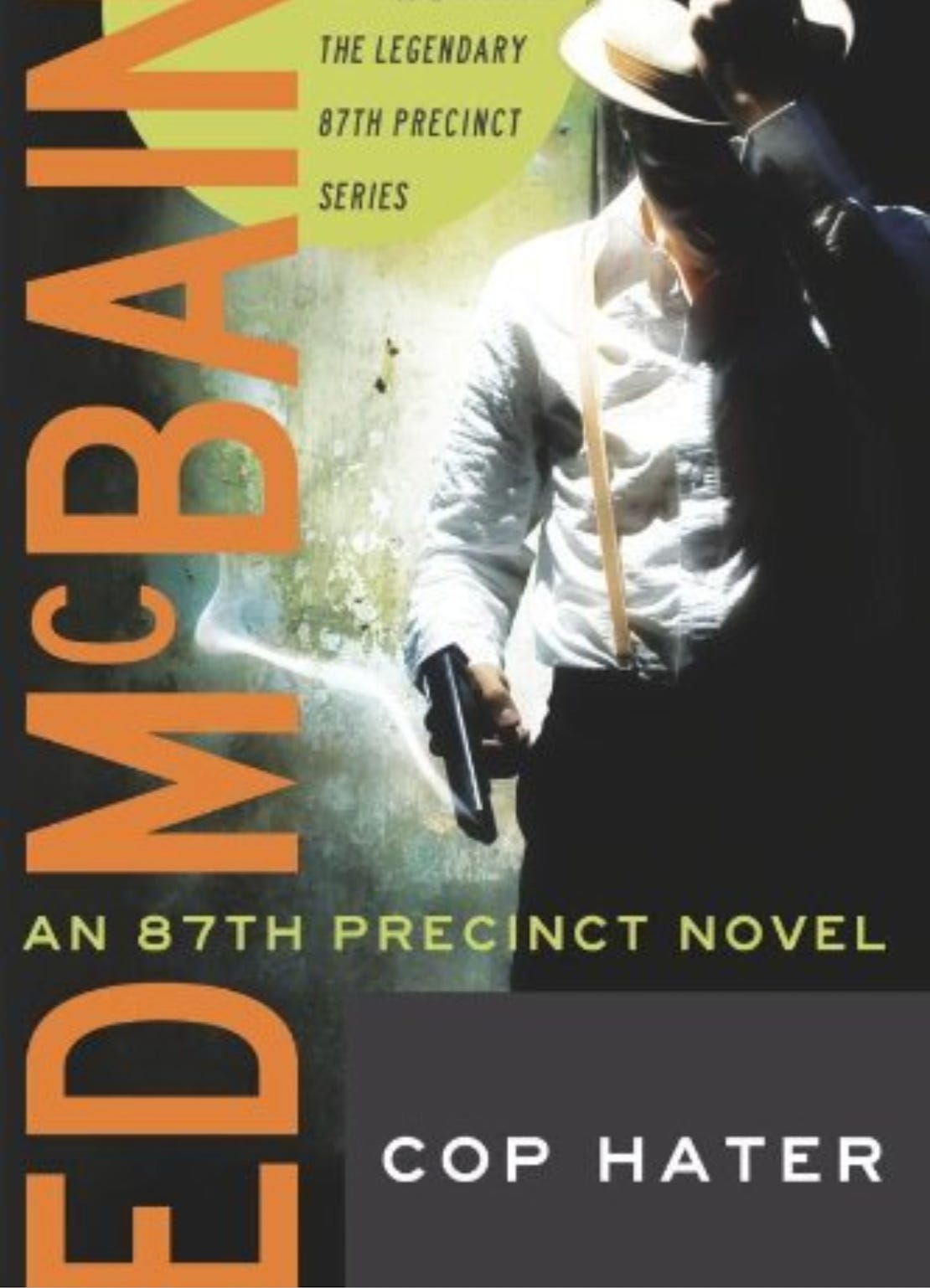
The 1956 novel Cop Hater is a groundbreaking police procedural—the origin point for Hill Street Blues, The Wire, Law & Order SVU, and endless other television cop dramas in which the ensemble cast, gritty competence and shoe leather are simultaneously the heroes and the narrative pleasures.
Cop Hater, though, is also a noir, complete with femme fatale and vindictive, panicked misogyny. This genre overlap is arguably just an indication of genre evolution. Author Ed McBain (aka Evan Hunter) was building a new kind of police crime novel, and he naturally used some of the materials of the old crime novel—masculine anxieties, female villains— to launch him on his way.
But I don’t think the overlap between policing and male panic is just a historical accident of development. Contemporary discussions of police generally focus—rightly—on racial disparities and racial hatred. But racism and misogyny are intertwined, and there’s good reason to believe that cops are charged with upholding gendered hierarchies as well as racial ones. Cop Hater in that context remains, 70 years later, a vivid account of who cops hate, and to what end.
“A Conglomerate Hero”
In his retrospective introduction to Cop Hater from 1989, Hunter explains that as he was contemplating a new series of crime novels, he initially thought of using a policeman as a protagonist. “But then,” he says:
thinking it through further, it seemed to me that a single cop did not a series make, and it further seemed to me that something new in the annals of police procedurals (I don’t even know if they were called that back then) would be a squadroom full of cops, each with different traits, who—when put together—would form a conglomerate hero.
The hero of the 87th precinct novels is not this cop or that cop. The hero is the police as a whole. The entire precinct—and occasionally cops from outside the precinct—represent a collective force for good, defending the city from not this evil or that evil, but from the collective amorphous forces of chaos. The goodness of the 87th precinct does not rest with the goodness of one man (and indeed some 87th precinct cops are very bad people.) Rather, the system itself is imbued with virtue, independent of any individual body that holds the gun.
Hunter plays with the collective identity of the protagonists in a number of ways. At times he emphasizes their unanimity, as in the following passage in which the two main characters of the novel, partners Steve Carella and Hank Bush, turn into a single efficient badge.
The doors slid open. Carella and Bush stepped into a sunlit corridor. Simultaneously, they reached for the leather cases to which their shields were pinned. Again, simultaneously, they pinned the tin to their collars and then walked toward the desk behind which another patrolman was seated.
In anticommunist horror of the period—like Invasion of the Body Snatchers—this kind of erasure of individuality might be seen as inhuman and nightmarish. But for McBain, the coordinated submersion in a corporate self is a way to signal efficiency, humility, and power. The cops are part of a machine of justice that is bigger than themselves. Law-abiding citizens should be comforted; law-breakers should fear.
Hunter also uses his new idea of conglomerate hero to wrong-foot readers who might be expecting the usual singular protagonist. The novel opens with policeman Mike Reardon getting up to go to work on the midnight shift. He admires his sleeping wife, checks in on his kids, and starts out the door. In most novels of this type, this would be your main character. But instead, mere pages after he’s introduced, he’s gunned down. The cops who show up to investigate the murder take the main character role from him, like he’s passing the baton.
Hunter likes this trick so much he uses it again. Hank Bush is, as mentioned above, one of the two main characters in the book. But that doesn’t save him. Towards the end of the novel he is shot too.
Hank doesn’t just die though. He manages to shoot his murderer and claw at his face, giving the lab techs hair and skin samples. Hank is aware he is part of a collective entity and like a worker in an ant colony he sacrifices himself in such a way as to make that collective stronger. Or as the lab tech explains, Hank knew
“…he’d been shot two or three times already, and possibly knew he’d be a dead pigeon before this was over. Whatever the case, he knew we could use more information on the bastard doing the shooting.”
The murderer keeps shooting cops. But where one cop falls, the next rises up stronger. The long arm of the law will always grab hold of the wrongdoer, because there is not just one long arm. There are many.
“A Cloying, Clinging Embrace”
Initially, all those arms in Cop Hater believe that they are reaching for a cop hater—someone who loathes the police and is targeting them for revenge or retribution.
Over the course of the novel, that theory becomes less tenable. Among other things, as Steve Carella argues, the cops are all shot while they are in plain clothes.
“We knew these men well; we worked with them every day. Cops. We knew them as cops. We didn’t know them as men. They may have been killed because they were men, and not because they were cops.”
“Men” there doesn’t just mean “civilians”. It is intentionally gendered. The dicks are, as it were, being murdered because they are dicks.
This is where the femme fatale comes in— Alice, Hank Bush’s too, too sexy wife.
The first thing we learn about Alice is that Hank checks up on her at home a little obsessively. Then we’re treated to a scene with the two of them at home, in which Alice strips in front of Hank but refuses to have sex with him—framed as a mean-spirited tease of both husband and reader.
“Come here,” he said.
“No. I don’t want to, Hank.”
“All right,” he said.
“Do you think it’ll cool off tonight?”
“I doubt it.” He watched her closely. He had the distinct impression that she was undressing for him, and yet she’d said…He tweaked his nose, puzzled. She turned from the window. Her skin was very white against the white of her underwear. Her breasts bulged over the edges of the inadequate bra.
“You need a haircut,” she said.
After Hank is murdered, Carella goes to question Alice, and the aura of sensual menace is ramped up even further.
She looked at him wide‐eyed. Her eyes were very brown, her hair was very blonde, her complexion was fair and unmarred. She was a beautiful woman, and he did not like considering her such. He wanted her to be dowdy and forlorn. He did not want her looking fresh and lovely. Goddamn it, what was there about this room that suffocated a man? He felt like the last male alive, surrounded by bare‐breasted beauties on a tropical island surrounded by man‐eating sharks. There was no place to run to. The island was called Amazonia or something, and the island was female to the core, and he was the last man alive.
The room and Alice Bush.
The femaleness reached out to envelop him in a cloying, clinging embrace.
Just as Hank passes on the investigation to his living colleagues, so he seems to have passed on his wife and his own sexual frustration to his partner. The upright, synchronized regimentation of order is enveloped in “femaleness”, a suffocating miasma of deviance which swamps duty and righteousness.
This is the terrain of noir, and Alice is the stereotypical oversexed villainness. She hates her husband for his upright, dutiful refusal to bend to her womanhood (“Cooped up in that goddamn apartment, waiting for him to come off some burglary or some knifing or some mugging? What kind of life is that for a woman?”) And so she seduces another man and convinces him to murder a string of cops in order to confuse the issue when he finally offs Hank.
Alice’s disordered, overbearing femininity is juxtaposed in the book with the demure subservience of Carella’s fiancé, Teddy. Alice is resentful of the demands made on her and withholds sex as a kind of revenge. Teddy’s whole personality and inner life is focused on Carella, with whom she is eager to leap into bed.
Alice is defined by her hectoring; Teddy, on the other hand, cannot speak. She is deaf. And while in real life of course deaf women have agency and their own inner lives and goals, in the novel Teddy’s lack of a voice is a symbol of and a guarantor of her passivity and subservience. The good woman is a woman who does not speak and who acts only in the interest of her man. She is not even angry when Carella gives a foolish interview to the press that leads the murderer to her and puts her life in dangers.
When one cop has an argument with his wife, the novel quips about controlling women and how men are “trapped in the labial folds of a society structure.” But as is the way of such things, the joke is meant to obscure the novel’s forceful assertion that good women bow to men, and bad women who do not are to be punished. The book pretends that men live under matriarchy because that’s one way you justify, and obfuscate, patriarchy.
The 87th Precinct Today
Cop Hater is not innovating when it imagines men joining forces to punish and discipline the femme fatale. As just one example, in Double Indemnity, insurance agent Walter Neff (Fred MacMurray) finally chooses his avuncular boss Barton Keyes (Edward G. Robinson) over the seductive Phyllis (Barbara Stanwych). The patriarchal order closes ranks and the suffocating rot of femininity is lopped off and sterilized. Thus virtue is restored.
The fact that in Cop Hater male virtue is restored specifically by the police, though, has a queasy resonance outside the bounds of genre. It’s something of a joke among progressives that liberals want to fix policing by adding more women cops. The point is well taken—but it’s also worth noting that even seven decades after the all-male police force shown in Cop Hater hit bookstores, women still make up only about 12% of police officers.
The demographics reflect the mission. Police and the justice system enforced patriarchy in Cop Hater, and they still do so outside the pages of genre fiction. In her harrowing study, Unreasonable Women, researcher Justine van der Leun explains that police and judges regularly refuse to intervene when women are targeted for domestic and sexual violence. When women defend themselves against abuse, however, the full power of the state is unleashed against them.
Van der Leun highlights the cases of three women, all of whom were sexually abused as children and then abused brutally by intimate partners as adults. Law enforcement did nothing to help. One woman killed her abuser; another killed her mother’s abuser; another was forced at gunpoint to help with a crime. And only at that point did police and prosecutors take an interest, doing everything in their power to incarcerate them—up to and including breaking promises of immunity.
More, the prosecutorial arguments deployed against these women sound like something Ed McBain’s cops might have used in describing Alice. Van der Leun interviews Rachel White-Domain, a Chicago lawyer who represents imprisoned survivors of sexual and domestic violence. White-Domain explains that when her clients go to court, the state has a standard story for jurors.
Nuanced stories of complex human relationships and lives saturated with violence and chaos were expunged or reworked by government employees and agencies. In their place emerged a plainer and more popular tale: The defendant was simply a slut, a manipulator, a liar who snapped for no apparent reason, or a hysteric who overreacted when a more measured, appropriate response was called for. The violence enacted against her was diminished, or disregarded, or ignored. She made it up or exaggerated. She was no more than a murderer.
If you think about Cop Hater after reading this quote, you start to wonder how much you can trust the portrait of Alice drawn by Hank and Carella and the novel. Again, we know that Hank checks up on his wife constantly; he’s controlling. We also know that he and Carella see her sexuality as aggression and violence. And we know that police officers commit domestic violence at terrifying rates—one study suggested that 40 percent of officers perpetrated some form of intimate partner violence in a six month period.
In Cop Hater, Alice is “no more than a murderer”—her motive, as Alice herself puts it in the novel, is simply that “I wanted him dead.”
But perhaps the cops are lying, as cops often do. Maybe Hank Bush beat his wife. Maybe he sexually assaulted her. Maybe she didn’t ask him for a divorce not because she preferred to kill him and torment him, but because she knew that threatening to leave him would lead to a catastrophic escalation of violence, as it often does. The fact that she is sentenced to the electric chair by a jury including eight men is not, in this reading, a sign that her feminine wiles failed her. It’s merely the usual outcome for women who dare to defend themselves from male assault.
You’d like to think that we’d moved past the retrograde attitudes of 1956. But copaganda has only metastasized since Ed McBain’s innovations in the form, and the destructive misogyny of our justice system remains ubiquitous and violent. Alice never existed. But the fantasy of Alice still undergirds police handling of intimate partner violence. The 87th precinct continues in its lockstep patriarchal trudge, grinding beneath their feet Alice’s story, her freedom, and her life.
"The book pretends that men live under matriarchy because that’s one way you justify, and obfuscate, patriarchy.
Reactionaries' playbook for any systemic issue.
Bravo!
"The 1956 novel Cop Hater is a groundbreaking police procedural—the origin point for Hill Street Blues, The Wire, Law & Order SVU, and endless other television cop dramas..."
To say nothing of more comic portrayals of the police. McBain was the clear dramatic precursor of "Barney Miller" and "Brooklyn 99" on TV, and the "Police Academy", "Naked Gun" and "Zootopia" movies, among others. And it did have antecedents in other earlier film projects such as "The Naked City" (which was adapted for TV at the time the novel came out) and "Detective Story" in previous years, so it wasn't operating in a vacuum.
The 87th ended up being a very long-lasting series, as McBain kept writing novels, novellas and short stories about the precinct until he died in 2005. And while he did his best to keep up with the time, he could never shake the flaws of the multi-character arc style of writing he pioneed here.