

—
Everything Is Horrible is having a sale! It’s 40% off, $30/year. Please consider joining as a paid subscriber so I can keep scribbling!
—
Kenji Tanigaki’s martial arts sledgehammer of a film The Furious is a wonder of inventively, glorious balletic brutality. It’s also an ugly illustration of how moral panics about children are used to justify apocalyptic violence and cruelty. The fundamental silliness of the exercise only underlines the cynicism of the strategy. It’s not enough to enjoy simulated uber-carnage; you also have to feel good about it.
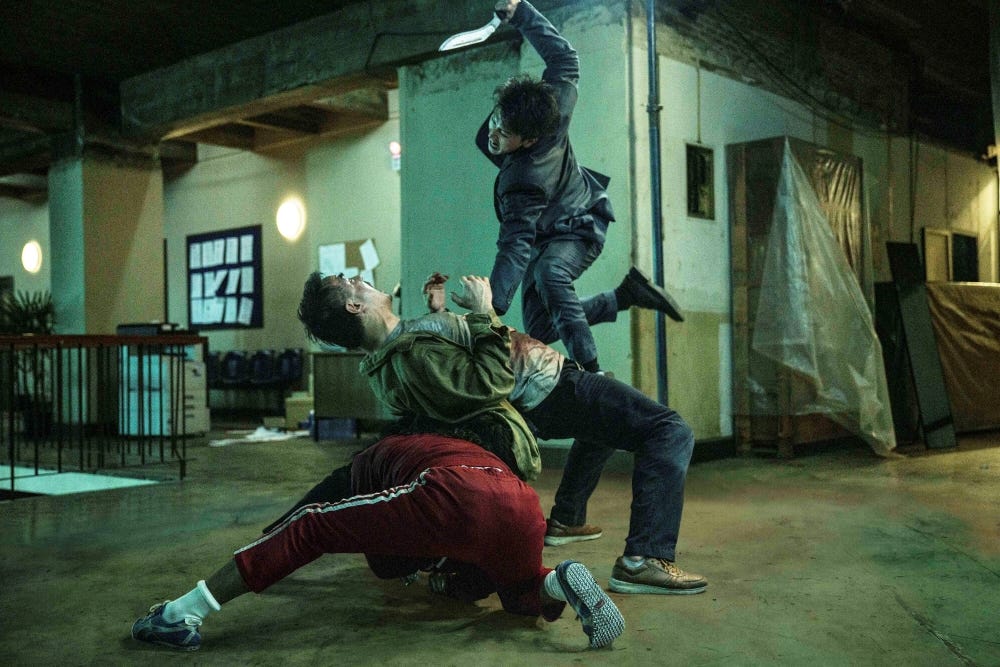
That simulated uber-carnage is, again, absolutely top tier. The film has been compared to The Raid in its relentlessness—and in its love of fights in labyrinthine buildings with narrow halls and lots of stairs. Tanigaki also, though, has his own individual gift for inventive set-piece battles, epitomized by the climactic almost Jackie-Chan like sequence involving the antagonists fighting each other with literal bicycles. They first duel holding the bicyles like unwieldy two-handed swords, and then devolve into bashing each other with pedals and trying to strangle each other with bike chains.
There are lots of other fun accessories: hammers, sledgehammers, a large wooden pallette used as a barricade, movable metal tables, garbage bags, ladders. But even without such additions, the fights have a gritty, sweaty grace, with the stung men crawling over and under each other, like everybody is everyone else’s scalable netting. Rapid fire leg to leg kicks, leading inevitably to falls and floor spins, highlight the connection to dance. It’s like watching the Nicholas brothers’ amazing routine in Stormy Weather if the Nicholas brothers were trying to tear out each other’s throats with their teeth. (Yes, there’s a scene in The Furious where one guy literally tears out another’s throat with his teeth.)
The set pieces are the reason to see martial arts films in general and they’re certainly the reason to see this one in particular. But creators and viewers also, for some reason, believe you need to have a plot to make you feel like the martial arts are righteous, or at least like they are headed in some direction.
And so The Furious offers a story of human child trafficking. Paklung (Joey Iwanaga), an organized crime asshole, is kidnapping children for never clearly defined but obviously evil purposes. Journalist Matia (Jeeja Yanin) investigates the ring; when she disappears, her husband Navin (Joe Taslim) attempts to track her down. Meanwhile a mysterious mute handyman Wang Wei (Xie Miao) is searching for his kidnapped daughter Rainy (Yang Enyou). The heroes plan consists of beating the crap out of an endless string of flunkies—especially the massive Ho (Brian Le) and the sinister archer Tak (Yayan Ruhian).
The stranger-danger-threat-to-kids plot is so much a part of the vocabulary of Hollywood product that the thought of questioning it rarely registers for most viewers. Nonetheless, the fact is that “the most common perpetrators of physical and emotional violence for both boys and girls across a range of ages are household members” per one 2018 analysis. Today in the US, the main kidnapper of minors is undoubtedly ICE, which has detained and imprisoned 6200 children.
Along those lines, it’s telling that the one discussion of monetizing the children in the film involves selling them to work on fishing boats, which makes little sense. The people kidnapped and forced to work on fishing boats in southeast Asia are adults, since children would be much less able to perform such backbreaking work.
Of course, children are sometimes attacked or harmed by criminal strangers. China’s one-child policy led to a wave of abductions of infants to satisfy domestic and international adoption markets. But the kind of mass conspiracy of criminal child kidnapping that the movies love tends to erase the fact that the more common threats to children come much more often from their caregivers and their governments than from cabals of strangers.
More, the stranger danger threat frames violence by caregivers as necessary, admirable, cool, righteous. Wang Wei engages in murder and calculated torture and we’re supposed to cheer him on, even though, in real life, unfortunately, extremely violent fathers are exponentially more likely to harm their children than to protect them.
The movie is not unaware of this dynamic. Wei as good father is doubled by a number of bad fathers. One of the children in captivity seems to have been the son of one of the gang members, who, it is suggested, was abusive.
Even more tellingly, Paklung is married to the daughter of the chief criminal muckety muck. When said muckety muck decides to make Paklung take the fall for the exposure of the child trafficking ring, Paklung goes feral, murdering his father-in-law and everyone else in the room. That includes his wife, who he accidentally stabs in the stomach, killing her and their unborn daughter.
Again, Paklung is evil; Wei is good. But in the name of revenge for their children, they both behave in much the same way, unleashing an endless torrent of (visually stunning) bloodshed and cruelty. Wei’s is all directed at bad people; he only bashes in the skulls of criminals and only uses electricity to torture the worst of the worst when he needs information. Paklung, in contrast, lashes out at others indiscriminately—when he murders his wife and daughter, he blames everyone else but himself. He says he’s getting revenge, but really he’s simply using the deaths of his family to commit more murder and mayhem against his “enemies”, just as his hatred of his enemies led him to murder his family (and was that murder really “accidental”?)
Paklung alternately stalks children and mourns them. This hypocritical vacillation mirrors the energy of the film and of moral panics in general—like the moral panics directed at trans children, for example, which claim to protect them in order to justify terrorizing them, forcing them out of public life, and killing them.
Martial arts films thoroughly aestheticize their battles; no one is trying giddy somersaults with sledgehammers at home. Nonetheless, the narrative and psychological use of children as rationale for bloodshed in The Furious maps onto the ways that moral panics around children generate excuses for violence and hate even as they throw a smokescreen up around the actual threats children face from the families and governments that are supposed to protect them.
This doesn’t make The Furious a bad movie, especially since the plot is mostly an afterthought which is just there because you need somewhere to hang the pretty violence. It’s worth just pointing out that moral panics are also afterthoughts in much the same way.