

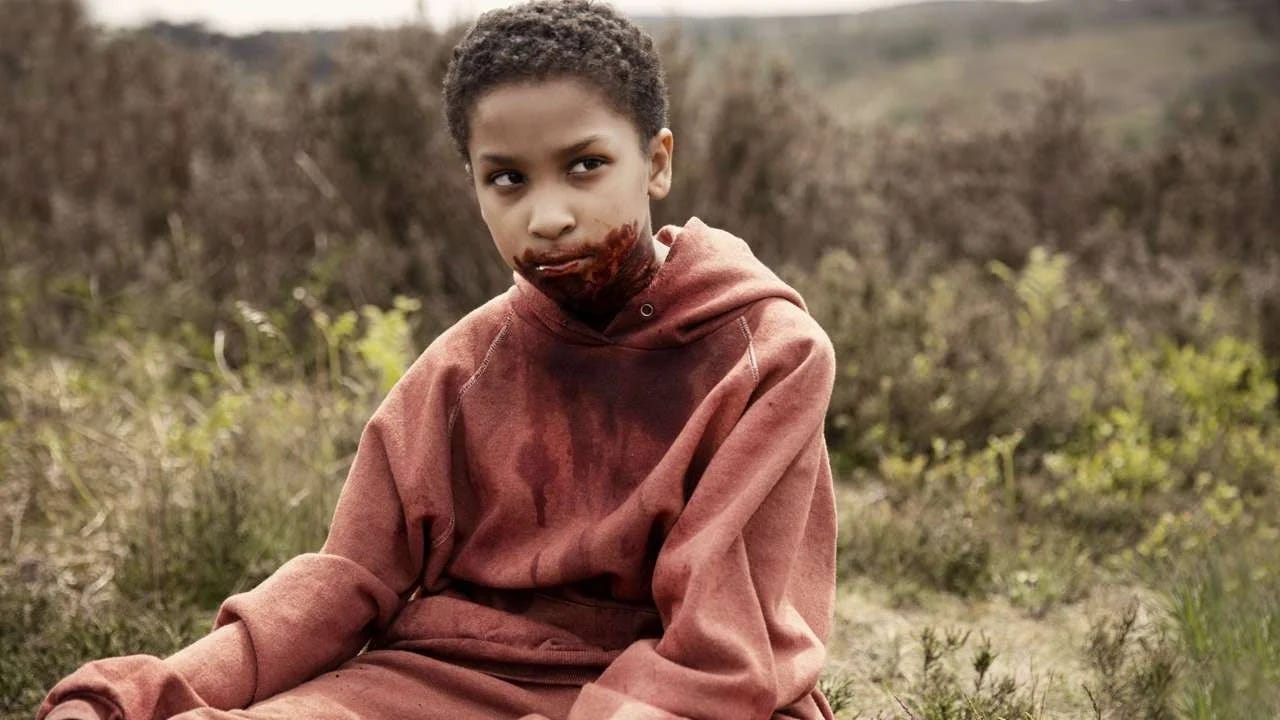
Colm McCarthy’s The Girl With All the Gifts, released in 2016, feels now like a prescient warning, not of our current apocalypse, but of the paranoid apocalyptic thinking that made our apocalypse possible. The film imagines a world in which the future belongs to Black people, disabled people, women, and, perhaps most terrifyingly, children. The marginalized rise up in feral glory, dragging London back down the primordial evolutionary ladder, and thereby justifying any and every atrocity in the name of resistance—or so the adults claim.
—
Everything Is Horrible needs your donations! If you want me to keep writing, please consider contributing. This has not been a great month so far, so help would be appreciated! It’s $50/month, $5/year.
The film is set in a semi-Romero-esque near future, in which hungry zombies have taken over England, and probably the world. This particular zombie infestation is spread by a fungal infection, and while adult bite victims turn into your standard mindless hungries, children—especially late term fetuses infected in the womb—retain intelligence.
Melanie (Sennia Nanua), a brilliant tween zombie child, is raised in a research facility, where she bonds with her teacher, Helen Justineau (Gemma Arterton). Dr. Caroline Caldwell (Glenn Close) plans to vivisect Melanie to find a vaccine, but before she can the base is overrun. Melanie, Justineau, Caldwell and Sergeant Eddie Parks (Paddy Considine) escape and head to London to try to connect with other human holdouts.
Nanua is extremely charismatic, and her portrayal of Melanie—her hero-worship of Justineau, her eagerness to please, her delight at each new piece of information, whether about the depth of rivers or the use of hollow-point rounds—is by turns delightful and heartbreaking. That gives an extra edge to the brutality directed at her; the adults call her “abortion”; people who touch her or talk to her are reprimanded; Caldwell insists she’s not human, but just a fungus imitating consciousness.
It’s not just the adults in the film who dehumanize Melanie. The filmmakers do as well. While she is bright and generally in control of herself, when she’s hungry she can also be driven wild by the smell of flesh, human or animal. Despite having a kitten picture on the wall of her cell, one of the first things she does when let loose in the world is stalk a cat and devour it raw, the blood spread down her front. When she encounters other hungry children, she fights and murders their leader in a sequence which echoes the tribal to-the-death struggles of colonial fiction.
Framing a Black girl as an atavistic primitive dovetails with racist stereotypes, and with Brexit reverse colonization fears—the terror that, as we once went and invaded them, they will now invade and replace us. Colonized people are always associated with children—they are less developed, further back down the timeline, not fully ready to take their place among the civilized. A London occupied by mixed race cannibal adolescents is a nightmare vision of decolonization, where the center has been bloodily ingested by the too-precocious periphery. To provide an extra shiver, Melanie at the conclusion of the film bonds with a giant fruiting fungal tree, going back past mammals and reptiles to an infecting, parasitic spore.
If childhood is a metaphor for colonized people, though, the colonized are also a metaphor for children. Melanie is a symbol of Black immigration to London, but she’s also a symbol of the next generation—multi-racial, feminized, physically disabled (she’s locked to a chair and wheeled around in a facility), cognitively superior (she seems to have a photographic memory) and cognitively other (the whole eating flesh raw thing) in disorienting and frightening ways. “Pretend you’re frightened of me,” she tells Justineau and Parks after committing a vicious murder. “Pretend?” Parks says.
Melanie is frightening. But she’s also lovable, inspiring, and the hero of the film. In this, The Girl With All the Gifts follows not Romero’s zombie films, but Richard Matheson’s influential vampire novel I Am Legend. At that book’s conclusion, the vampire killer, the sole human left alive, realizes that it’s the vampires who have inherited the earth, and that he is now the monster. That moment of recognition echoes—and is magnified by the resonance with race, with childhood, and with colonialism—when Eddie Parks whispers just before he dies, “It’s over. It’s all over.” Melanie responds, with chilling and comforting reassurance, “It’s not over. It’s just not yours any more.”
The movie is, again, on Melanie’s side—so much so that it makes clear that Melanie’s side is, really, the only side. Eddie’s last memory is of his pregnant wife, who may well have given birth to a zombie baby like Melanie. Practically the last thing Melanie says to him is that she learnd how to use a gun from him. “Of course you did,” he says—which is resignation, but also pride. Melanie is his successor, but she’s also—or rather because—she’s his daughter. Time goes on, and adults have no choice but to leave the world to the strange, alien, but also beautiful creatures to whom they give birth and to whom they give way. The girl with all the gifts has all the gifts because those gifts—of knowledge, of love, of hope, and also, unfortunately, of hate and violence—were given to her by the people who raised her.
The power of the film, though, and its relevance, isn’t just in its message of acceptance, but in its vision of the terror that potential acceptance provokes. Time may only go forward, but there are those—like Trump, like Stephen Miller, like Nigel Farage—who want to make the future like the past. And they want to do this through the violent cleansing of those they see as usurping their power and their lives—including Black people, immigrants, women, queer people, disabled people, and the young, not least their own children.
In that sense, The Girl with All the Gifts is not apocalyptic, but utopian. The soldiers, the vivisectors, the racists, and the fascists are swept away, and all that’s left are the teachers, passing along the gifts that are needful to a better future. It’s hard to see how we get there from here. But tomorrow is tomorrow, and as Melanie says in the film’s last line, “There will be lots of time.”
Have you read the book? It's different in interesting ways.
Beautiful essay- I can’t wait to watch this.