

The Illinois Democratic primary elections, which concluded yesterday, were in many respects a dispiriting and ugly spectacle. AIPAC and crypto interests spent massively in the campaign—dropping almost $100 million in what American Prospect executive editor David Dayen terms “a full-spectrum disaster for democracy.” New Republic editor Meredith Shiner’s assessment was equally dismal. “A bunch of cooked octogenarians finally retired and the fight to replace them was so bleak,” she said. “Totally crowded fields, millions in outside money, no substantive debate really about the future of the Democratic Party or country.
Nonetheless, as the title of this newsletter indicates, my general expectations are pretty low. And on the scale of “absolute worst possible night” to “could have been much worse,” I feel like the Illinois primaries ended up very much on the less apocalyptic end—with some surprising victories over supposedly unbeatable foes, and a few real lessons for progressives going forward.
—
Everything Is Horrible is entirely funded by your donations. If you find this post valuable, please consider becoming a paid subscriber. It’s $50/yr, $5/month.
Some bad, some good
There was, inevitably, a fair bit of bad news. Melissa Bean, a longstanding Wall Street House shill who was defeated by a Republican in 2010, rewon IL-8 on a centrist message and the strength of millions in AIPAC and AI cash. Donna Miller won IL-2, thanks to AIPAC donations and a massive crypto spending campaign against progressive Robert Peters.
The big money didn’t have it all its own way though. In IL-7, La Shawn Ford defeated AIPAC-funded Melissa Conyears-Ervin. In IL-9, Laura Fine, who received staggering amounts of money from AIPAC, finished third behind Evanston mayor Daniel Biss (pro Israel, but calling for limits on Israel aid) and progressive hope Kat Abughazaleh (who has called Israel’s policy in Gaza a genocide). In a state House race, community organizer and pro-immigrant activist Miguel Alvelo-Rivera defeated incumbent Jaime Andrade, a centrist who had boasted about his pro-ICE stance.
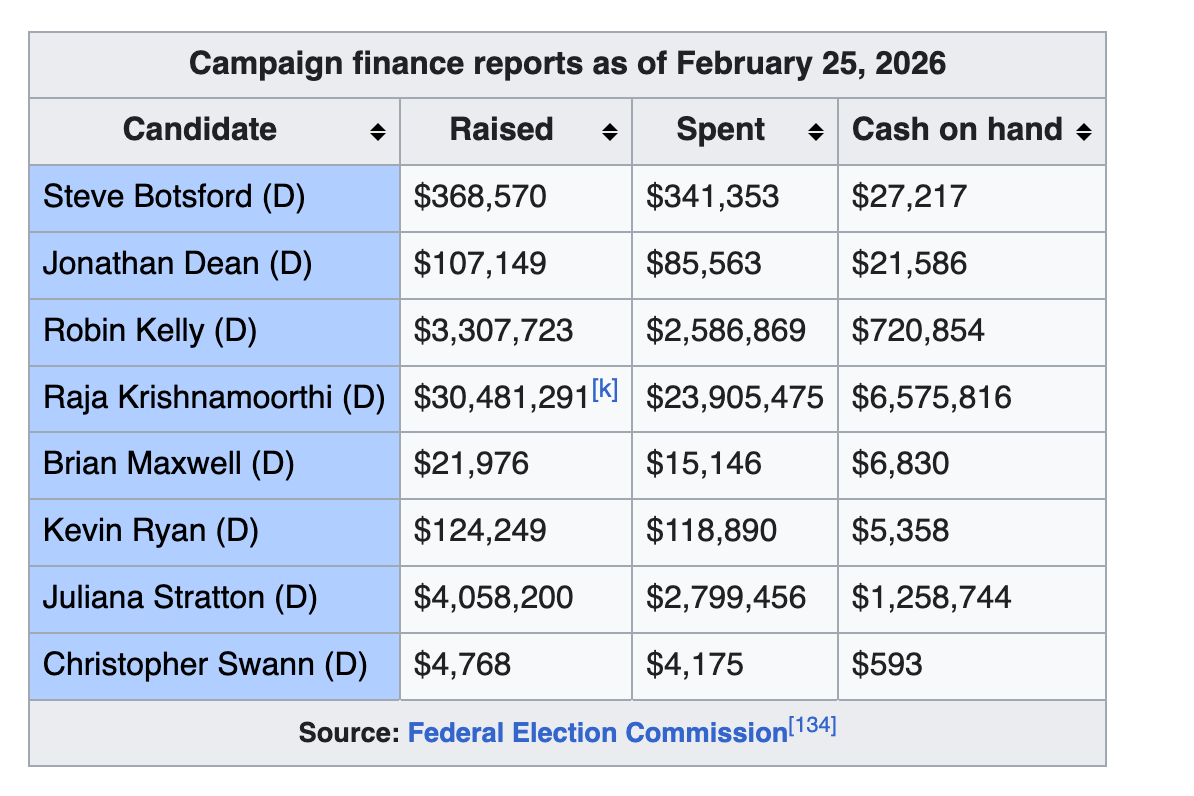
And in what was perhaps the biggest ray of something like sunshine, Lt Governor Juliana Stratton won the IL Senate race fairly easily against Congressman Raja Krishnamoorthi, who spent heavily, early, and often thanks to grotesque amounts of cash from Trump donors and crypto interests. Krishnamoorthi’s was a cynical, duplicitous campaign, and its defeat is worth celebrating.
Why did we win where we won?
But how did that defeat happen? Why did candidates defeat big money assholes where they defeated them?
There are a couple of pretty clear answers here, I think. First, AIPAC, and big money outside donors in general, are quite unpopular in Democratic primaries. Candidates who took dark money were attacked for it by their opponents—and even by their allies. Jan Schakowsky (retiring congresswoman for IL-9) withdrew her endorsement of Donna Miller in IL-2 because she had taken AIPAC support.
Miller still won, though. Dark money has downsides, but it also obviously helps you get your message out and can overwhelm opponents who don’t have other advantages.
What other advantages? Well, the big one is endorsements. Progressives often talk about endorsements with a certain amount of resentment, because establishment Democrats often give their support to—well, other establishment Democrats.
The thing in Illinois, though is that the Democratic establishment is quite progressive—certainly more progressive than AIPAC. Popular billionaire Illinois governor J.B. Pritzker in fact denounced AIPAC as “MAGA-influenced.” He also endorsed Stratton enthusiastically, contributed to her war chest, and appeared in her ads. Stratton ran a strong campaign in other respects, but if there’s one thing that offset Krishnamoorthi’s cash advantage, it was Pritzker.
There’s a similar story in the other races where big money lost. Retiring Rep Danny Davis endorsed La Shawn Ford for his seat in IL-7; retiring Rep Jan Schakowsky endorsed Biss for her seat in IL-9. They both beat their AIPAC-fueled rivals. Money can get you attention and put your name in front of people, but endorsements by popular, well-known politicians, can be more powerful. If Robin Kelly, who retired from her seat to run for Senate, had been willing to endorse Peters in IL-2—you can’t say he would have won for sure, but I think it would have been a different race.
Progressives need to nationalize their races
Biss won IL-9. But 26-year-old media critic and analyst Kat Abughazaleh also beat Laura Fine, and she did it without much in the way of big name local or national endorsements. She was, in fact, new to the district, and when she announced her run, most experts assumed hers was a vanity no-hope run.
Instead, Abughazaleh, who had worked for Media Matters critiquing Tucker Carlson and other right=wing assholes, released a string of engaging, powerful videos embracing forthright, clearly stated progressive positions and calling for a much, much stronger Democratic response to Trump. She turned her campaign into a mutual-aid hub and courageously protested at the Broadview ICE detention facility, where she was roughed up and targeted for federal charges.
All of which got her a huge amount of coverage in both progressive and mainstream media. That helped her pull in enough donations to compete with Biss and Fine.
In the last 24 hours of the campaign, Biss was accused of, and admitted to, an inappropriate relationship with a former student while he was a math professor at the University of Chicago. The accusation didn’t lead to his defeat, but it certainly lowered my estimation of his character, and made Abughazaleh’s loss feel significantly bleaker.
Nonetheless, we shouldn’t let defeat distract us from Abughazaleh’s accomplishments. Earned media, paid media, massive progressive enthusiasm, and a smart, principled, and passionate campaign allowed her to defeat the AIPAC funded candidate in the race and almost allowed her to overcome Biss’ establishment credentials as well.
Going forward
There are a few takeaways from these results.
First, progressives would do well to build bridges to established, popular politicians where that is possible. New York Mayor Zohran Mamdani has already been active in promoting progressive Brad Lander for a House seat against a centrist opponent.
Obviously, there are a limited number of progressive stars, and Senator Bernie Sanders, Representative Alexandria Ocasio-Cortez, or for that matter Pritzker. have their own priorities and missions which might keep them on the sidelines in Democratic primaries. But when key figures endorse the right race, —as rising House star Delia Ramirez did to help put Miguel Alvelo-Rivera over the top—they can often beat big money.
Second, progressives need to look at races they can nationalize. Rather than denigrating or questioning the authenticity of candidates who have a national profile and who speak to a national audience, progressives need to see this as a tactic. National progressive donor and media networks can be powerful—but candidates need to figure out ways to energize them and access them. Abughazaleh’s campaign was a blueprint that others might do well to emulate. (Also, imo, people should probably pay Abughazaleh to run their campaigns, if she decides she’s willing to do that.)
Third—Democrats need to get serious about getting dark money out of politics. The only way to really do that is to rebalance the Supreme Court. When Christofascist oligarch-bought robed assholes are the most powerful legislators in the land, it imposes an impossible burden on democracy. We need to recognize that and change it.
Finally, it’s worth remembering that the fight against big money and reactionary assholes is just a slog. Progressives have been targeting Jaime Andrade for years before backlash to ICE finally gave them the opportunity to force him out. Democracy is messy and electoral politics are unenlightening at the best of times. Nonetheless, last night the bloated forces of capital did not sweep all before them. It wasn’t a victory all around, but sometimes there’s value in staving off the worst.
Kat's campaign should turn a lot of heads in Democratic leadership and the consulting class. Because either she's a rare political personality who they should reach out to and help cultivate for a future race or she's a pretty smart tactician who understands modern politics and how you have to leverage different media platforms and campaign strategies to gain voters' attention. (I think it's slightly more the latter but she also has an engaging personality and I can recognize that someone like me who has worked on campaigns probably doesn't have the personality to be the candidate and do as well as her.)
Either way if Democratic leadership were smart they'd do a case study on Kat's campaign. Or better yet they'd hire her as a consultant to take the place of one of the wealthy centrist consultants who still think it's 1996 (my sample size is only 1 but I'm friends with a consultant who got famous in Dem politics because of his beef with Rahm Emmanuel and him and his pollster/consultant friends absolutely still operate like it's 1996).
Even here in Oregon I know about Kat and was cheering for her. I think she has a bright future, and we definitely need her to keep up the progressive pressure in whatever way she wants to. One thing I learned from reading your work is that these elections matter, not just for the outcome, but because clarifying voter priorities can actually shift what the conversation is about.
Thank you.