

This was commissioned by a film professor who thought it would be fun to share with their students. It’s therefore for people who have seen it already—which means I get to dispense with worrying about spoilers. Yay!
Also I hate this movie,and it should be spoiled.
--
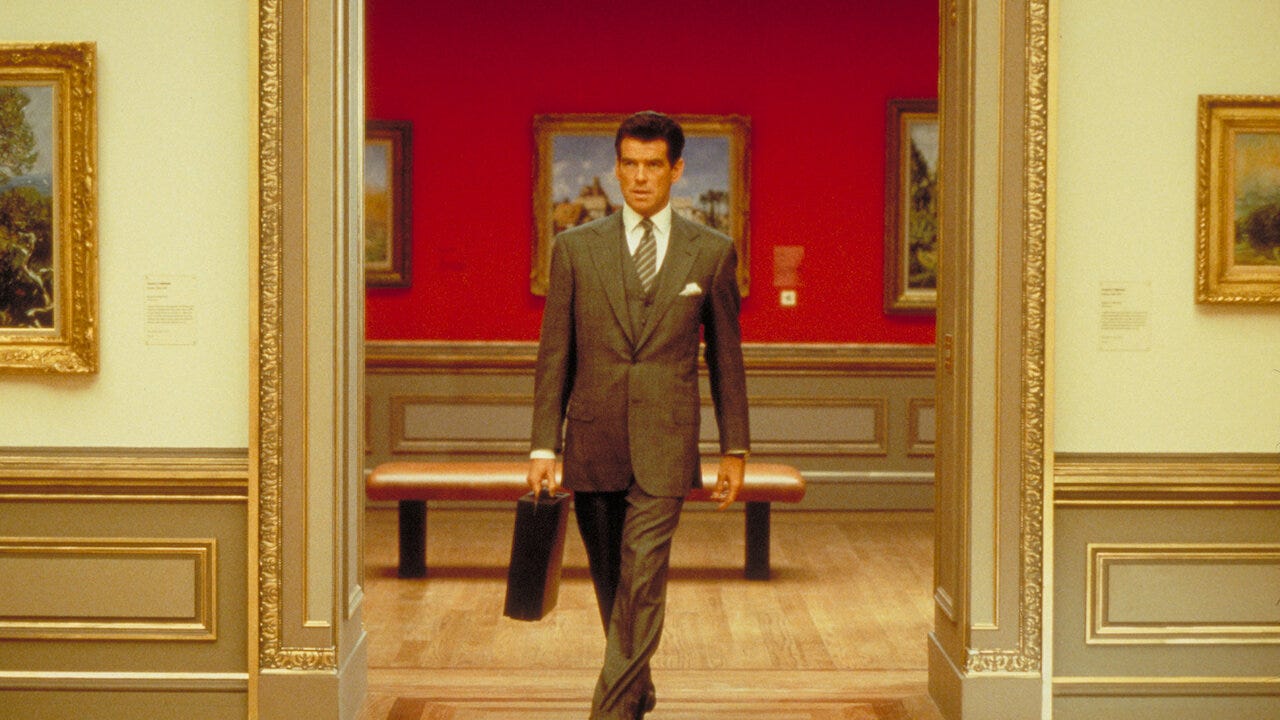
Women rarely get to give chase, art thief Thomas Crown (Pierce Brosnan) smugly tells insurance investigator Catherine Banning (Rene Russo) in John McTiernan’s The Thomas Crown Affair. Later, after their sparring has progressed to sex and then to breakfast afterwards, she sighs, “I hate being a foregone conclusion.”
Catherine wants to get to do the things women don’t; she does not want to be in the standard narrative position of being the one pursued and falling gracefully into the bed of her pursuer. And yet, even as the movie touts its edgy suave flouting of the rules and the status quo, it ends up doing the most boring thing possible, wearily reproducing the standard gender scripts of heterosexual heterosexing, admirably omniscient men, and women as expensive and admiring prize. Mastery of crime is mastery of masculinity and femininity, in the movie’s simplistic formulation—complicated only by the stodgy insistence that there is no crime.
—
Everything Is Horrible relies on your donations. If you value by writing, please (please!) consider becoming a paid subscriber. There is a 40% off sale now; $30/yr. Hit that button!
—
Before he is an art thief, Crown is a fabulously wealthy finance asshole who gets off on the thrill of swindling other finance assholes, wrecking sailboats, and plotting incredibly intricate crimes. After he steals a fabulously expensive Monet with his excessively tricksy tricks, Catherine is sent by the insurance company to find the culprit and avoid the $100 million payout.
Catherine is presented initially (a la Trinity in the Matrix) as a hypercompetent investigator and observer; she identifies Crown as the criminal by simply scoping him out (with the sexual connotations very much in place.) In the terms of Laura Mulvey’s famous essay Visual Pleasure and Narrative Cinema, Catherine is taking the place of the iconically male viewer, who both enjoys the sensual pleasure of the bodies spread out before him and identifies with the protagonist, whose all-seeing gaze controls plot and action. Catherine’s fetishy high heeled lace up boots and her comfort with toplessness figure her as powerful and deviant, as does her refusal to pursue the expected romance arc offered to her by nice guy Detective Michael McCann (Denis Leary).
But this flipping of gendered scripts is, like the heist itself, all feint and no payoff. The Thomas Crown Affair is not Bound or Femme Fatale, or Drive Away Dolls where the creators are genuinely amused and exhilarated by the possibilities of castration, lesbianism, and seizing the gaze and/or the phallus from the patriarch. On the contrary, Thomas Crown merely raises those criminal and unsavory possibilities in order to reject and discipline them.
That discipline consists in large part of reiterating, over and over, that it is not Catherine who sees effectively, but Thomas. Catherine believes that she is the mistress of the gaze, but after she makes some initial impressive deductions, the movie relentlessly, monotonously, and not a little sadistically insists that it is not her, but the guy with the crown who sees all. When Catherine thinks she’s found the Monet, it turns out to be a fake painted on top of a picture of dogs playing poker—a personal taunt, since we’ve been told that her brothers didn’t let her play poker with them.
Similarly, Thomas makes Catherine think that his sexy young associate Anna (Esther Cañadas) is his mistress rather than his forger in order to manipulate her into a position of vulnerability. He substitutes a Pisarro for a Monet, he substitutes a tropical island for New York after they get on his private plane, he constantly anticipates and misleads her, in ways big and small, friendly and much less so. She has no agency; she has no will; he moves her around with nonchalant ease. It is like Pretty Woman, except for the part where Julia Roberts remakes Richard Gere as he remakes her.
Crown makes a few pro forma comments about how Catherine is the only one and how she’s transformed him. But it’s all abstract and half-hearted, especially when compared to the way that Catherine completely surrenders to his masterful machinations by the denoument.
The climactic scene of the film (double entendre intended) is back in the museum, where Crown has promised to return the Monet, and Catherine (who believes he has cheated on her) warns the police to catch him in the act. Thomas, wearing a bowler hat in honor of the famous Magritte painting, has paid tons of other bowler-hatted doggelganger’s to wander through the halls with him, baffling the cops.
Catherine, almost weeping with relief and excitement she watches on the video monitor. She is no longer in control of the gaze—she doesn’t even know which Thomas she is looking at. Instead, she is reveling in her disempowerment before his masterful orchestration of image and pleasure. Nina Simone’s “Sinnerman” plays in the background, a song by a Black woman about (among other things) racial oppression which is here manipulated by Hollywood so that it turns into a tribute to the utterly contentless “rebellion” of a massively wealthy white jerk.
Catherine’s humiliation isn’t done though. Having learned that Thomas was not unfaithful, she rushes to their rendezvous only to be met by another bowler-hat wearing double who hands her another stolen painting (one she particularly loves) as a kind of punishment for her lack of trust in Thomas—a lack of trust which he anticipated, as he anticipates virtually all of her actions. He knows her better than she knows herself. When he at last reveals himself to her, having deceived and tormented her for his own amusement, she can do nothing but wipe her tears away and leap into his arms. She whispers to him that if he pulls such a stunt again she will break his arms, but the castration threat is by this point simply a further restatement of her impotence and acquiescence—a sign that she is the kind of expensive, interesting, edgy acquisition that it is worth his while to acquire.
In his bemused review, Roger Ebert wonders at the patness of it all:
Despite the cleverness of the caper and the beauty of the lush locations, the wit in the dialogue and the neat twists and turns, it never seems to risk anything. There’s something odd about a caper romance where you never believe anyone is really ever going to go to jail or bed.
But the lack of risk—or specifically the way that the movie mimes risk in order to present an absolutely riskless two hours of Hollywood boilerplate—is undoubtedly the point. The film is about restoring and reasserting truths of gender, of class, of hierarchy by reappropriating and taming the challenge posed by career women—or really the challenge posed by women with autonomy of any kind. Women try to assert their ability to see and to control their own narratives, but a masterful man—armed with vast wealth and a suitably banal taste in art—can mold them to his whims and plots. The Thomas Crown Affair is disguised as a caper romance, but beneath that overpainting, it’s really yet another dreary exercise in anxious male competence porn.
"Also I hate this movie, and it should be spoiled."
You had me right there.
Great analysis of dressed up patriarchy.
I didn't care of it either, I would like to see the original.