

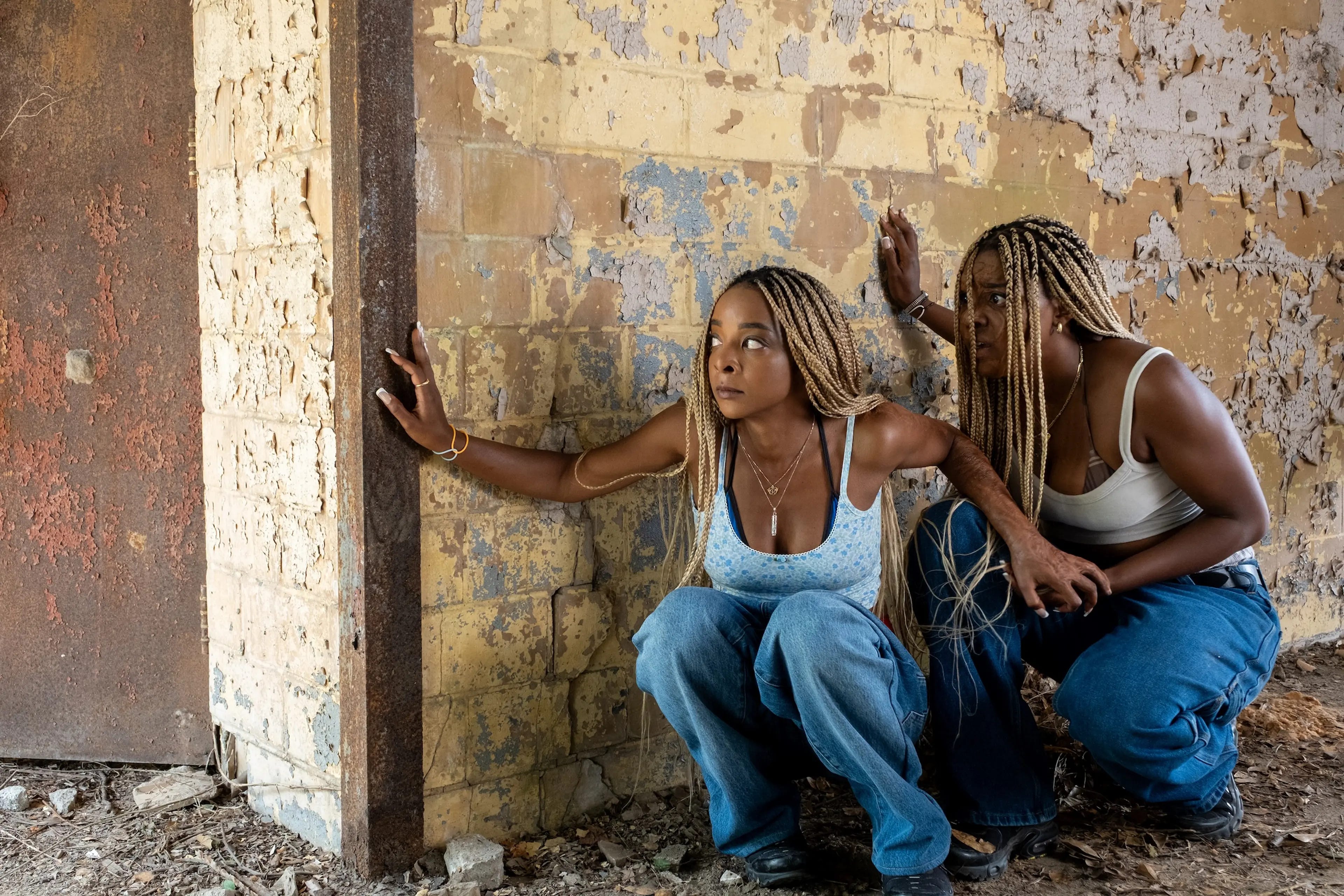
Revenge is one of the backbones of scuzzy exploitation fare. It provides a powerful motive for action, and a powerful excuse for depictions of hyperbolic, entertaining violence. The scythe goes forth, the scythe comes back, and the narrative surges ahead through joyful gouts of blood and death.
—
Thanksgiving sale! it’s 40% off, $30/yr. If you value my writing and would like it to continue, please consider supporting me! and the cats!
Thanksgiving sale! it’s 40% off, $30/yr. If you value my writing and would like it to continue, please consider supporting me! and the cats!
—
Playwright and debut director Aleshea Harris is aware of the formula, and she’s not exactly undermining it. But the movie’s absurdist elements and its engagement with serious and bleak themes of child and domestic abuse underline the way that the revenge fantasy is a fantasy. What is happening on screen is not exactly happening. Revenge is a dream of empowerment and therefore, quietly amidst all the screams and flames, it can maybe in for other possible empowerments as well.
The revengers in the film are twin sisters Racine (Kara Young) and Anaia (Mallori Johnson). They both suffered severe burns as children when their abusive father (Sterling K. Brown) set their mother, and their house, on fire; Racine’s hand and Anaia’s face are badly scarred. The girls were raised in a series of abusive foster homes, and they had thought their mother, Ruby (Vivica Fox) was dead. But she sends them a letter and when they visit her she says her dying wish is for them to kill their father, who has moved on to a new family. Racine, who refers to Ruby as “God”, relishes violence and is eager for the assignment. Anaia is much less so, but she agrees to accompany her sister.
One reason that Anaia is reluctant is that she is not convinced their mother cares for them; why disappear from their lives for decades only to reappear asking them to become murderers? Their father, for his part, is a hyperbolic monster, who tears out the tongue of his lawyer to keep him from incriminating him. He barely pauses when he sees the dead bodies of his family on his way to make himself a sandwich.
Racine and Anaia’s parents are awful, but they are also a kind of sweeping, spiritual truth. The twins live in a world where no one cares about them but each other. Most of their interactions with strangers, relatives, bosses, or acquaintances involve someone insulting Anaia and Racine beating the snot out of them. On their journey, they meet a range of half-brothers and potential surrogate mothers, all of whom are indifferent to their past trauma when they aren’t actively violent and cruel. Abusive parents can seem all powerful, and in this film those abusive parents seem to function as antagonistic gods, setting the parameters of a world in which the lives of disabled Black girls are seen as worthless even by those who are supposed to care for them most.
That makes the movie sound like a bleak trudge through despair. It isn’t, though, because Racine and Anaia care about each other enough for everyone else and then some. There are scenes of them pulling over to the highway to dance joyously in front of the “Entering Virginia” sign or insulting their boss who just fired them in escalating streams of profanity. Often they communicate wordlessly, in written words over their heads on screen, because they know each other so well they can read each other’s thoughts. “You know I got you,” Racine tells Anaia, and Anais does know it. The world they live in may hate them, but they’re a world in themselves, whether they’re dancing together or beating those who threaten them (or who just disrespect them) to a bloody pulp.
Racine and Anaia do argue on occasion about how many people it is reasonable to murder with their rock-in-a-sock in pursuit of vengeance. But in general they are so close, and so self-contained, that you do start to wonder whether there are in fact two of them. It’s significant that during the final argument with their father, Racine is sidelined; the most intense emotional moments of the film are just Anaia negotiating with and trying to understand their abusive shit of a father. Racine appears again when Anaia needs to fight—as if she is the part of Anaia’s personality who fights back, who delivers revenge, or imagines it.
Is God Is has been compared to Tarantino films, and there is a parallel with something like Inglourious Basterds, in which the revenge on Hitler has a sting because viewers know this is not what happened, and that no one was saved in this way. Pulp revenge is an empowerment fantasy, all the more appealing because we all know it isn’t true.
Is God Is works a little differently. The revenge on offer strikes too many innocents to be unproblematically satisfying.Racine kills people for the equivalent of looking at her sideways; she kills people who are themselves trying to flee abuse. You’re always on the side of the twins, but you aren’t rooting for them to murder the bad guys in the way you do in a Tarantino film, because a lot of those bad guys aren’t really bad by any reasonable definition. They’re just annoying and in the way.
Revenge fantasies in Tarantino are unsatisfying, or poignant, because they aren’t true. They aren’t satisfying in Is God Is in part, at least, because they don’t feel like justice. They do, though, at times, feel like love and care. You can see Racine’s violence as Anaia’s dream of what it would be like to have someone who would go to the mat for her—a good parent, rather than all the bad parents she’s been stuck with.
Revenge films (like I Spit On Your Grave) not infrequently end with the suggestion that the cycle of violence is unbreakable, and that trauma and retribution stain everyone permanently. Is God Is, in contrast, closes with Anaia anticipating a baby. She promises to tell the child about Auntie Racine, and, implicitly, to care for the baby as she and Racine cared for each other. Violence doesn’t have to be passed on; fantasy violence can, perhaps, lead to a kind of acceptance of, and détente with, actual violence. Racine says she’s inevitably a killer since her father and mother mother both embrace violence. But being marked by your parents doesn’t mean you have to be your parents. The revenge on the screen is only as real as you choose for it to be.
A great many "blaxploitation" films of the 1970s had revenge and violence perpetuated by Blacks at the center of their narratives, in the same wish-fullfillment way as this film. But the magic realist elements here may make it has hard to accept as "real" as those films still are seen.