

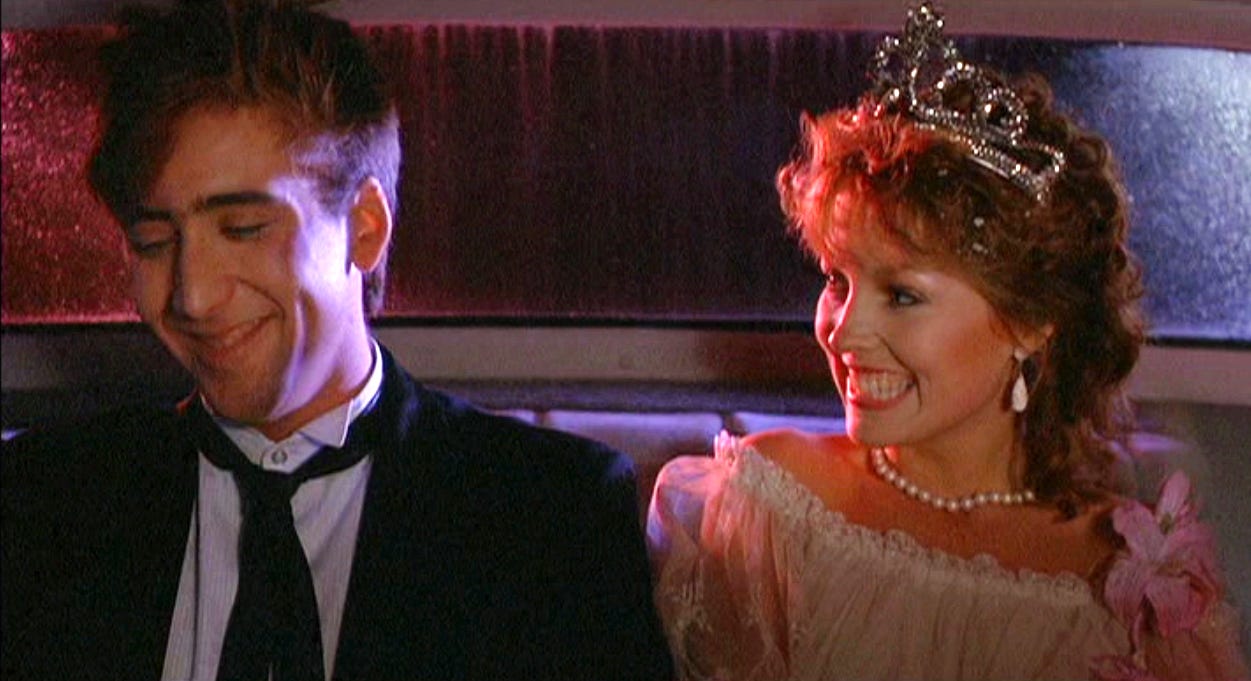
Can you create an enjoyable romcom in which the leads have no distinguishing characteristics of any sort? You’d think the answer would be obvious. But Martha Coolidge’s 1983 Valley Girl decided, for unclear reasons, to put it to the test anyway.
The film is sort of kind of not really a Romeo and Julia riff, and sort of kind of not really a social satire. Julie (Deborah Foreman) is a privileged upper-middle class Valley Girl, like the title says. She is dating the vapid and selfish Tommy (Michael Bowen), but he bores her. She impulsively dumps him, and soon thereafter sparks fly at the beach with Randy (a shockingly young Nicolas Cage.) But Randy is poorer and sort of punk, so Julie’s friends pressure her to break up with him. Will they find true happiness?!
It is just really hard to care, since both of them are about as deep as a teaspoon. Julie is very pretty and very blond and that seems to be the extent of the character development. She has no hobbies, no dreams, no real interests, no thoughts, no discernible sense of humor. She is worried about what her friends will think of her, and kind of embarrassed by her permissive parents—whose hippie nostalgia is rote, but leaves them looking fully developed compared to their daughter.
Nicolas Cage for his part does his best with Randy—after his rejection when he bellows in mockery of Julie’s valley girl accent, he foreshadows much scene-chewing to come. Even he can’t overcome the script, though, which has him slouching around, staring soulfully, and occasionally making half-hearted declarations about how free he is. Unlike Julie, he does express a preference or two—he doesn’t like New Wave—but for him too there are no real plans and no interests. We never meet his parents or family and a drunken encounter with his ex-girlfriend doesn’t really count as backstory, just as his de rigeur stalking behavior doesn’t qualify as a personality.
Neither is the class gulf between the two clearly delineated, much less explored. Randy isn’t familiar with sushi; Julie isn’t used to packed rock bars. But there’s not much more to it than that. The claim that Randy is more dangerous or edgy is pretty thoroughly undermined by scenes of Julie’s friends partaking in sex and drugs and even in rock and roll. Randy and Julie never have intercourse, though it’s unclear whether that’s because Randy is a gentlemen or whether the script writers felt that Julie and Randy would be too interesting if they actually did the deed.
There are a couple moments where the film seems like it might be willing to have something to say or at least actual characters. Julie’s friend Loryn (E.G. Daily) has a heavy petting session with Tommy right after Julie dumps him. She asks him to be her boyfriend, and he slut shames her and rejects her. She struggles to process his cruelty, which is by far the most unpleasant thing he does in the film, validating Julie’s decision to break up with him, if she only knew about it. But Loryn never speaks about what he did to her, and the film never grapples with what it means that she’s silenced. The plot moves on to the nothing happening elsewhere, brushing Loryn off much as Tommy did.
The other suplot involves Julie’s friend Stacey (Heidi Holicker) whose step-mother Beth (Lee Purcell) tries to seduce her boyfriend. That’s an ugly betrayal of trust—but the film treats it simply as a question of who will win the guy, tricking you into thinking it’s the mom though it ends up being Stacey. There’s no recognition that having your mother try to steal your boyfriend might have implications beyond who ends up with the boyfriend, or that Stacey might need real help and face real challenges if her stepmother is willing to treat her in this way. Again, a more interesting and disturbing plotline is shelved in favor of following the romcom default to its banal conclusion.
In his contemporary review, Roger Ebert praises Valley Girl for being more realistic, and more true to teen experience, than Porky’s. I can’t really argue that point, and Ebert did not have John Hughes’ films as a point of comparison since they hadn’t been released in 1983. But we have now all seen Sixteen Candles and The Breakfast Club and Pretty In Pink, and for all their weaknesses, glibness, racism and misogyny, they do nonetheless demonstrate that movies are a lot more entertaining when the filmmakers make some vague effort to give the people in them things like traits, motivations, and arcs. I’d even dare say that most teens do in fact have traits and motivations, and that robbing them of that makes them less realistic and less believable.
You could argue that Valley Girl paved the way for Hughes, and for much, much better than Hughes teens romcoms like Clueless or But I’m A Cheerleader. That may well be the case, but it’s still not a lot of fun to watch the tropes line themselves up with little panache and less purpose. It’s not hard to understand why this film has been largely forgotten.
—
This piece was commissioned; I may offer opportunities for more commissioned reviews in the future. Watch this space!
I think the plot was beside the point. The whole "Valley Girl" phenomenon was driven by a recording by Moon Zappa that was meant to make fun of this social strata signifier of intentional vapidness--the valley girl accent--and it became a cultural moment in the late 70s/early 80s that Hollywood attempted to capitalize on. https://youtu.be/R5Q1yVLSR3I?si=GE2PPT_4uHE9hDO6. The movie "Clueless" which came later was a better film, with a similar intent.
Can't really argue with this review, though as a young teen when this came out, a lot of the holes you point out did resonate in a provocative way, and when I've revisited the film as an adult I've wondered if those were actually points of subversion peeking through the romcom industrial curtains (though it is really hard to swallow Cage's use of the F-word slur). In contrast, John Hughes foregrounds interesting character, then systematically undermines them by reimposing an oppressive, patriarchal social order. To me the hero of the era is Amy Heckerling for Fast Times at Ridgemont High.