

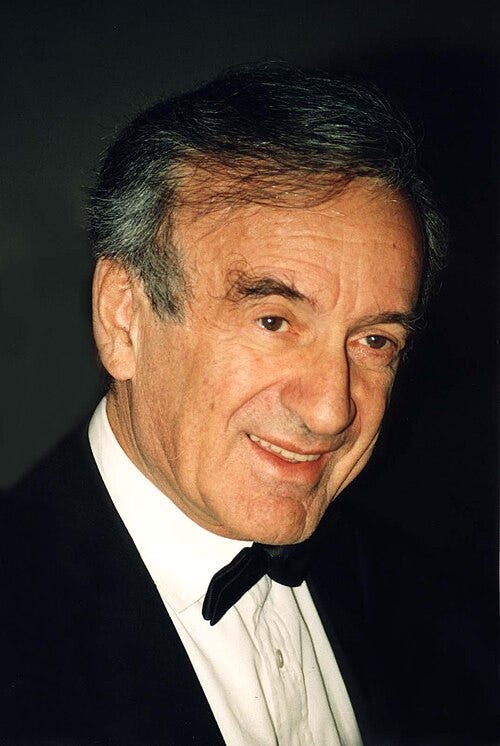
Holocaust survivor and Nobel Peace Prize winner Elie Wiesel is generally viewed in the US as something like a secular saint. His memoir Night, is regularly assigned in high schools, and his personal courage and unwavering moral commitment to human rights in the face of unimaginable atrocity are cited as exemplars of (in the words of the Nobel committee) “peace, atonement, and dignity.” He is celebrated, not least, for his criticism of the US—criticism which seems to hold everyone, friend and foe, to the same moral standard.
Yet, many of Wiesel’s moral choices were themselves compromised—not least in his criticism and questioning of the US. In Our American Israel, Amy Kaplan’s study of the American/Israel relationship, she focuses on one of Wiesel’s most famous indictments of America—a speech he gave at the opening of the US Holocaust Museum in 1993. Standing on the same stage as President Bill Clinton, Wiesel used the opportunity to excoriate the US for failing to do more to prevent the Holocaust.
“Why weren’t the railways leading to [Auschwitz-]Birkenau bombed by Allied bombers?” he asked. “As long as I live I will not understand that. And why was there no public outcry of indignation and outrage?”
Kaplan adds that the Holocaust Museum itself enshrined this question and this outrage. It includes a letter from Secretary of War John J. McCoy refusing a request to bomb Auschwitz. The caption says,
“although bombing Auschwitz would have killed many prisoners, it would also have halted the operation of the gas chambers and, ultimately, saved the lives of many more.”
Wiesel and the museum together appear to be bravely calling the US to account for its complicity in atrocity and fascism. This is an iconic and welcome example of America grappling honestly with its past and its failures in order to recommit itself to the fight for democracy and justice. Never again will we fail to bomb when bombing could right a wrong.
That seems inspirational. Unfortunately, it is not. The indictment of America represented by Wiesel is bad history and bad politics—not least because it suggests that bombing is always the answer, and papers over failures that are much logistically simpler to address, but much less politically popular, than war.
Bombing the railways was not an answer
The historical debate about the plausibility of bombing railways or camps is contentious. But scholar Peter Novick in his 1999 The Holocaust in American Life, makes a vigorous case that Wiesel was talking nonsense. “The question of bombing the rail lines can be dismissed immediately,” he says.
“Massive experience had taught the Allies that bombing rail lines was hardly ever effective: the few hits scored could be quickly repaired. Railways might be bombed in support of tactical operations—to prevent the enemy from moving troops and materiel for several hours, perhaps a day or two. Beyond that, the method was nearly useless.”
Bombing the camps, and specifically the machinery of death, was similarly difficult. Despite Allied propaganda to the contrary, it was, Novick says, “often hard for Allied pilots to reliably hit anything smaller than a city.” Any bombing of the camps would probably have killed large numbers of inmates. Some survivors have said they would have welcomed death if the camps were destroyed. Others, though, have pointed out that by Fall 1944, when the US could reasonably have conducted such raids, people in the camps knew the war was moving towards a conclusion, and did in fact hope to survive it.
Novick also points out that destroying Auschwitz, or other camps, wouldn’t have necessarily stopped the killings. The Germans had crematoria that the Allies had not located, in the first place. In the second, the Nazis had earlier in the war killed Jews simply by shooting them. If Nazis didn’t have gas chambers, there was no lack of other efficient methods of murder.
The moral indictment of the US in this context, then, requires (a) the belief that the US had the capacity to accurately bomb the camps, (b) the belief that if the camps were bombed, the Germans wouldn’t be able to kill people as rapidly. Both of these beliefs are extremely tendentious. Maybe the US should have tried anyway. But again, there was a real chance of killing more people than were saved. Beyond that, the resources for a dubious bombing campaign could be used elsewhere to destroy military targets and bring the war to a quicker end, which was the only sure way to end the killing..
The focus on bombing the camps is especially wrong-headed because it distracts from the one way in which the US could have saved Jewish people—namely by offering them asylum, both during and after the war.
Turning Jews away to die
As the Holocaust ramped up, Jewish refugees attempted to flee Germany for other countries. That included the US. America could have saved tens of thousands of lives at least. But instead Franklin D. Roosevelt’s administration remorselessly and consistently turned Jews away to die.
America has a range of reasons for refusing refugees. FDR thought that accepting Jews would undermine the US patina of neutrality. His administration was also afraid that German spies might sneak in among the refugees.
But the bottom line was that America during the 30s and 40s was both antisemitic and xenophobic. Most Americans thought Jewish people were dirty and uncivilized and maybe associated with Communism; they feared that they would fail to assimilate to American values, would become criminals, would be a drain on the public purse. The same anti-immigrant nativism which has led Trump to refuse asylum to all refugees who aren’t white Nazis was in effect during World War II. As a result thousands and thousands of Jews who could have been saved died in the camps.
Nor did the antisemitic antipathy to refugees end with the war. Even as knowledge of Nazi antisemitic atrocities spread across the globe, Americans continued to resist Jewish immigration. After the end of the conflict, some 250,000 Jewish refugees landed in Displaced Persons camps in Germany, Austria, and Italy, fleeing from devastated communities and from ongoing antisemitism in the former Nazi occupied territory.
Eventually most of these refugees were received in Israel. This was not because the US and Britain were enthusiastic about the idea of a Jewish state—they generally were not at that point. Rather, it was because the British and US populace was wildly antisemitic and rejected any effort to welcome Jewish people. As Kaplan writes:
Public sympathy for the DPs did not translate into welcoming them to the shores of America. When a Gallup Poll conducted in December 1945 asked whether more persons from Europe should be permitted into the country than before the war, only 5 percent agreed. In reaction to a 1947 congressional bill proposing to admit four hundred thousand DPs into the United States over four years, citizens bombarded their representatives with demands to keep out the “riffraff” and “scum of Southern and Eastern Europe.” In favor of the bill, Eleanor Roosevelt warned that “every representative in Congress” told her that “the general feeling is that they wish to stop all immigration.” In letters and congressional hearings, the threat of foreigners to “our way of life” merged with fears of communist infiltration. There was a widespread belief that most of the DPs were Jews, and that most of these Jews were communists. (my emphasis)
The idea that Jews and Communists were interchangeable was, of course, a staple of Nazi propaganda, elaborated obsessively and endlessly in Mein Kampf. It served as a major justification for the Holocaust. Americans had just defeated the Nazis, and in theory deplored their genocide of Jews. But when push came to shove, they didn’t want to live near Jews either, and for the same prejudiced, paranoid, bigoted reasons as the Nazis.
Why bombs but not immigrants
The case for American complicity for failing to bomb Auschwitz is week and tenuous. The case for American complicity for failing to admit refugees is clear and iron clad. Why, then, did Wiesel focus on the first rather than the second.
I think Wiesel focused on the first rather than the second because he was a right wing Zionist.
Wiesel’s Zionist politics are well known, and well-documented in Kaplan’s book. She doesn’t directly tease out the implications for his Holocaust Museum speech, but I don’t think the links are too obscure.
Zionists (Jewish and non-Jewish) have long argued that the way to prevent another Holocaust is an ethnonationalist Jewish state with a strong, overpowering military. When Wiesel criticizes the US for failing to bomb Auschwitz, he is arguing that force of arms wielded with righteous intent can prevent Jewish genocide. America did not have the will to wield force; Israel will. Therefore the US has a moral obligation to provide Israel with the arms and firepower to prevent Jewish slaughter. QED.
You’d think that the refugee crisis would have a similar valence; if no one will take in refugees, then Israel must exist so it can provide safety. But from a Zionist perspective, there are problems with making this argument. First of all, Zionists did not want America or Britain to take in Jewish refugees after the war. They wanted Jewish refugees to go to Palestine, where they could help build Jewish numbers in order to gain power over Arab people.
More, while Israel took in Jewish refugees, it also exiled and refused to readmit some 750,000 Palestinians during the 1948 Nakba. A principled demand that all nations accept all refugees, no matter their ethnicity, is a dicey argument for a Zionist to make.
Zionists can unabashedly support the use of force to protect Jewish people. But an ethnonationalist state is going to have a lot or reservations about an argument for unrestricted admission of refugees no matter their ethnicity. Zionism is based on the idea of strict control of borders and on the belief that ethnicity should determine where you live. Wiesel is happy to criticize the US for not dropping enough bombs. He is less willing to criticize the US for an ethnonationalist border policy.
Never again
Elie Wiesel often insisted that “never again” was a moral call to prevent a repetition of the Holocaust. But Kaplan points out that the very phrase “never again” in reference to the Holocaust was coined by right-wing Jewish fascist asshole Meir Kahane, who famously advocated ethnic cleansing and whose Israeli political party was banned for being “Nazi-like.”
“Never again” can be deployed in the name of a wide range of policies. One can say, for example, “never again will we fail to bomb expeditiously.” Or one can say, “never again will we refuse to open our country to refugees.” The first is I’d argue justly deployed as an argument to ai Ukraine, but has also been an attractive excuse for illegal attacks on a range of countries, from Iraq to Iran. The second has never been seriously proposed by any American administration. Who can say which is more congenial to power, or which is the better way to save lives?
The Holocaust, Kaplan argues, has become a central event in American history; it is seen as a guarantor of American virtue (we fought on the right side!) and as an iconic moment of American guilt which calls us to be better (we were complicit…never again!) It can be used to praise America or critique America.
But, unfortunately, both the praise and the critique can be used, and have been used, for dubious ends—not least because the lesson of the Holocaust in the hands of Wiesel and the American presidents he cultivated so often seems to be that America can only be more moral by being more martial. The possibility that America might be more moral by being more welcoming, or by confronting its own racism rather than someone else’s, is rarely bruited. But if we want to be less antisemitic and less fascist, the best start, contra Elie Wiesel, is not finding someone to bomb. It’s letting in some huddled masses yearning to breathe free—whether they’re Haitian, Somali, or Jewish.