

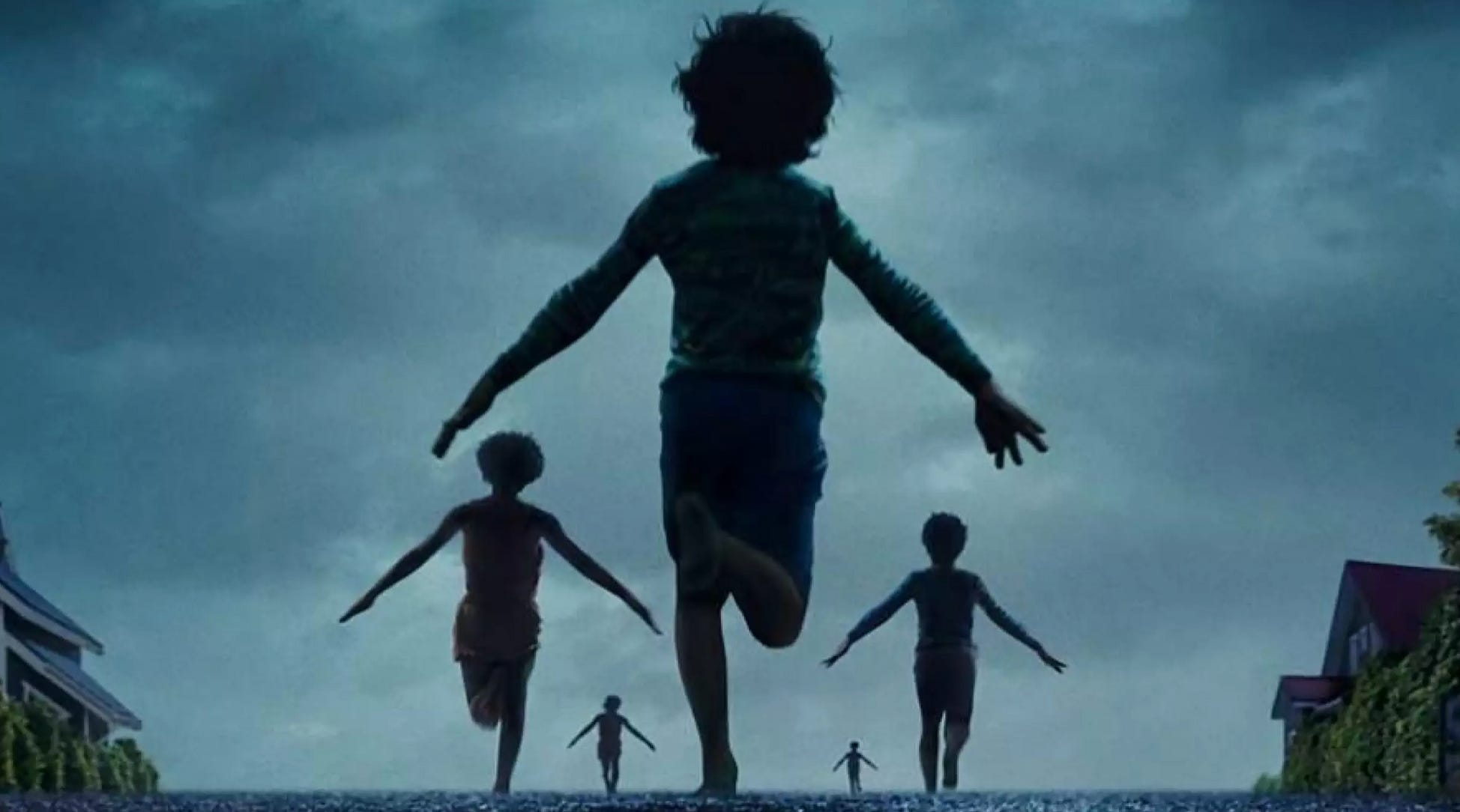
Zach Cregger’s Weapons is a chilling film, both because of its depiction of abuse of children, and because of the gleeful vindictiveness with which it blames that abuse, not on the institutions and people who are actually responsible for abuse of children, but on some other, demonizable scapegoat. The movie brilliantly, and nauseatingly, demonstrates the dynamics of blood libel—though not so much as a critique as simply because it thinks that blood libel is fun.
—
Everything Is Horrible is entirely reliant on your donations. The beginning of the year is especially rough for freelancing; if you value my writing, please consider becoming a subscriber.
—
The unsettling plot starts with 17 children in a third-grade class in Maybrook, PA, who run out of their homes at 2:17 AM, arms stretched out as if flying, and disappear into the dark. The town suspects their teacher Justine Gandy (Julia Garner) and/or the one remaining class member Alex (Cary Christopher), but neither seems to know anything. Eventually it becomes clear that the villain is supernatural—a witch/parasite, who stole the children to feed.
The film is constructed through a series of different point of view sections that move back and forth in time. This Pulp Fiction conceit isn’t new, but I, at least, have never seen it deployed in a horror film (I missed Cregger’s Barbarian), and it’s startlingly effective. One segment creates questions and foreshadowings which are answered and (generally bloodily) fulfilled in leisurely fashion by the next, and the next.
This interwoven and interconnected structure also evokes the communal nature of the tragedy and the grief which has engulfed the town. One of the children’s father’s, Archer (Josh Brolin), policeman Paul (Alden Ehrenreich), the school principal Marcus (Benedict Wong), Justine, and Alex all follow their own painful stories until they tangle with someone else’s, trying to offer help (mostly in vain) or hurting one another (mostly with a lot of blood.)
This form, and a good bit of the action, suggests a collective responsibility as well as collective tragedy. That’s underlined by the film’s one clumsy moment; a dream image in which Archer sees an assault rifle hanging in the air over a house into which his son Matthew has disappeared. The gun, along with the title, make it clear that the children’s disappearance is a metaphor for school shootings—America’s reiterated, repulsive sacrifice to the right-wing death cult of the Second Amendment.
Cregger doesn’t exactly follow through on that metaphor, though. Instead, the most visceral moments of terror in the film focus on a different kind of violence against children.
Spoilers follow.
The witch, we learn halfway through the film, is Alex’s elderly aunt Gladys (Amy Madigan). She came to stay with Alex’s parents and hexed them, so they are under her mental control. Then she threatens Alex that she will make them kill each other if he does not help her hex his classmates.
Alex’s section of the film is a truly nightmarish depiction of the absolute, horrific disempowerment of domestic abuse and neglect of children. Gladys acts and speaks as if she’s Alex’s parent; she orders him up to bed, she tells him to do his chores (feeding soup to his immobilized parents), she asks him to help her when she’s ill. But she offers him no reciprocal help or affection—only terror and violence. Her repeated insistence that he tell no one enables and compounds the violence; we see his days flit by in an alternating nightmare of silence at school by day and torture—and worse, collaboration in torture—at night.
Alex is in hell—and the truly demonic part is that, while witches aren’t real, this particular hell is. Children whose parents turn on them are in fact often unable to speak; they are manipulated and brutalized in intimate ways that take advantage of both their weakness and their love, of their hopes and their fears. And people who try to help—principals, teachers, the cops—often make things worse, either because parents retaliate, or because being removed from parents can in many situations be even more abusive and traumatizing. The relentless misery of Alex’s life, a misery from which there is no escape, is unflinchingly gutting. It’s the heart of the film.
That heart, though, is more than a little duplicitous. Alex’s parents have not, after all, turned on him. Gladys is not Alex’s mom, and she isn’t really figured as a double for his mom, the way that Bob, the evil spirit, is a double of Leland in David Lynch’s Fire Walk With Me.
Lynch is very clear that the horror of child abuse is precisely that it is often committed, not by outsiders, but by those that children know best. Cregger, in contrast, blames that perennial outsider, the witch, for everything. Gladys—an aged, ugly single relative, who even Alex’s parents barely know—comes into town from outside and immediately starts consuming the souls of children. It’s not parents who hurt their children; it’s not a society obsessed with guns. It’s the witch. She’s almost a caricature of a scapegoat.
The movie seems to have some level of self-awareness that it is reproducing very ugly dynamics. Most obviously, as mentioned above, the townspeople initially blame Justine—herself a single woman with notably asocial behavior like drinking and adultery. Parents try to physically assault Justine at a school meeting; someone paints the words “Witch” on her car. She’s perceived as something of an outsider and so she is targeted and harassed—a convenient repository for hate and grief.
More subtly the film is framed by the narration of an unnamed and unseen girl, who relates the (bleak) backstory and the (bleak) aftermath with a kind of ghost story relish; she seems to be cuing you to take joy in the proceedings. That could be a tip off, perhaps, that the movie is not encouraging you to empathize with grief or suffering, but is instead an engine of sadism, designed to focus pleasurable rage and disgust at a convenient target.
Self-aware sadism is still sadism, though, and self-aware misogynist scapegoating doesn’t stop being that because the person deploying it thinks it’s fun or entertaining or a cool jump scare delivery system. You could, perhaps, read Weapons against itself and see Gladys as a mass hallucination created by a community that hates and harms its own children and needs to blame someone else for the results. But that reading against is done despite the film, I think, not because of it. Weapons is complicated formally, but thematically it’s a story as old as witch burnings.
As someone who identifies as a witch (we are real, BTDubs, and hell on earth is a perfect description of this country’s gun violence disease)-I now feel like I should see this as an inoculation precaution. A nothing’s shocking project to steel myself against new iterations of the misogyny monster of our culture. Of course using a female outsider scapegoat for a Hell made overwhelmingly by male perpetrators is right on par for American films made by men.
Welp. This sounds about as pleasant as punching myself in the face.