

Public support for Israel in the United States is at an all-time low. For years, Israel was very popular in the United States; in 2023, before the years long genocidal campaign against Gaza, 54% of voters sympathized with Israel while only 31% sympathized with Palestinian people. A Gallup poll this February, however, showed a massive shift; now 41% of Americans sympathize with Palestinians and only 36% with Israel. That’s a 28-point shift in public opinion.
For Democrats, the change has been even more stark. Fully 65 percent of Democrats say that they support Palestinians while only 17 percent support Israel—a massive 48-point gap. Any Democrat who enthusiastically endorses Israel or who tries to downplay the genocide is defying a supermajority of their own voters. This is not a smart primary strategy, to say the least.
And yet, Zionism remains strikingly popular among Democratic politicians. In a July 2025 vote on arms sales to Israel, 24 Democrats voted against the sales and 20 voted for it while 3 abstained—a dramatic shift from past years, but nowhere near as dramatic as Democratic voters are demanding.
In primary races, too, Democrats are often unwilling to take the easy win and simply acknowledge the straightforward truth that Israel is committing a genocide and we shouldn’t be funding that. In the Illinois Senate race, for example, the two frontrunners Raja Krishnamoorthi (who sucks) and Juliana Stratton (who is for the most part quite good) have refused to distance themselves from Israel. Jasmine Crockett, facing a tough Senate primary in Texas (which she narrowly lost) also defended her record and affirmed her commitment to ongoing arms sales to Israel. New York Congressman Dan Goldman, facing a strong progressive primary challenge from Brad Lander, has doubled-down on his pro-Israel stand—even though, again, “give all the arms to Israel” is an extremely unpopular position and is likely to lose him votes he desperately needs.
The stubborn simultaneous defiance of voters and of morality is enraging and can seem baffling—especially, again, in hard-fought high-profile primaries where it’s clear that support for Israel is a vote loser. There are, though, several reasons why Democrats continue to support Zionism. Understanding those reasons can help us overcome them.
—
Everything Is Horrible relies entirely on reader support. If you value my writing, please consider becoming a paid subscriber. It’s $50/year, $5/month.
Grandfathering Zionism
First, I think it’s important to recognize that some Democrats support Israel out of sincere ideological commitments. Politicians generally try to position themselves in line with public opinion. But sometimes, on some issues, they feel so strongly that they are willing to defy their voters.
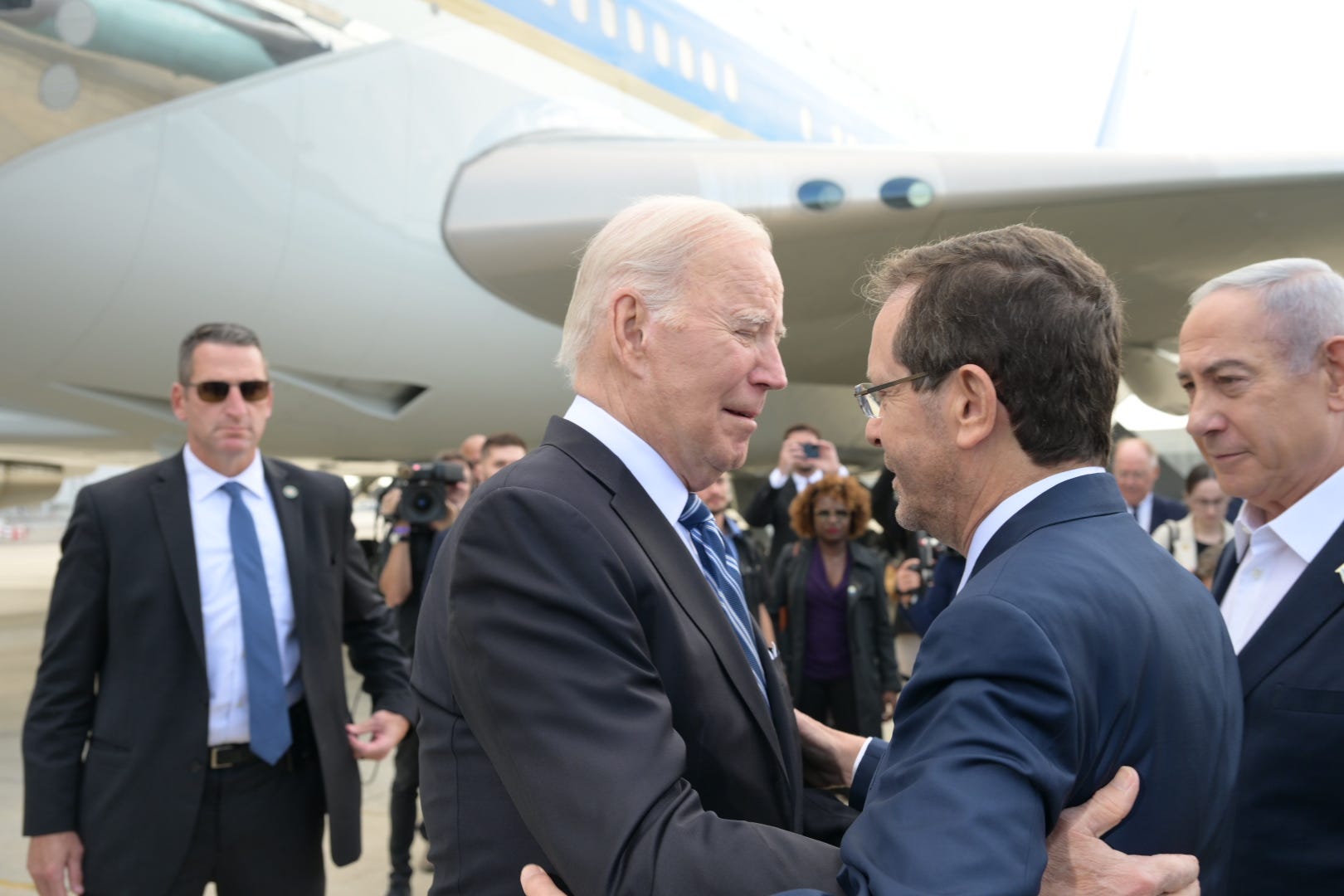
Joe Biden, for example, spent decades positioning himself as Israel’s most consistent and adamant voice in the Democratic party because (all reporting indicates) he believed that it was the right thing to do. Similarly Senate Minority Leader Chuck Schumer has said his “job is keep the left pro-Israel”—which is to say, he believes he needs to explicitly defy the pro-Palestinian shift in public opinion in order to (in his words) “fight for aid to Israel.”
Pro-Israel sentiment was a vote-winner for Democrats until three years ago. People who supported Israel often won primaries because voters agreed with them on Israel policy. More, Zionism could be a bipartisan bridge in purple districts and a way to perhaps appeal to conservative Zionist voters across the aisle. Many politicians have spent their entire careers in an environment in which supporting Israel has been an easy way to gain votes in both primaries and general elections.
People like Biden and Schumer who could project sincere enthusiasm for Israel made gains at the polls. It’s not surprising, therefore, that some politicians selected for Zionist rhetoric and actions believed in what they were saying and doing. The electoral calculation has changed, but Zionists elected in a pro-Zionist era remain in positions of power—until we can vote them out.
The old and the billionaires
One common explanation for Democratic politician intransigence is donor cash. Democrats, the argument goes, are bribed to support Zionism by big donors, often with money funneled through AIPAC and similar networks. The subtext for a lot of these charges is the antisemitic implication that Jewish people have a lot of money and are therefore able to rig the election process with their cash.
There are a number of problems with this conventional wisdom. First of all, donors don’t generally bribe politicians—which is to say, donors do not pay politicians to change their views or adopt the donor’s positions. If they did, the solution would be simple—just outbid them. AIPAC doesn’t give that much money to individual candidates; if politicians were truly for sale, you could just crowdfund and buy them off for the pro Palestine position. Which would be venal, but ultimately worth it.
What actually happens is that pro-Israel donors give to boost the campaigns of politicians who already align with them—like, for example, Chuck Schumer. The influx of cash to pro-Israel Democrats can have very powerful effects in relatively low turnout primaries—AIPAC claimed credit for defeating Cori Bush in Missouri in 2024 for example. A few high-profile defeats like that can keep Democrats afraid of challengers toeing the pro-Israel line, not because the incumbents are being paid so much as because they don’t want donors spending against them.
Zionist donor cash also isn’t driven by some sort of stereotypical concentration of wealth among Jews. Most billionaires aren’t Jewish—the wealthiest man on earth, Elon Musk, is a violently antisemitic Nazi.
More, Jewish people have been affected by the anti Zionist turn as well; 61% of American Jews now say Israel has committed war crimes. Younger Jewish people, especially, are more critical of Israel than their parents and grandparents. The generation gap is also part of the explanation for donor enthusiasm for Israel; older people, including non-Jewish people like Warren Buffett, are much more supportive of Israel and also have significantly more money.
But a big part of the ongoing support is probably a combination of small but impassioned networks and a long term status quo. Institutional Judaism has longstanding organizational and institutional ties with Israel which drive lobbying and fundraising. Israel has also been an attractive cause for donors because it has seemed like a unequivocally righteous bipartisan empowerment fantasy for wealthy people who like to imagine themselves as scrappy underdogs battling and winning rather than as bloated entitled assholes. If you give money to Israel you know that you are paying to bomb and subjugate marginalized and poor Palestinians, whereas giving to worthy causes in the US might mean inadvertently lifting up people with less money and power.
Inertia
The common factor here is inertia. Politicians who were elected on a platform of supporting Zionism are still in office; institutions built to support Zionism still have substantial influence; people who amassed money while Zionism was an uncontroversial and cool cause still are in the habit of donating.
Inertia is no small thing, and we shouldn’t underestimate the power of American Zionism to continue to perpetuate itself even as the moral consensus that sustained it disintegrates. But it’s also true that inertia, by its nature, is not especially innovative. Zionist institutions, politicians, and advocates are ill-prepared to deal with a rapidly changing situation in which their default reliance on overwhelming bipartisan support is no longer sustainable.
You can already see numerous examples of Zionist flailing in elections. The utter failure of the grotesque smear campaign against New York City mayor Zohran Mamdani is an obvious example. AIPAC managed to delegitimize itself even further in the special election for NJ-11 this year, in which they targeted moderate Democrat Tom Malinowski after he said he might be open to conditioning aid to Israel. AIPAC spent $2 million to defeat him in hopes of electing a rabid all-Zionist-all-the-time alternative. Instead, they helped ensure the election of Analilia Mejia, a forthright pro-Palestinian candidate.
This kind of overreach has made AIPAC increasingly toxic in Democratic primaries. Candidates this year have regularly had to defend their decision to accept AIPAC cash, and/or have boasted about their refusal to do so. Illinois’ billionaire Jewish governor J.B. Pritzker denounced AIPAC’s connections to right-wing donors and its meddling in the Democratic primary process, stating through a spokesperson that the organization “has abandoned its bipartisan principles and become a pro-Trump organization” Ruben Gallego—a right-leaning Democratic senator with presidential ambitions—has abandoned his reflexively pro-Israel position to become an outspoken critic of Israel’s advocacy for the current Iran war.
History and tradition can have powerful effects on the present; entrenched politicians, donors, ideologies, and institutions can continue to influence policy even when the situation on the ground, and public opinion, has transformed. But Israel’s warmongering overreach, its increasing alignment with Trump, and the inevitable voter reaction to both, is only going to make military aid to Israel, and Zionism in general, less tenable for Democratic politicians. Democratic leaders will eventually have to follow the moral lead of Democratic voters. The sooner the better.
This reminds me of polling on gun control. The vast majority of Americans want policy reform, but our elected officials just post “thoughts and prayers” on social media. Feels like another example of the USA not being as democratic as we were taught it was.
Thank you Noah. I reflexively thought this was about AIPAC and money- not realizing that thinking is tied to ugly stereotypes.
I’m still so naive that it shocks me that our representatives don’t push back against arming Israel to commit genocide- even leaders I look up to, like Jasmine Crockett.