

I was commissioned to write about frivolity—but alas the editors found my approach too frivolous and killed it. I am able to weather these setbacks because of support from readers like you. So if you find this piece valuable and/or unvaluable in entertaining ways, please consider becoming a paid subscriber. It’s $50/yr, $5/month.
—
There’s nothing more frivolous than self-indulgence, so I will start this essay on frivolity by sharing one of my own frivolous poems
No Scones
We wanted to buy the British Vogue with Timothée Chalamet on the cover.
But they did not have the British Vogue with Timothée Chalamet on the cover.
The day is sexless and without glamour.
The lumpy pit bulls cry at the door because they are not greyhounds.
The classical guitarist plays a mournful song on a guitar that is not even blue.
The Queen is dead and we have to read the Vogue memorial edition
and nothing else
out here on the patio that is too small
out here with large-eyed pigeons who do not comprehend
why they have been scattered on the pavement like discarded feathery things
beneath a sky so sconeless.(first published in Welter)
Scones, Vogue, Timothée Chalamet, British royalty—this poem is a veritable nesting doll of frivolity, and that’s even before you get to the narcissism of foisting my own sad scones upon you when I was specifically contracted to write about someone else’s buttery pastries. Or, arguably, contracted not to write about buttery pastries at all.
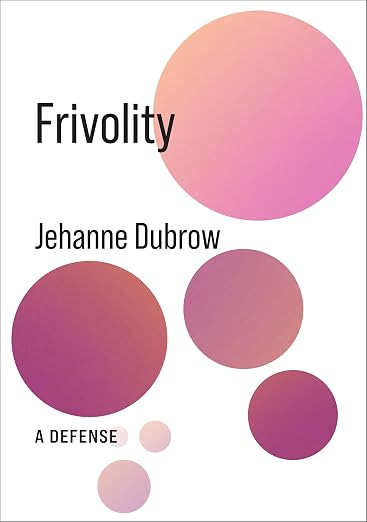
Certain editors may well be just offscreen gnashing their laptops upon the offending scones or lack thereof. But in my defense, I have been inspired by the book I am belatedly going to start writing about, Jehanne Dubrow’s Frivolity: A Defense. (Now available for preorder.)
Like the title says, Dubrow’s book is a stirring defense of the shallow, the silly, the unserious, the irrelevant. Skipping lightly hither and yon as the whim takes her, she describes her makeup regime, pauses to celebrate a few selfies, sparkles with avarice for pretty rings, and even reprints one of her own poems (about rabbits rather than Timothée Chalamet. Though admittedly the latter does sometimes have a gently vacant cottontail stare. And I wouldn’t mind seeing an all-bunny version of Dune.)
Dubrow doesn’t just indulge herself in British Vogue (or the equivalent). She insists that indulging yourself in British Vogue (or the equivalent) is a worthwhile and virtuous pursuit that will please the pit bulls and comfort the pigeons (or the equivalent.) And while her approach is (in the spirit of the thing) not systematic, her arguments I think can fit into three broad categories.
Frivolous categories
First, Dubrow points out that serious accusations of frivolity are themselves applied with an unserious lack of rigor. “[F]rivolity” she notes, “is stitched to gender. It is often tied to queerness and to color as well.” She elaborates with some flourishes:
Items deemed frivolous—let’s say a lip stick shaped like a sleek, red bullet of seduction—are mostly marketed and sold to women. Men’s passions are taken seriously. The games they play as children become their weekend hobbies as adults, even if now they only watch a ball being hurled back and forth from the marshmallow cushions of their living rooms.
Watching adults grunt and bash into each other is respected if it’s a football game; less so if it’s a Hallmark Christmas movie. Looking at yourself is awesome if you’re a man pumping iron in front of a mirror and a sign of a catastrophic character flaws if you’re a woman taking your own picture. Frivolity isn’t a way to call people to moral seriousness, but simply a way of reserving seriousness for straight guys.
Second, Dubrow argues that frivolity is central to being, and becoming, human. She begins her book by talking about her pledge, in 2020, to embark on a “Year of Perfect Skin”—an entire annum dedicated to fighting the wrinkles of her mid-40s with creams and moisturizers and fragrant soaps.
This frivolous project became seriously frivolous a few weeks later, however, when the pandemic hit. Suddenly, Dubrow’s regimen had to hold off not just wrinkles, but despair.
What could I do in that year but insist on skin without flaws? What power did I have beyond leaning toward my own reflection and studying the lunar contours of a pore? If I stood close enough to the mirror, the world was reduced to my face.
In the midst of a natural disaster, frivolity becomes for Dubrow a way to insist that the universe still has a place for human whim, human self-consideration, and ultimately for the human, period.
In that vein, Dubrow quotes Timothy Snyder’s On Tyranny, in which the historian recommends that those who want to resist fascism should “make eye contact and small talk.” The frivolous phatic rituals of daily contact are a serious matter when you are trying to create community, trust, and solidarity to resist. Fascists want everything to be a Very Serious expression of submission to racial teleology, the state, and its march towards absoluteness. Talking about the weather—or dressing up in a frog costume to protest ICE—functions as “tactical frivolity”, in a term Dubrow picks up from novelist Gary Shteyngart. Laughing at fascists probably isn’t enough to defeat fascism all by itself. But it can at least remind you, and others, that freedom is, among other things, the freedom to be frivolous from time to time.
Frivolous authority
Dubrow invokes Snyder and Shteyngart in order to talk about and think about their serious insights into frivolity. But she also invokes them because they are serious insight-ers, and their insightful authority makes frivolity seem serious too.
Nor does Dubrow stop at Snyder. The book is a veritable listicle (nonpejorative) of thoughtful thinkers who have thunk thoughts on the seriousness of frivolity or (sometimes) the frivolity of seriousness. Here’s Voltaire urging you to cultivate your garden; there’s Montaigne obsessing frivolously about himself and the frivolity of obsessing about himself; here is Jane Austen cheekily pointing out that the transient frivolous beauty of Jane Bennett may save her family from penury; there is Flaubert with Emma Bovery, “the first sex-and-shopping novel.” Mozart, Dickinson, George Eliot, Lichtenstein—they flash by in a kaleidoscopic coruscation of authority, the frivolous colors blurring into a soothing palette of vindicating text.
Given all these heavy names, I was certain that Dubrow would mention the grand poobah of earnest frivolity, Oscar Wilde. After all, who wouldn’t quote Oscar Wilde if given a chance? There are a bunch of apropos zingers Dubrow could have inserted:
We should treat all the trivial things of life seriously, and all the serious things of life with sincere and studied triviality.
Or
It is a curious fact that people are never so trivial as when they take themselves seriously.
And of course:
To lose one parent, Mr. Worthing, may be regarded as a misfortune; to lose both looks like carelessness.
But alas, there is no mention of Wilde in the book, not even any kind of mention at all.
In fact, Dubrow’s defense of frivolity is oddly denuded of the biggest names in canonical nonsense. Dorothy Parker makes it in on the strength of her blackly humorous “Resume”. But not only is Wilde absent, so is P.G. Wodehouse, Sandra Boynton, Margaret Wise Brown, Gary Larson. The moon does not say goodnight, the hippos do not go berserk, and Gussy Fink-Nottle does not gyre and gimble in the wabe. What kind of frivolity is this anyway?
Obviously, you can’t write about every frivolous thing that comes to mind. And perhaps Dubrow left Wilde out, not from carelessness, but because he’s too obvious a poster-child for the trivial. If Wilde tells you it’s okay to be frivolous, you might toss his advice aside lightly, like the bathwater. But if Timothy Snyder says, “be frivolous!” you will nod sagely and toss the baby out too.
Or perhaps that analogy, like the baby, did not quite land where I had hoped. In any case, the point is, it is not a crime to forget Oscar Wilde (though he would probably disagree.) But I think it is telling that Dubrow tends to use a more serious canon to sell her silliness. The very fact that she pens a defense of frivolity, after all, suggests that she feels it needs defending. And she worries out loud that her project will lead her to irrelevance. “In writing lyrically about the frivolous, might my prose—and the anxiety that sits behind my words—fall into frivolity?”
Dubrow’s defense of frivolity is, then, a rearguard action. She is defending frivolity on the enemy’s terrain. She (at least primarily) wants you to take frivolity seriously, rather than demanding that you recognize that seriousness is frivolous.
“I find frivolousness to be very deep,” she writes—which is, again, a humanist move. Frivolity for Dubrow means creating space for the self and its care; it means valuing small things; it means carving out a space for the soul. She talks about using a make-up regime to handle the pandemic; she talks about the difficulties in her marriage and how she began to be obsessed with perfume as a coping mechanism. “In a dark time, I am in love with something frivolous,” she writes, quoting another of her own books.
Frivolity without humans
Obviously, everyone is entitled to their own frivolity. Even if my allergies mean I can barely smell most of the time, I don’t begrudge Dubrow following her nose. I do think it’s worth pointing out, though, that while there is a humanist frivolity of cultivating your own garden, there’s also an anti-humanist frivolity which urges you to toss aside the gardening shears and let muppet teacups grow in the flowerbed.
“Always the frivolous asks us to examine what we find worthy and what we dismiss,” Dubrow writes in her closing paragraphs. But sometimes the frivolous specifically refuses the dreary demands of examination and worthiness with their attendant disciplines of confession and categorization. Dubrow notes that frivolity and camp are associated with queerness, but she doesn’t really grapple with the way that camp can be used as a tool to deny the relevance of the true, delimited, stable selves that state or society can police. “It is a terrible thing,” Wilde writes, “for a man to find out suddenly that all his life he has been speaking nothing but the truth.” Truth and seriousness are a tedious trap, like an unflattering tie. No one of any refinement would buy them at any price.
Frivolity in distilled form can go beyond pantsing morality or society, and right on to tweaking the ruddy cheeks of physical reality, logic, and language. The Monty Python sketch in which every cheese in the world is named expressly to show the emptiness of shop, world, and life itself is one example Edward Lear’s “Dong With The Luminous Nose” is another.
And now each night, and all night long,
Over those plains still roams the Dong;
And above the wail of the Chimp and Snipe
You may hear the squeak of his plaintive pipe
While ever he seeks, but seeks in vain
To meet with his Jumbly Girl again;
Lonely and wild — all night he goes, —
The Dong with a luminous Nose!
And all who watch at the midnight hour,
From Hall or Terrace, or lofty Tower,
Cry, as they trace the Meteor bright,
Moving along through the dreary night, —
“This is the hour when forth he goes,
“The Dong with a luminous Nose!
“Yonder — over the plain he goes;
“He goes!
“He goes;
“The Dong with a luminous Nose!”
Some phallic something searches through the night by its own preposterous light, finding only the dong, dong of its own reiterated appellation. Storyline, character, rhyme and meter clunk against each other, birthing only gibberish.
A third example is Rumiko Takahashi’s giddily nonsensical martial arts Japanese manga Ranma ½, which features a hero who turns into a woman when he has water dumped on him. His (or her) father turns into a panda under the same conditions; his friend and rival turns into an adorable little pig; and he has a wide variety of enemies and allies who transform into a range of improbable animals and monsters at the tilt of a water glass, creating escalating chaos when they all have to compete in (for example) ice-dancing battles.
The frivolity in Takahashi’s narrative is not about exploring small, denigrated pleasures in pursuit of self-discovery or self-cultivation. The frivolity is in anarchically dunking self and sense in an escalating cascade of preposterous narrative contrivance and cute panda pics. Secret selves emerge, not with tears and confession, but in a spray of saturated silliness. Takahashi treats identity as a formal conceit you don’t have to take seriously; everyone gets to be at least one other person (or critter), with the attendant angst, deception, and exhilaration.
Frivolity: A Defense is impressive and persuasive. If you are looking for serious thoughts about frivolity, it will provide them, decked out in appealing frills. “To explore my interest in frivolity,” Dubrow writes, “is to examine and defend the lightest part of myself, the soul as an ice cream sundae topped with a spray of rainbow sprinkles.” There are a lot of sprinkles; they go down delightfully.
But I think the book would benefit if Dubrow could have found it in herself to be, at least occasionally, a little more forthrightly, and a little less anxiously, goofy. If we are going to be frivolous, damn it, let us pick up those sprinkles and scones and frivol. Frivolity deserves a defense. But it also deserves advocates who believe that no defense is necessary.
So much depends upon Chicken Little’s sky having been sconeless
This was so fun to read- absolute joy! I think it’s pretty hilarious and unfortunate that the editors wanted a more serious look at a book about frivolity. I imagine being an editor takes all the fun out of reading.
One of my frivolous pursuits is gardening, and it’s made me notice all the things that need doing in any given garden. Editing might be like that. It’s definitely less fun.
In any case, thank you for kicking off my Wednesday! I’m off to see how silly I can be.