

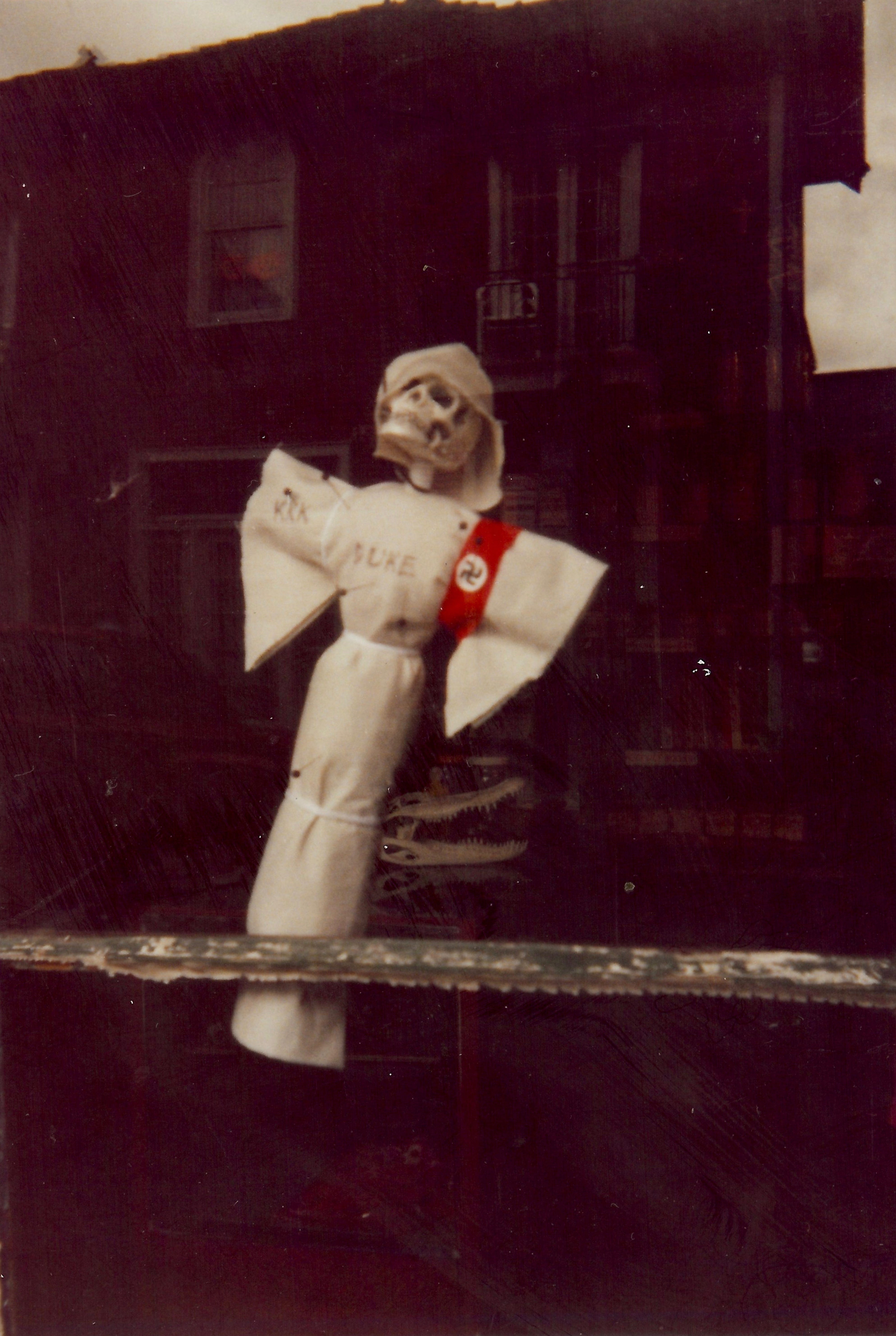
This week ex-SNL star Bowen Yang used the word “Zio” on a podcast to describe Jewish singer Regina Spektor. The term is increasingly used in some left spaces to refer to Zionists. But it was originated by David Duke, a notoriously and virulently antisemitic neo-Nazi and member of the KKK.
Duke coined “Zio” as a racist slur which he directed at Jewish people. For example, after attending the violent neo-Nazi march in Charlottesville in 2017, Duke wrote:
there is no future for white children…there is no future for America…there is no future for the west unless we overthrow this Zio-garchy that is ruling over us. In the media they dominate the international globalist media, they dominate the Zio-fed Federal Reserve and the banking institutions, they dominate politics.
Yang apologized for using the term, noting that it was, “Particularly upsetting to realize that I adopted language popularized by far-right movements whose rhetoric we should be wary of and act against.”
But not everyone on the left reacts with such self-reflection when told about the word’s origins. On the contrary, it’s fairly common on social media to encounter people who insist that “Zio” is a natural abbreviation, and that asking people not to use it is onerous or a distraction from the work of Palestinian liberation. Only repulsive Zios would care about the use of the word “Zio”, is the often not very buried (or not buried at all) subtext. Anyone who objects to neo-Nazi slurs must be pro-genocide, they suggest, and should be ignored.
This is grotesquely wrong-headed for the obvious reason that you should not adopt the rhetorical framework of neo-Nazi shitheads. That’s because those frameworks are deliberately designed to spread fascism and harm all marginalized people, including (but not limited to) Jewish people, Muslims, Black people, LGBT people, and women.
Since people do continue to defend the use of “Zio”, I think it’s worth explaining briefly how David Duke hopes to use the term to corrupt left spaces and advance the Nazi goals of harming Jewish people, leftists, and marginalized people everywhere.—
—
Thanksgiving sale! it’s 40% off, $30/yr. If you value my writing and would like it to continue, please consider supporting me! and the cats!
—
“Zio” is meant to turn belief into ethnicity
Again, “Zio” is a shortening of “Zionist”. “Zionist”, in itself, is not a slur. It is a self-description. Zionists—people who believe Israel should exist as a Jewish state—call themselves “Zionists.” If they are fine with the longer term, how can the shortening be a problem?
The thing abou “Zionist” or “Zionism” is that the form of the word—the “ist” and the “ism”—show that the words refer to beliefs and ideologies, like socialist or leftist or Communism. Anyone can believe in socialism; anyone can be a Zionist. You just have to embrace the tenets of the ideology. The words themselves—their English structure—tells you that they refer to ideas, not to ethnic identity.
By cutting off those last four letters, Duke deliberately turns a (self-)description of an ideology into a more nebulous marker of identity—a nebulousness which Duke himself is, of course, not at all nebulous about. “Zio”, for Duke, doesn’t mean people (Jewish or non-Jewish) who believe in Zionism. It just means Jews. When Duke says “Zio-garchy” he’s saying that Jewish people rule the world. When he talks about the “Zio-fed” he’s not talking about Israel policy or Palestinian liberation. He’s talking about evil Jewish people controlling the banking system. Neo-Nazis are not especially subtle.
Using “Zio” as an all-purpose slur and prefix to dehumanize and ridicule Jewish people is dangerous Nazi propaganda which threatens all Jewish people, regardless of their stance on Israel. It also mirrors, and effectively amplifies, Zionist propaganda in ways which undermine the liberation of everyone, including Palestinians.
Zionists often argue that all Jews—or at least all Jews that matter—are Zionists, and that support for Israel is core to Jewish identity. Jewish Zionist Jonathan Greenblatt, the current head of the ADL, puts is bluntly when he insists that “Zionism is fundamental to Judaism.” Non-Jewish Zionist Donald Trump echoes that sentiment when he claims that Jewish Democrats demonstrate “disloyalty” when they don’t vote for him, since he is so pro-Israel.
For many Zionists (Jewish and non-Jewish), Zionism is the core of Jewish identity, which is why they will insist that Jews who are not sufficiently Zionist, like Bernie Sanders, aren’t really Jews at all. They erase the distinction between belief and identity because they want to use Jewish identity as a shield for Israel’s ugly genocidal policies.
But this is simply the mirror image of antisemities like David Duke, who erases the distinction between Zionists and Jews in order to use Israel’s actions as a way to attack all Jewish people. In both cases, “Zionism” and “Jewish” are treated as synonymous. In both cases Christian Zionists and antizionist Jews, are erased in order to pursue ugly ideological goals—for Duke, exterminating Jews, for Zionists, subjugating and murdering Palestinians.
When people on the left use “Zio”, therefore, they are undermining the cause of Palestinian liberation in numerous ways. First of all, using neo-Nazi rhetoric inevitably backfires; people of good will, who might be willing to give antizionism a hearing, will be repulsed by people who talk like David Duke, and will conclude that the movement is about targeting Jews, not about liberating Palestine.
And second, as I’ve explained, using “Zio” replicates the logic of Zionism. Collapsing the distinction between Jews and Zionists makes it harder to understand and critique and fight an ideology in which powerful non-Jews like Donald Trump and Joe Biden use Jewish identity as an excuse for their commitment to the violent genocide of Palestinian people.
“Zio” allows Nazis to infiltrate left spaces
The use of “Zio” is also dangerous because it allows neo-Nazis to set the terms of left discourse, which means that neo-Nazis become welcome in, and arbiters of, left programs and left community.
This is not some sort of accident. “National socialists” referred to themselves as socialists not because they believed in socialism, but because they wanted to co-opt left energy, infiltrate left spaces, and undermine left ideology. Similarly, David Duke framed his hatred of Jewish people in the (distorted) language of antizionism because he wanted to cloak his bigotry in the legitimacy of a liberation struggle and because he wanted an entré into left spaces, which are a refuge for a range of people he hates, including (but not limited to) Jews.
This is how the right co-opts left spaces. Neo-Nazis and far right assholes like, say, Tucker Carlson, condemn Israel because (like Duke) they hate Jewish people. They are then welcomed into pro-Palestinian spaces, where they use “Zio.” People pick up the term unwittingly and start to repeat it. (And yes, I think this is how the term spread on the left; I do not think there is some natural inevitable tendency to abbreviate “Zionist.”)
The slur gains currency. Eventually, Jewish people in left spaces—who are likely to be antizionist!—point out that “Zio” is a slur and ask people to stop using it.
Sometimes, that goes fine, and people like Bowen Yang apologize and stop using “Zio”. Sometimes, though, people using the slur dislike being asked to stop and don’t want to be called in. They may double down. They may notice that the people asking them to stop are often Jewish, allowing them to lean into antisemitism. Jews in left pro-Palestinian spaces are labeled as divisive, giving right wing bad actors a chance to gain status by denouncing those wrecker Jews most forcefully, which they are eager to do because, (again) they are Nazis.
This is bad for antizionist Jews, who often have few options for community outside of left spaces. It weakens left spaces overall, since neo-Nazis are much less reliable comrades than antizionist Jews, to put it mildly. And it also puts other marginalized people—very much including Arabs, Muslims, and Palestinians, but also Black people, LGBT people, and women—at risk.
Think, for example, about former Maine Democratic Senate candidate Graham Platner, a guy who got a Nazi tattoo, wore it for years and then lied about it. Platner appealed to many leftists because he said he opposed Zionism. But, in addition to the Nazi tattoo, it turned out Platner had a long history of using homophobic, ableist, and misogynist slurs. He’s also been credibly accused of rape—which is what ended his Senate campaign.
People who get Nazi tattoos, like Platner, are dangerous and violent; you let them into your community at your peril. Normalizing neo-Nazi rhetoric, and defending it, makes it easy for bad actors to pose as comrades and makes it difficult for those who understand the danger to come forward and say so without being ostracized or targeted. That’s very much the future David Duke wanted when he invented the term.
What to do when someone says “Zio”
Luckily, it is in fact not that hard to handle the problem of “Zio.” Bowen Yang himself provides a great model. He used “Zio” without knowing the history. He was informed of the history. He apologized and said he would not use it again. Easy!
Sometimes people want a longer explanation as to why the word is ugly and dangerous. That’s fair—and it’s why I wrote this essay. If someone uses the term, you can use the arguments here, or just provide them with the link. It doesn’t have to be a big thing.
If someone doesn’t know, they don’t know. But once they do know, once you have explained the problem with the term to them, it is then up to them to decide whether they want to keep using David Duke’s talking points in the full knowledge that they are ventrioloquizing David Duke, or whether, instead, they don’t want to do that.
Hopefully, people of good faith and good intentions will follow Yang’s example. If they don’t, if they affirmatively insist that it is core to their identity to keep using a neo-Nazi slur—well, then you and everyone else knows who you’re dealing with. You should act accordingly to protect yourself and those you care about.