

—
Before you start reading—I have a sale today! It’s 40% off, $30/year. If you value this piece, or my writing in general, consider becoming a contributor so I can keep scribbling.
—
AIPAC is loathed on the progressive left. That’s understandable. I am on the progressive left and I loathe AIPAC. The American-Israeli Public Affairs Committee is a domestic lobbying group dedicated to pushing politicians to support Israel and defend its policies, including its disgraceful treatment of Palestinians. Since the horrific Hamas attack on Israel on 10/7 and Israel’s even more horrific response, AIPAC has embraced disgusting genocide denial. Most recently, it’s been shilling for the indefensible joint US/Israel war of aggression on Iran. AIPAC is a vile garbage dump of war-mongering and atrocity-promotion. Fuck them and all their works.
Often, though, left denunciation of AIPAC goes beyond pointing out that it is a reprehensible organization, and goes on into conspiratorial charges of vast, shadowy power. AIPAC has many wealthy donors and it has been known to spend heavily in Democratic primaries—$14 million in Illinois’ recent elections. Therefore, the argument goes, AIPAC is essentially bribing elected officials and uses its vast resources to control US policy on behalf of a foreign power.
This attribution of sinister, sweeping influence to AIPAC has a couple of major downsides. First, it dovetails queasily with antisemitic conspiracy theories about wealthy alien Jews using their money to corrupt the noble institutions of Anglo-Saxon democracy. Second, overstating AIPAC’s power actually helps AIPAC—the organization very deliberately cultivates a myth of undefeatability to try to scare politicians into doing its bidding.
Again, though, that undefeatability is a myth—and so is the idea that AIPAC’s (diminishing) power comes primarily from its money.
AIPAC was powerful because Democrats supported Israel
AIPAC has long been a powerhouse in Democratic primaries. But a lot of that power was based not on bribing officials, but on the fact that Democrats were broadly supportive of Israel. As recently as 2016, 43% of Democrats sympathized more with Israel compared to only 29% saying they sympathized more with Palestinians—a 14 point gap.
When Democrats support your issue by 14 points, you have a lot of leverage in Democratic primaries. There was a time, not that long ago, when AIPAC endorsements were valuable for Democrats because Democratic constituencies broadly agreed with AIPAC —just as NRA endorsements have been important in Republican primaries because most Republican voters agree with the NRA.
In both cases, progressives will sometimes default to a kind of vulgar conspiratorial corruption narrative, framing donations as bribes. But the truth is that donations are more a signal of approval than an effort to sway votes. The NRA and AIPAC would both spend money in primaries to tell voters which politician agreed with them on the issues. This was effective because voters in the primaries largely agreed with the lobbying groups on the issues and trusted those groups to tell them who to vote for.
To be clear, AIPAC and the NRA are both ugly orgs lobbying for ugly things. But their power has been in the fact that voters like those ugly things and even see those ugly things as an important part of their partisan identity. AIPAC and the NRA both appealed to and weaponized those identities. That’s where their influence came from, not from distributing shadowy bribes to encourage politicians to vote against their consciences.
AIPAC is a weakening org
You can see that AIPAC’s power was based on public opinion, not money, because as public opinion has shifted, their influence has also fallen drastically.
Democratic support for Israel’s policy of apartheid and slow (and then fast) genocide has been declining for years, despite AIPAC’s best (or worst) efforts. In 2018, 27% of Democrats said they sympathized with Israel over the Palestinians vs. 25% who said they sympathized with the Palestinians. Today, in 2026, that number is only `17% who sympathize with Israelis and 67% of Democrats who sympathize with the Palestinians.
That’s a massive change over the course of a decade, and Democratic politicians have noticed. Illinois Senator Dick Durbin—a longtime recipient of AIPAC donations—was the first Senator to call for a cease-fire in Gaza. Even more shockingly, he voted for Bernie Sanders’ bill to condition military aid to Israel. Even considering that Durbin is retiring, this reversal is difficult to explain if AIPAC were bribing him for his votes. After all, AIPAC checks still cash when you’re retired. It’s easy to explain Durbin’s actions, though, if he is following his constituents. When they supported AIPAC, so did Durbin. When they stopped, so did he.
There are numerous other signs that AIPAC’s power over Democrats is much reduced now that they are promoting policies that are wildly unpopular with Democrats. Anti-Zionist Zohran Mamdani won his race for mayor of New York despite a huge effort by AIPAC and Zionist donors to defeat him. In a New Jersey House primary, AIPAC spent big against Tom Malinowski, a moderate Zionist who had suggested putting some conditions on military aid to Israel—and ended up thereby helping to elect an outright anti-Zionist in Analilia Mejia, who won a stunning upset victory. In Illinois, (as I discussed last week) two House candidates with major AIPAC funding lost their races.
You can also see AIPAC’s diminishment in the way Democrats talk about it. An AIPAC endorsement used to be something you’d boast about, because a lot of Democrats liked AIPAC and the candidates who it endorsed.
No longer. Seth Moulton, a moderate current House rep challenging further left Senator Ed Markey in Massachusetts, loudly returned AIPAC donations as one of the first acts of his campaign. Centrist Arizona Senator Ruben Gallego said that taking AIPAC money is “akin to endorsing” the Gaza genocide and Iran war. Right-leaning California Governor Gavin Newsom, a 2028 presidential contender, boasted that he never had and never would take money from AIPAC. Illinois Governor J.B. Pritzker—a 2028 presidential contender and a past AIPAC donor—said that AIPAC is now “an organization that was supporting Donald Trump and people who follow Donald Trump.”
For Democrats, being associated with AIPAC is now toxic. It’s like being linked with, say, the NRA. AIPAC has attempted to address this by funneling its donations through front groups with innocuous names like Elect Chicago Women and Affordable Chicago Now. But this just makes it look devious and untrustworthy, and further harms the candidates at whom it shovels cash.
AIPAC did fund a couple of winning House candidates in Illinois House races; money can help in a primary, and AIPAC is not yet so completely toxic that it will sink candidates who have other endorsements and strengths. But its power is eroding—and the more its power erodes, the more Democrats are willing to defy it. It’s a virtuous circle, and one that progressives should do everything they can to encourage.
AIPAC Tracker isn’t helping
And yet, often progressives seem determined to help AIPAC by attributing to it influence it doesn’t have and handing it wins it didn’t win.
Here’s one example:
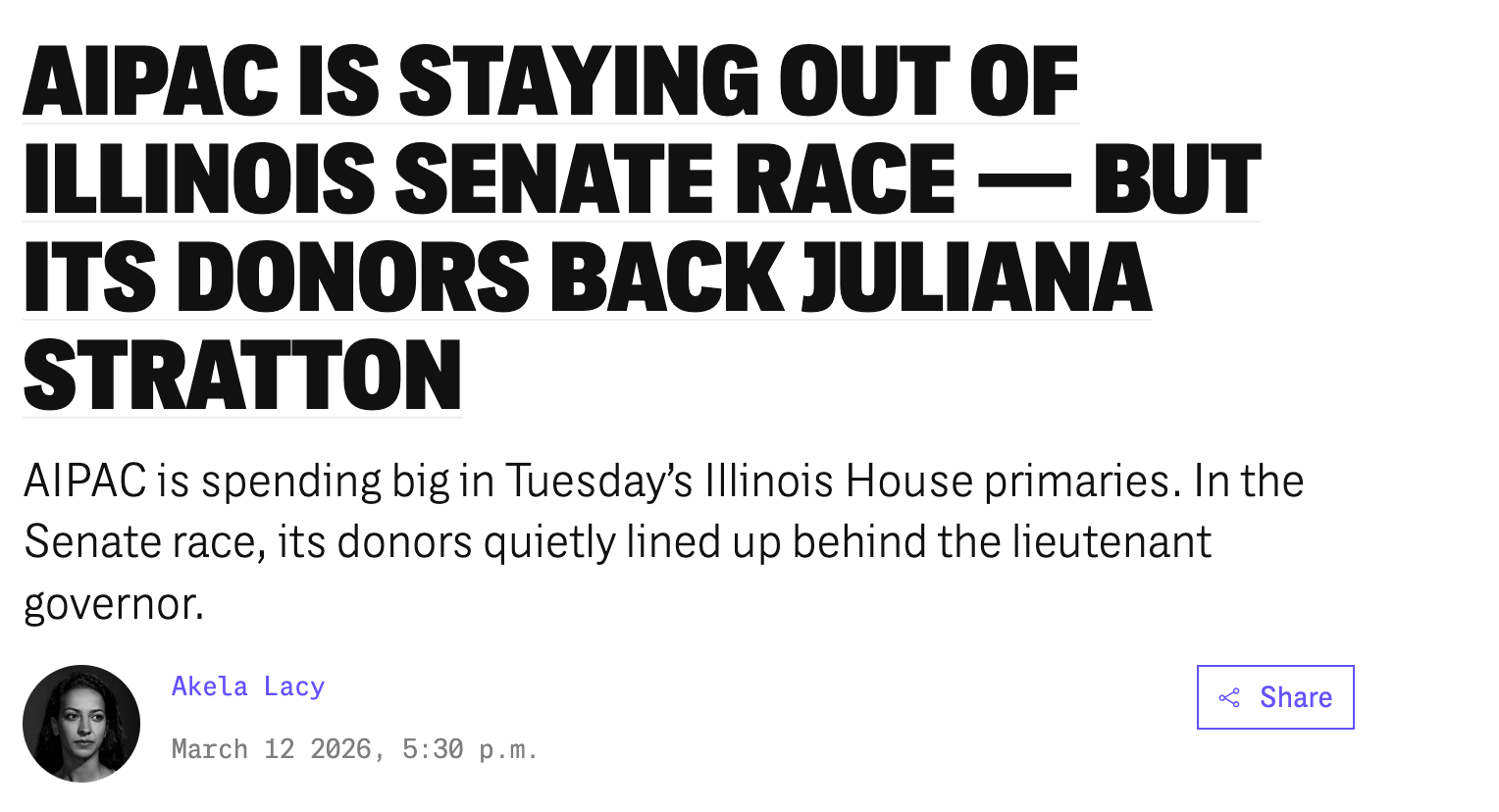
This article is from the Intercept, and was published shortly before the Illinois primary. The writer, Akela Lacey, is an excellent journalist who I admire a great deal, and the article itself is a careful description of the positions and funding of the three major candidates in the race: Juliana Stratton, Raja Krishnamoorthi, and Robin Kelly. Lacy notes that all three have past ties to AIPAC and have supported Zionist policies, though Kelly’s current positions are the most progressive; she also explains that AIPAC has not endorsed in the race, though some AIPAC donors have contributed to Stratton and at least one contributed to Krishnamoorthi.
This nuance, you’ll notice, is lost in the fear-mongering headline (almost certainly not written by Lacy): “AIPAC is staying out of Illinois Senate Race—but its donors back Juliana Stratton.” That strongly implies that AIPAC is not staying out of the Senate race, but has instead chosen Stratton as its candidate.
This is bad for multiple reasons. First, the headline essentially encouraged progressive voters who care about Israel policy to vote against Stratton—which would have helped the crypto funded ICE apologist Krishnamoorthi, who is no better, and probably worse, than Stratton on Israel policy.
Second, and more importantly now that the primary is over, the headline frames the Stratton victory as an AIPAC victory. Based on the headline, you’d conclude that AIPAC sneakily backed a Senate candidate and won. A lobbying organization that can get a Senate candidate elected by hook or by crook is an organization to reckon with. Thus, the Intercept, a progressive org, misrepresents its own (excellent) reporting in order to claim a victory for AIPAC which AIPAC had nothing to do with. That’s incredibly counterproductive and helps no one but AIPAC.
An even more egregious example involved Daniel Biss, the winner of the Democratic primary in IL-9. Track AIPAC, a popular left org which purports to track AIPAC contributions to political candidates, claims that Biss took more than $460,000 from —well, if you glance at it, it sure looks like it’s saying Biss took the money from AIPAC.
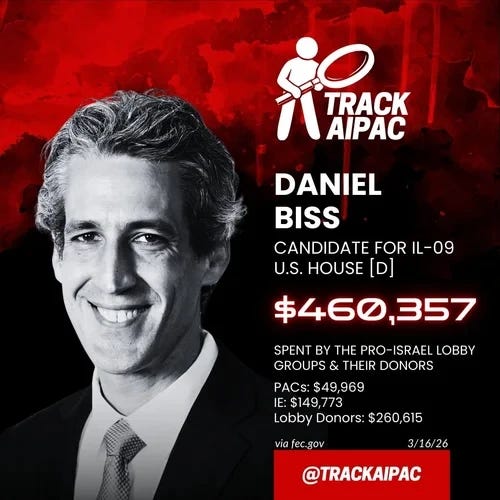
If you read the fine-print there, though, you’ll notice that Track AIPAC doesn’t say that Biss took money from AIPAC. It says he took money from “the Pro-Israel Lobby Groups & Their Donors.”
This is a very consequential (and weasily) distinction, because Biss took zero money from AIPAC in his House race. On the contrary, AIPAC spent massively against Biss in order to elect Laura Fine. Many establishment Democrats worried, in fact, that AIPAC would damage Biss so badly that he would lose to anti-Zionist Kat Abughazaleh.
Biss did take money from J-Street. J-Street is pro-Israel, and it’s not an org that I love. But it’s very different from AIPAC; in fact, it was formed to combat AIPAC from the left, and AIPAC and its supporters loathe it. J-Street currently supports human rights conditions on aid to Israel and opposes the war in Iran. These are deep, important differences with AIPAC, and eliding them so you can imply Biss is supported by AIPAC is, in my opinion, a gross smear.
To be clear, I wanted Kat Abughazaleh to win in IL-9 and donated to her campaign. She is further to the left than Biss, not least on Israel; she has called Israel’s actions a genocide, which they are, while Biss has refused to do so. More, in the last days of the campaign, one of Biss’ former students revealed that he had had an inappropriate relationship with her. This is a serious issue, and I think says ugly things about his character and his fitness for office.
So my main concern here is not that people are being too mean to Biss. My main concern, again, is that if you mislead people and say that Biss is AIPAC’s candidate, then you are saying that AIPAC won IL-9. This is a boon to AIPAC—as both AIPAC and Biss recognize.
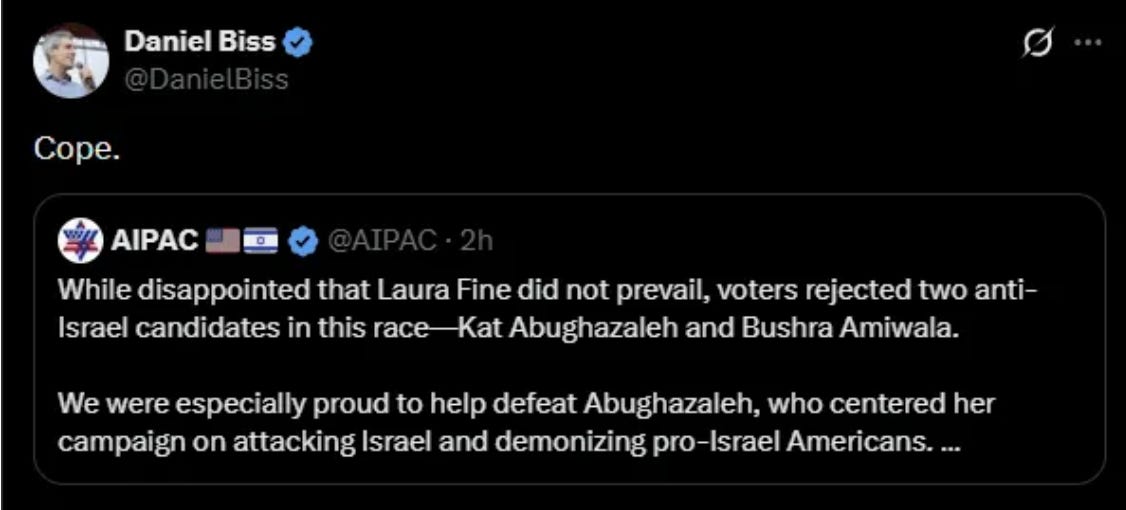
After the IL-9 results came in, AIPAC rushed to X to claim victory: “While disappointed that Laura Fine did not prevail, voters rejected two anti-Israel candidates in this race—Kat Abughazaleh and Bushra Amiwala.”
AIPAC pretended that it had not desperately tried to defeat Biss because it wants people to think it never loses and can swing Democratic primaries. Biss—who is understandably pissed that AIPAC spent millions to defeat him—sneered that AIPAC was indulging in “Cope” and he’s correct. AIPAC lost, and everyone who opposes them benefits by making it clear that they lost.
Which again, leads you to ask, what the fuck are the Intercept and Track AIPAC doing? They both claim to want to defeat AIPAC. And yet, they both give AIPAC credit for wins—in IL-9, in the Senate—that are actually AIPAC losses or which have nothing to do with AIPAC. Lobbying orgs are stronger when people think they can determine elections; they are weaker when people recognize that they are losing losers who lose all the time. Progressive orgs that give AIPAC credit for wins when it hasn’t won are boosting AIPAC. They are using literally the same talking points that AIPAC itself uses to try to increase its own influence.
Why are you helping AIPAC? Stop that.
Why do progressive orgs like the Intercept and Track AIPAC, and many progressive people online, overstate AIPAC’s influence and misstate the nature of that influence? Why give AIPAC unearned wins? Why do propaganda for the org you hate?
Obviously I can’t see into anyone’s heart. I can say, though, that populist arguments—the idea that a shadowy elite is corrupting society through financial influence—has a narrative excitement that often drives more attention than more complicated and less dramatic stories (like, “This lobbying org’s cause used to be popular and now it isn’t.”) In addition, if you want a candidate to win (like Robin Kelly or Kat Abughazaleh) there’s a strong incentive to demonize their opponent, even if doing so overstates the power of your enemies. And finally, antisemitism—like many another bigotry—is pervasive and easy to slide into if you are not careful and thoughtful about what you are doing.
Whatever the incentives, though, I think we need to do better. AIPAC is on the ropes as a force in the Democratic party. If we want to finish it off, we need to understand where its influence has come from and emphasize the ways in which that influence is waning. Insisting that AIPAC’s power is mostly about money is wrong and makes it harder to analyze and fight that power. Claiming that AIPAC wins even when it loses simply delays the moment when we can defeat it entirely.
Progressives who are doing AIPAC’s work for it need to stop doing that. We are on the way to defeating Zionism and moving towards a policy that opposes Israel’s human rights abuses and warmongering. Too much is riding on that victory to fuck it up for clicks.
Thank you for another excellent—and excellently explained—piece on a subject I know little bit about, but is mostly based on the screaming Facebook posts of some of my very left friends. As I, personally, shift further left in my own politics, I find your articles substantive, insightful, and a nuanced blend of chastising and encouragement. Your newsletters are a pleasure to read, and I look forward to them both here and on Public Notice. EIH is one of the few substacks I pay for, and I always think it’s money well spent!
Thank you for another thoughtful piece on a subject that demands nuance. I am glad that journalist are starting to ring the alarms about anti jewish sentiment stemming from the actions of the Isreali goverment. AIPAC makes a convenient target for Americans to take out their frustrations with the Isreali Goverments policies. It doesn't help that we are feed curated information that often lacks balance