

New York Times columnist and tedious reactionary scold Bret Stephens got up on his soap box to say the same tedious left-punching shit he always says. This time he punched left at the National Book Awards which he claimed follow a “D.E.I. checklist.” “By my count,” he harumphs, “in the past decade, nine of the 10 winners of the National Book Award for fiction belonged to a minority group.” This trend, he insists, is “deforming and hollowing out literary culture in America.”
—
Everything Is Horrible is having a sale! It’s 40% off, $30/year. Please consider joining as a paid subscriber so I can keep scribbling!
—
Stephens is a lazy writer even by the standards of the general run of NYT centrist sinecures, and his relitigation of the canon wars is predictably shallow and low effort. Past defenders of the white male literary verities, like Harold Bloom, were at least willing to name specific writers they liked and specific writers they didn’t as they insisted on standards and objectivity and all the eternal verities.
Stephens, though, can’t be bothered. He names not a single writer who he feels should not have received a National Book Award, nor does he name a single writer who he feels has been unfairly sidelined. He doesn’t even bother to vaguely firm up his definition of “minority group”. Aleksander Maksik, a white-appearing Jewish-American man (like Bret Stephens), doesn’t qualify as marginalized; Kenan Orhan, a white-appearing Turkish-American man, does. That’s defensible—but only if you are willing to defend it by thinking about your criteria. But if you did that, you might start wondering if it really makes sense to lump queer people, native people, immigrants, non-white people and woman into a single box so you can rail against the exclusion of white male men.
The incoherence of Steven’s criteria and the laziness of his approach don’t really matter though. Racism isn’t a logic or an exercise in rationality. It is an excuse for the exercise of power. In that context, Stephens’ column functions not as an argument, but as a threat.
Stephens’ mentions that in the past the National Book Awards were very white. He brushes aside the idea that acknowledging the experiences of other people now might be necessary to make up for past elisions: “turning the tables isn’t the same thing as achieving justice” he declaims sententiously. But he doesn’t even mention, let alone engage with, the extent to which literary and artistic work by non-white and queer people is under attack right now, this minute, while Bret Stephens bleats and whines and sucks his thumb.
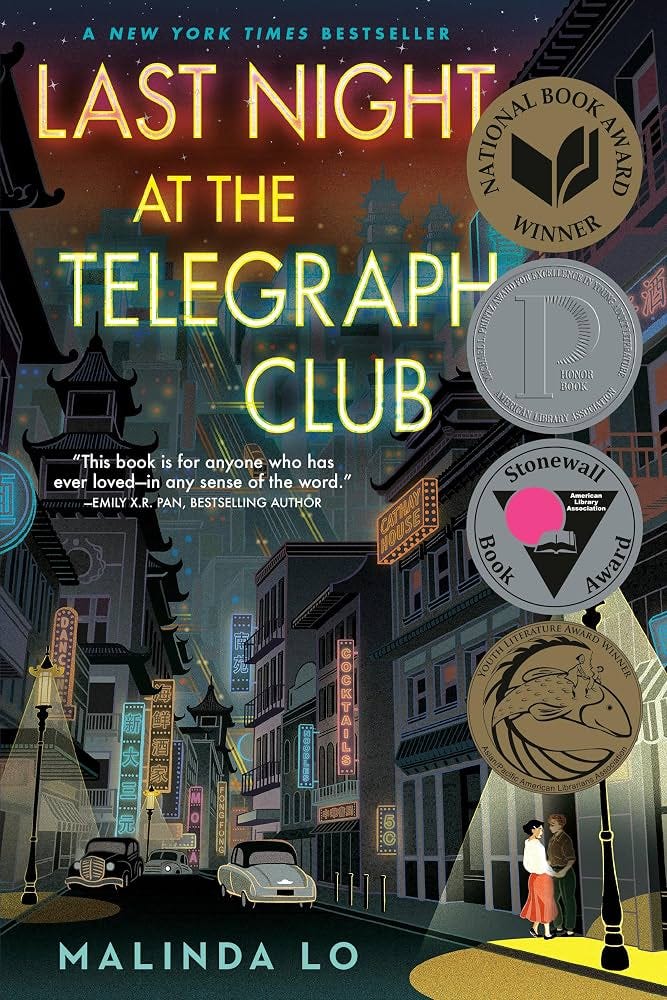
In the 2023-2024 school year, there were more than 10,000 book bans in high schools and libraries. Of those, 36% were about people of color and 25% featured LGBT people. Some, like Malinda Lo’s excellent, relentlessly banned Last Night At the Telegraph Club—a National Book Award winner in Young People’s Literature–feature non-white queer people. The horror.
When Stephens gets red in the face because the National Book Awards exhibit “obsessiveness in the matter of race,” he is knowingly providing excuses and arguments for school districts to literally ban these books. Stephens furrows his brow and worries that the National Book Awards are censoring vital authors (he doesn’t say which ones) when they honor books like Last Night At the Telegraph Club, or Colson Whithead’s Underground Railroad or Percival Everett’s James. But he skips lightly over the fact that school districts and libraries are in fact censoring these very books. The Underground Railroad has been challenged in Texas; so has Jesmyn Ward’s National Book Award winner Salvage the Bones. Percival Everett’s James, is told from the perspective of Jim in Mark Twain’s Huckleberry Finn—one of the most challenged and banned books in the US. Justin Torres says he wrote his queer National Book Award winning novel Blackouts as the “ultimate provocation” to right wing homophobic book bans.
With Trump back in the White House, the attacks on LGBT and POC writers are not just relegated to red states and local school districts. The NEA ended grants supporting DEI initiatives—leading organizations to worry that they would be targeted if they acknowledged or celebrated Black History Month. Trump and Elon Musk also illegally canceled humanities grants to scholars working on issues of race and ethnicity—the very topics that Stephens argues are too prevalent in the National Book Award’s nonfiction prizes.
Stephens writes as if he—a mediocre white asshole with a prestigious sinecure to troll nonwhite people—is laboring under the oppression of a nonwhite ruling class. He utterly ignores the fact that the current government of these United States is a fascist regime that regularly implements racist and homophobic policies designed to eliminate funding for, and public platforms for, artists who are anything other than straight white male dipshits like Brett Stephens.
What this means is that when Bret Stephens uses his very large platform to blast the National Book Awards as “DEI”, he is de facto attempting to alert an authoritarian government of internal enemies. Stephens’ article won’t necessarily lead to the federal government targeting the awards. But in this climate, it could. It only takes a tweet or two by Elon Musk to send hordes of right wing trolls to bombard judges with death threats. It just takes one evil flunky in the Trump administration to decide that an attack on the National Book Awards would entertain the orange overlord to lead to nonsense lawsuits, tax audits, or challenges to nonprofit status.
We are living in a country in which the federal government targets non-white people and queer people for violence, terror, and censorship. They justify this blatant discrimination by claiming that straight white Christian men are the real victims of discrimination. When Stephens singles out an org for supposedly discriminating against white straight men, he is identifying targets for the fascists.
Stephens, again, doesn’t acknowledge that the Trump administration is engaged in a sweeping campaign of racist and homophobic hate. But he knows that it is, and he knows what it means to attack the National Book Awards in this way, just as he would know what it meant to call an organization Communist in the middle of HUAC’s investigations. Stephens isn’t just innocently advancing an argument in the ongoing canon wars. He’s reminding the National Book Awards of the country they’re living in, and not so subtly warning them to elevate more white male douchebags like Bret Stephens—or else.
This threat could well be hollow; the Trump administration may not care about the National Book Awards, and/or may not have time or energy or leverage to do anything about it. But if Stephens wants to know why the National Book Awards over the last decade of Trumpism moved towards honoring more books by POC writers, LGBT writers, and immigrant writers, he might consider his own contribution to a culture of fear and white supremacist terror. In a world in which people like Bret Stephens can try to bring the federal government on certain writers with a realistic chance of success, those who love free speech and literature may well feel (correctly in my view) that they have a duty to elevate and celebrate those very same writers.
Spineless racist dipshits and authoritarian stooges like Bret Stephens hate literature and don’t really understand why anyone would defend it or champion it. But the National Book Awards, to their credit, have decided that the role of literature, in part, is to speak truth to power. The truth, in this case, is that Bret Stephens, Donald Trump, and their authoritarian white supremacist ilk do not control culture, or merit, or literature. The New York Times will always elevate mediocre white men, world without end. The National Book Awards, in the age of Trump, have chosen a more honorable path.
I try not to read Bret Stevens columns, but when I do, inevitably steam comes out the top of my head. So I am grateful to become aware of this most recent Brett Stevens opinion without my blood pressure rising. Big thanks to Noah, for the satisfying review.
There is, to a degree, biases against white men in 21st century publishing, considering the current preferred executive staff and publications at "The Big Five". But Stephens here is exaggerating that to an unhealthy degree that helps nobody in this debate.